
Adding an objective measurement layer to psychiatry is among neurotech’s long-standing ambitions in mental health. Tools such as EEG have been used for decades in research and increasingly in translational settings, but breaking into routine psychiatric practice has proved more difficult. In a field largely built around expert assessment, self-reports, and questionnaires, introducing a reliable biological data layer that meaningfully informs clinical decisions remains a major challenge.
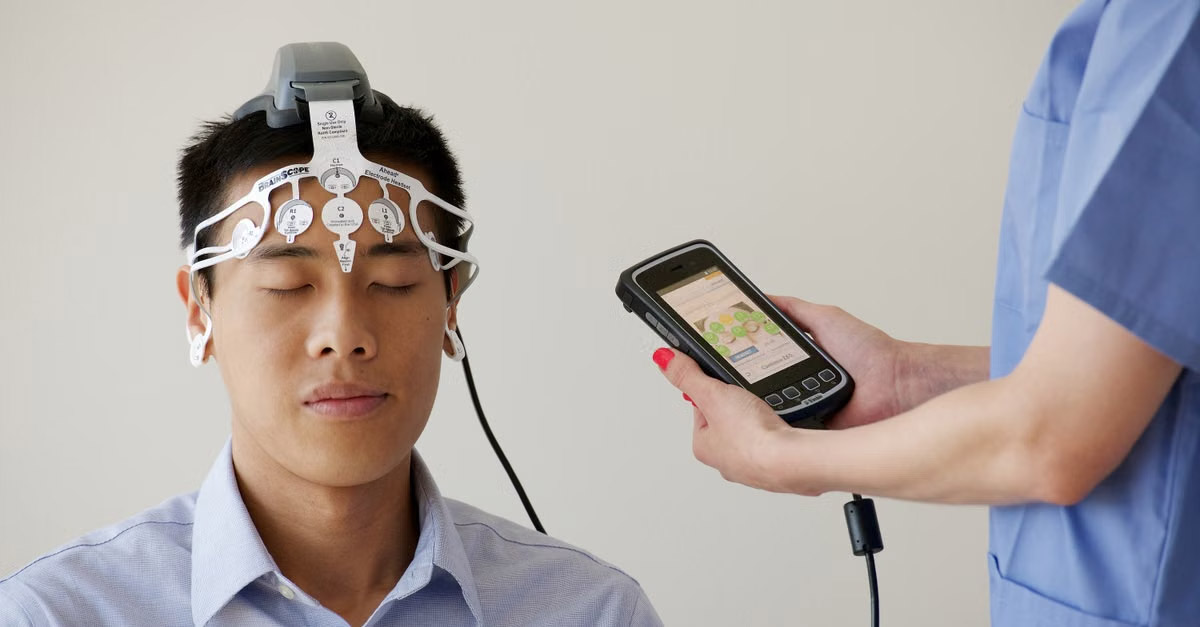
U.S.-based Universal Brain took a step in that direction in June, receiving FDA 510(k) clearance for its proprietary EEG system. Built around a dry-electrode baseball cap, the platform uses event-related potentials to monitor functions including attention, reward, and emotional processing. But CEO Kazu Okuda’s ambition extends well beyond the monitoring functionality included in the clearance. Ultimately, Universal Brain wants to work toward a platform that predicts patients’ responses to psychiatric treatments.
Universal Brain’s system combines a dry-electrode EEG cap with software that guides patients through short cognitive tasks and analyzes the resulting event-related potentials. Event-related potentials (ERPs) measure the brain’s response to specific stimuli. Universal Brain uses these responses to assess functions including reward processing, attention, and emotion, giving clinicians a way to track how those functions change over time.
Kazu Okuda, a physician and Universal Brain’s founder and CEO, sees the immediate opportunity as adding a more objective signal to treatment monitoring. A patient could be measured at baseline and again several weeks into treatment, providing a functional measure alongside symptom assessments and questionnaires. “It’s pretty much like blood tests and blood pressure tests for psychiatry,” says Okuda.
To create a product that can scale across clinics, Universal Brain had to build both the hardware and software itself. Okuda argues that much of the existing EEG market was designed around neurology and research, where expensive equipment, lengthy setup, and specialist operators are more accepted. Universal Brain developed its dry-electrode baseball cap to support faster, more repeatable measurements across a much larger number of patients, with home use a longer-term possibility.
That scalability also feeds into Universal Brain’s larger ambition. Using the same hardware and tasks across clinics could help build standardized datasets linking brain-function profiles with treatment outcomes. “It’s all about data set and then database,” says Okuda. Ultimately, he hopes those datasets can support more ambitious clinical use. “Predicting treatment is our ultimate goal," he says.

The near-term rollout will focus on interventional psychiatry clinics offering treatments such as TMS and ketamine, where staff are already accustomed to operating clinical devices. Universal Brain recently secured a $2 million grant from Japan’s AMED to support multi-site clinical studies and commercialization. Beyond adoption, Okuda sees reimbursement as the most immediate commercial challenge. “If we succeed in securing a reimbursement pathway in psychiatry or neuropsychiatry, we can be the one who wins the market,” says Okuda.
Universal Brain is not alone in bringing EEG into more translational settings. In late July, VoxNeuro announced FDA clearance for cfNI, software that analyzes EEG and ERP responses collected during standardized cognitive tasks. The platform compares results against a reference database to provide objective measures of cognitive function. Like Universal Brain, its current clearance stops short of diagnosis or treatment prediction.
Further along the treatment-selection path is Alto Neuroscience. The company develops psychiatric drugs around biological markers intended to identify patients most likely to respond. Its ongoing Phase 2b trial of ALTO-300 in major depressive disorder is enrolling patients characterized by a machine-learning-derived EEG biomarker, with around 200 biomarker-positive patients expected in the final analysis. Results are expected in the first half of 2027.
EEG companies are also supplying this infrastructure directly to drug developers. Beacon Biosignals supplies its at-home EEG platform within Takeda’s orexin clinical trials, which this month produced the FDA-approved narcolepsy drug oveporexton. Cumulus Neuroscience is taking a similar approach across neuropsychiatry, recently deploying its dry-EEG platform in Delix Therapeutics’ Phase 1b depression study.
Turning EEG signals into tools that reliably change treatment on the psychiatric frontline remains difficult. Clinical practice depends heavily on interviews, rating scales, and physician judgement, creating an adoption hurdle for biological-based measures. Reimbursement adds a financial one. Meanwhile, the science is equally challenging. Symptom-based DSM diagnoses are known to encompass substantial biological variation, leaving objective endpoints difficult to define, validate, and operationalize.
.svg)