
-1.jpeg)
Today, dementia diagnosis usually arrives years after the underlying brain changes have already begun. Researchers have spent the past decade chasing biomarkers, from blood tests to brain scans and spinal fluid analysis, that could flag risk long before symptoms start disrupting daily life. EEG has mostly stayed on the sidelines of that search, but BrainScope is starting to change that.
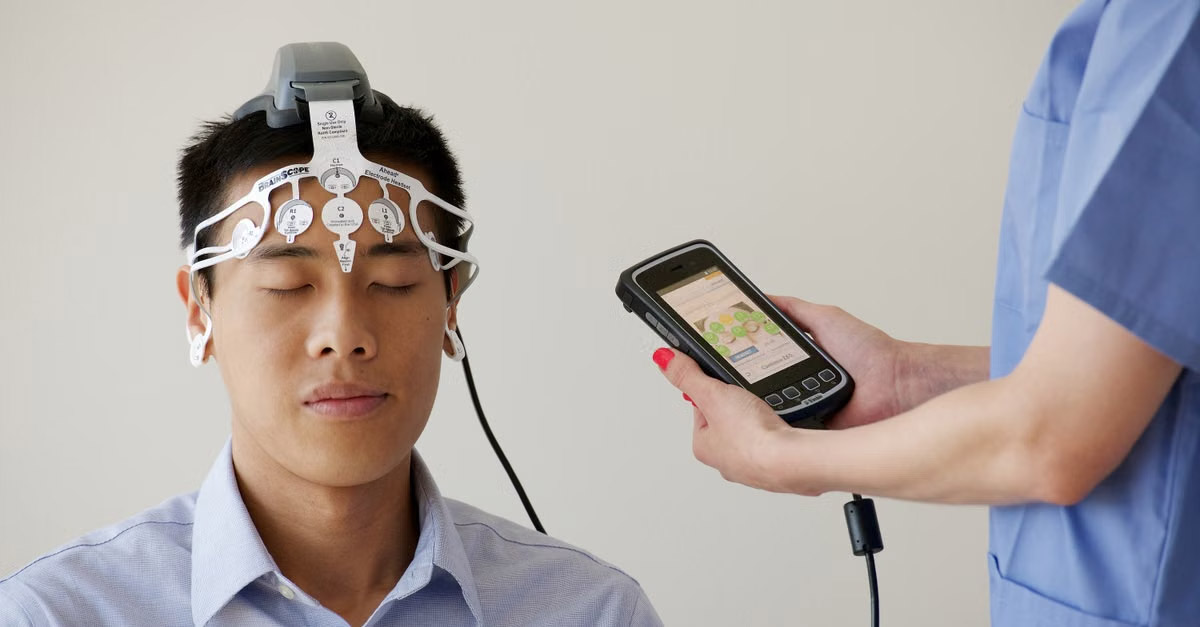
BrainScope, based in Rockville, Maryland, published a peer-reviewed study in Scientific Reports reporting an EEG-based biomarker that predicted future cognitive decline five to seven years before a formal diagnosis. Funded by the Alzheimer's Drug Discovery Foundation (ADDF), the study followed older adults with self-reported memory concerns and used their baseline brain activity to predict who would go on to develop mild cognitive impairment (MCI) or Alzheimer's-type dementia.
Researchers recorded resting EEG from 88 older adults, ages 52 to 85, all diagnosed with subjective cognitive impairment (SCI). SCI refers to self-reported memory concerns without a formal MCI or dementia diagnosis, staged here using the Global Deterioration Scale.
Participants were followed for five to seven years with annual clinical assessments. Twenty-nine participants later declined to MCI, fourteen were diagnosed with dementia, and the rest remained stable. Researchers used the baseline EEG data, collected before any diagnosis, to train a machine-learning model that separated the two outcome groups.
The model relied on 14 EEG-derived features. Disrupted signal transmission between brain regions and abnormalities in the alpha and theta frequency bands contributed most to its predictions. Theta activity, a slow brain rhythm, has been linked in past research to hippocampal and cortical thinning in neurodegenerative disease.
BrainScope’s biomarker reached an accuracy of roughly 80 percent, with an area under the curve (AUC) of 0.90. An AUC of 0.50 indicates chance-level performance, while 1.00 represents perfect separation between groups. Performance was lower when the model was tested on external datasets, with accuracy falling to 0.71 in a 19-person University of Kentucky cohort and showing a similar decline in a 28-person Italian cohort. The authors describe this drop as expected.
The EEG analysis reduced 19 standard electrode sites to only five frontal channels, overlapping with those used in BrainScope’s FDA-cleared traumatic brain injury algorithms. This links the dementia work to the same core platform behind the company’s Ahead 100, 200, and 300 devices, developed partly through more than $27 million in Department of Defense research contracts since 2011.
The stakes for earlier dementia detection are large. The World Health Organization estimated 55 million people were living with dementia worldwide in 2020, a number cited sources project will reach 78 million by 2030, and researchers are pursuing blood tests, cerebrospinal fluid analysis, and brain imaging alongside EEG to catch the disease sooner.
The authors compare BrainScope’s results with other approaches, including a three-biomarker blood test that reached an AUC of 0.89 for predicting progression from MCI to Alzheimer’s, and a model combining imaging and cognitive tests that achieved 81.7 percent accuracy. BrainScope targets an earlier stage, working from SCI rather than MCI.
The dementia biomarker has not received FDA clearance or entered a commercial product, and BrainScope has not disclosed a regulatory timeline. The study also remains small, with 88 participants and two limited external validation cohorts. Larger studies will be needed to confirm whether the signal generalizes and can move toward clinical use.
Produced with support from

%20copy.jpg)






.svg)

