Productivity hacking is becoming mainstream. Anyone who drinks an extra cup of coffee before a meeting, takes a walk to generate ideas, or plays a productivity playlist to concentrate is already participating. But as interventions become more sophisticated, from nootropics and sleep optimization to neurofeedback wearables, a measurement gap emerges. How do you know whether you are actually focused? And how can you tell whether an intervention is making you more focused?
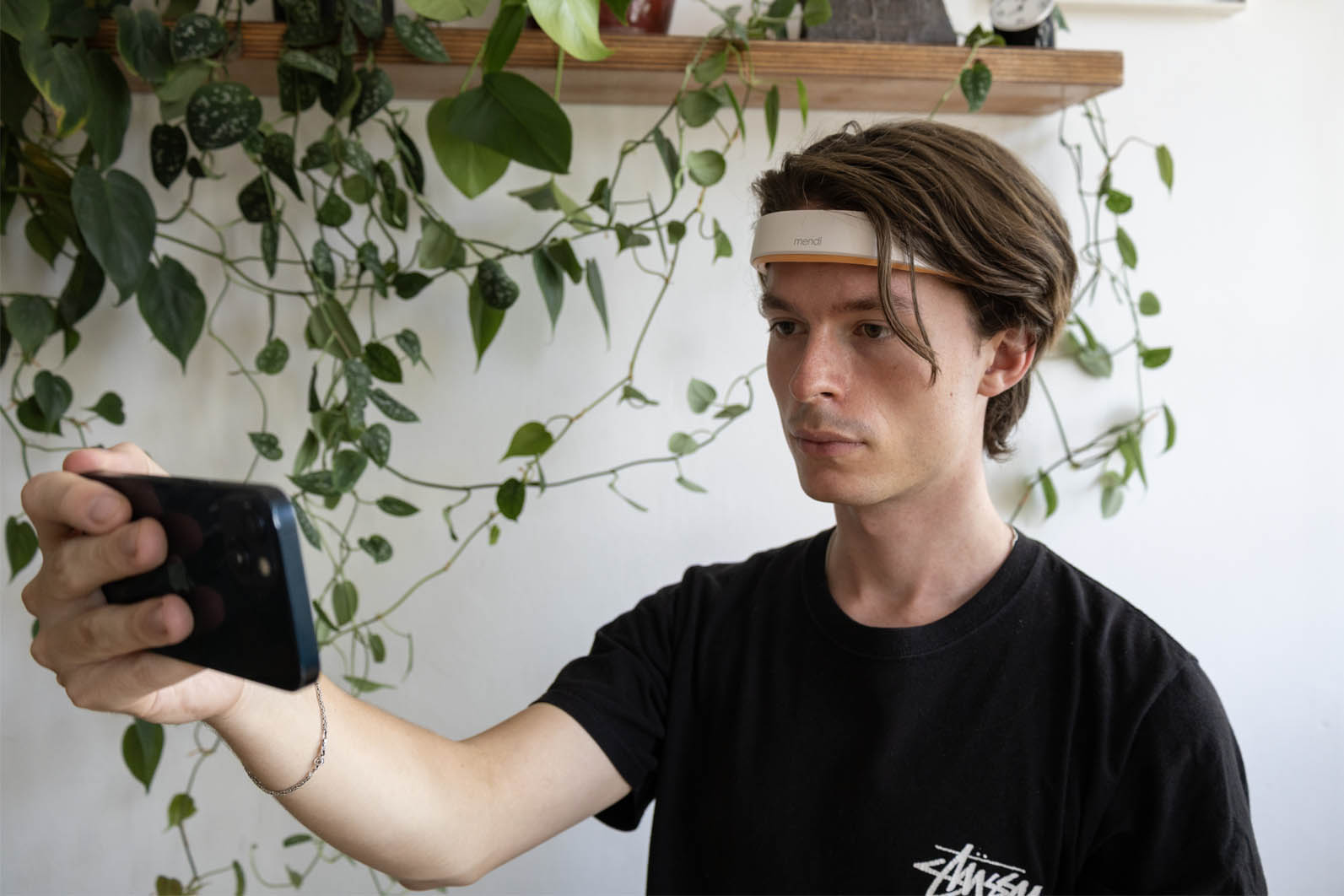
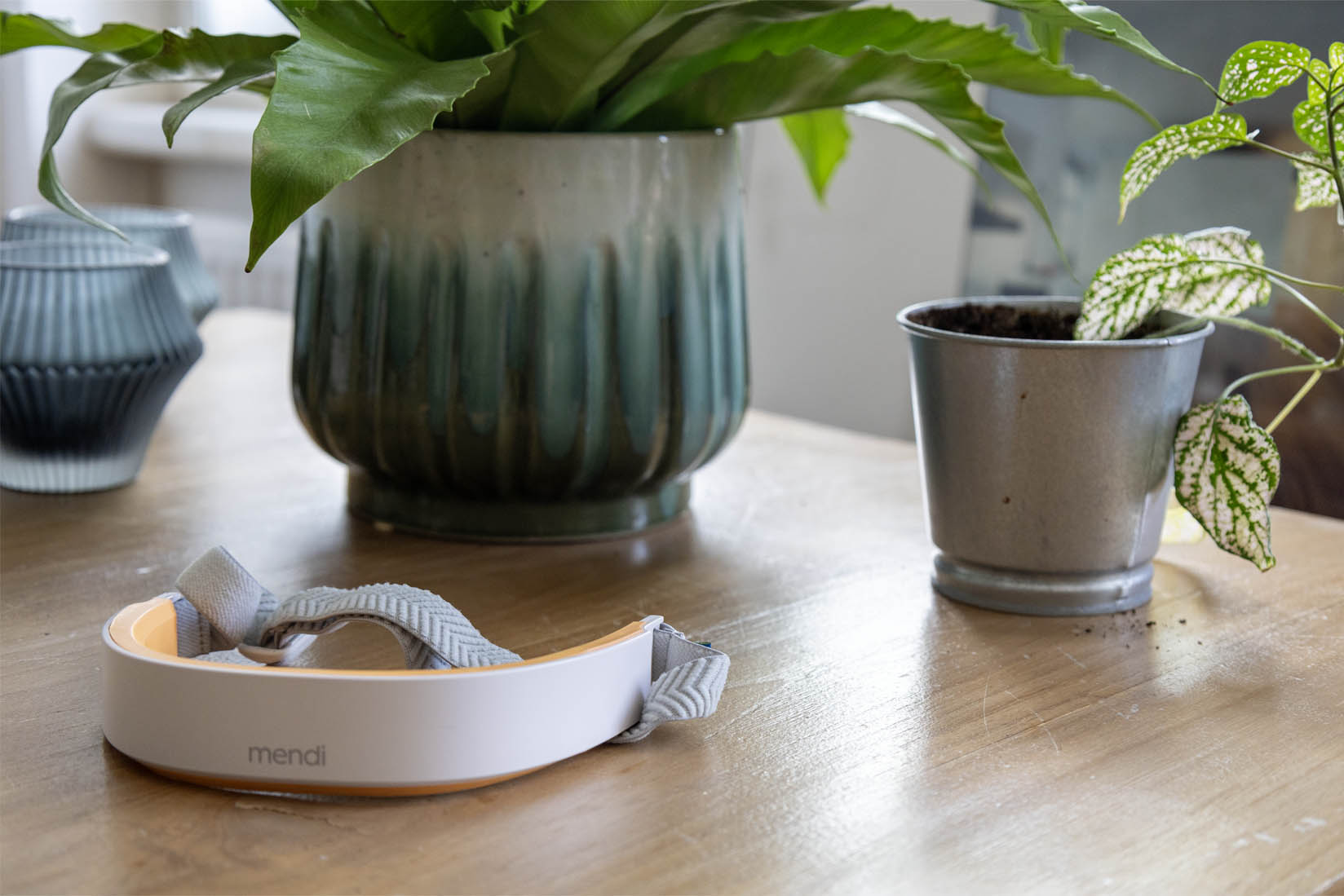
Swedish startup Mendi has developed a headband designed to measure and train consumers' focus using functional near-infrared spectroscopy (fNIRS). The device shines near-infrared light into the prefrontal cortex, and tracks changes in blood oxygenation as a proxy for neural activity. Neurofounders used Mendi’s headband for several weeks to assess the experience, the technology behind it, and whether it delivers on its central proposition.
Mendi's compact headband is sold for roughly $300 and paired with a free mobile app. The device was supplied to Neurofounders for testing, with no payment or editorial agreement tied to the coverage. The team used it across morning and evening sessions over several weeks, approaching it as an everyday consumer product.
At first, there are little signs that Mendi's headband contains neuroimaging tech previously reserved for labs and bulky headsets. The headband rests relatively comfortably across the forehead, positioning three sensors above the eyebrows. Setting up the headband and pairing it to your mobile device is as easy as pressing a button on the device and turning on Bluetooth. Yet how and where the device is worn does have a noticeable impact.
Bright rooms regularly made it harder to establish a reliable signal. Our strongest readings generally came during evening sessions and when used in darker environments. Mendi similarly recommends training in a dim or dark room, with the device fitted tightly against bare skin.
This sensitivity follows from the technology itself. Mendi uses functional near-infrared spectroscopy, or fNIRS, which sends red and near-infrared light through the forehead and measures how much returns. Of the main fNIRS approaches, Mendi uses the simpler continuous-wave method, with two longer channels and one shorter channel, to track relative changes in oxygenated and deoxygenated haemoglobin.
These changes provide an indirect view of activity in the prefrontal cortex, since active brain regions require more oxygenated blood. As light can only travel so far, the technique is largely limited to the outer cortex. And because vascular changes are not immediate, fNIRS generally responds several seconds after the underlying activity. This makes the technique better suited to broader shifts in cognitive demand rather than as an instantaneous measure of focus.
Each Mendi training session begins with a short check-in. The app asks users to select one of five smileys and up to five words describing how they feel, before moving into a minute of guided breathing. After a brief calibration, the phone rotates into landscape mode and a small ball appears on screen. The interface also shows a live measures of neural activity. In the settings, users can customise the entire interface, though we found the default setup the least distracting and easiest to use.
During the ten-minute sessions, users must move the ball uphill by maintaining a stable level of prefrontal activity. Upward movement is rewarded with animated stars and a pleasant jingle, while losing control causes both to disappear. The mechanic is basic, but surprisingly effective. It does not take long before the movement of the ball starts to feel consequential.
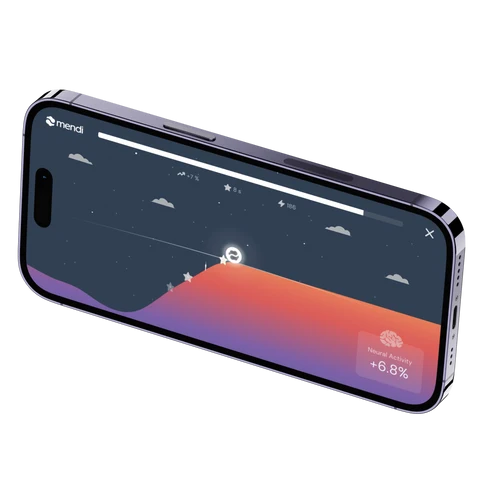
That feedback also encourages experimentation. We tried changing our breathing, narrowing our visual attention, and deliberately shifting between focused thinking and mind-wandering. Holding our breath sometimes moved the ball upward, while losing concentration did not always produce an immediate decline. This occasionally made the feedback confusing. Part of that may reflect how fNIRS works, as changes in blood oxygenation can appear several seconds after the underlying brain activity.
One of the clearest moments came while experimenting with a Sudoku puzzle. The ball initially hovered at a moderately high level while the grid offered few obvious answers. It rose sharply once momentum developed and the puzzle required more active reasoning. When only a handful of straightforward gaps remained, it dropped almost completely. The result was anecdotal, but it created a rare moment of awe in which changing cognitive demand appeared visible in real time.
Mendi presents neurofeedback as a repeated practice. “We focus on the ritualistic aspect of brain health,” Chief Product and Science Officer Mustafa Hamada previously told Neurofounders, comparing its use to going to the gym, practising yoga, or having a morning coffee. The company is also exploring adaptive difficulty, partly because users can learn the game and eventually plateau as the task becomes more familiar.
Mendi has explicitly looked to validate the underlying science. A University of Victoria study involving 30 students found that the headset detected higher levels of oxygenated haemoglobin during more demanding working-memory tasks. The findings support Mendi’s ability to capture changes in cognitive load, although they do not establish that improving within the game leads to sustained improvements in everyday focus.
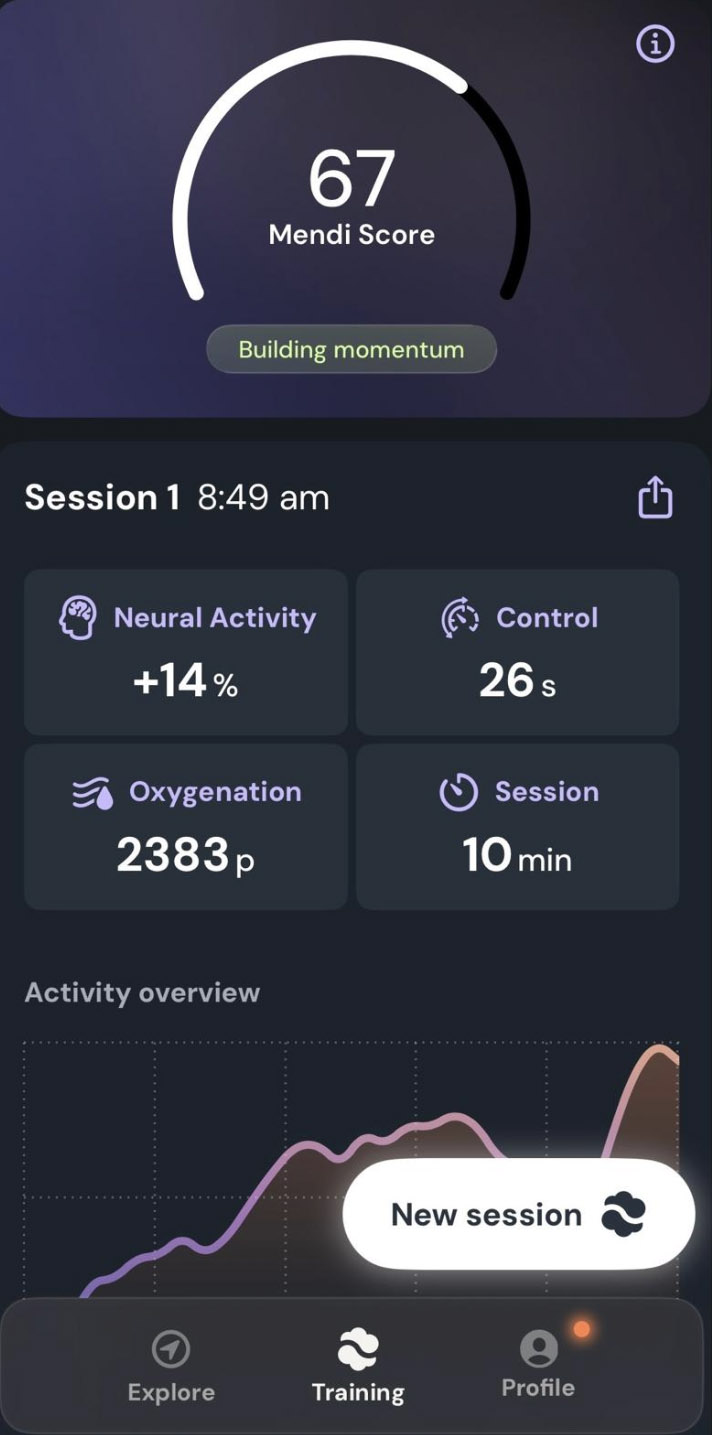
After each training session, the app presents an overall Mendi Score alongside oxygenation, control, and neural activity. Users can inspect an activity graph and record how they felt. Our scores stayed within a relatively narrow range, with no clear upward trend across the testing period. Evening sessions generally produced the most stable readings, although morning sessions appeared to have a more noticeable short-term effect on focus.
The app provides explanations of how its scores are calculated, along with guidance on building a routine and recognising patterns. Mendi recommends looking for gradual change and not treating each session as a standalone test, stating that meaningful progress is generally expected after four to eight weeks of regular use.
Still, the activity graphs were not immediately intuitive, and stronger scores did not always correspond with feeling more focused afterwards. The experience is easy to complete, while progress remains harder to interpret.
Mendi entered a consumer neurofeedback market that has historically been dominated by EEG headbands. Its use of fNIRS gave the product a clearer focus on prefrontal blood oxygenation, although that distinction is no longer exclusive. Muse’s latest Athena headband combines fNIRS with EEG, heart-rate sensing, and sleep tracking. Mendi is narrower by comparison, with one primary modality and a single training experience.
That simplicity is among Mendi’s main strengths. The headset requires little preparation, the game creates an engaging feedback loop, and the free app avoids placing the core experience behind a subscription. It turns a research technology into something that can realistically fit into everyday life. The main challenge is helping users understand what the scores represent, what influences them, and how progress inside the game relates to performance outside it.
As a consumer neurofeedback product, Mendi offers a polished and credible starting point. Its hardware has been validated to detect differences in working-memory load, and the headset can produce moments when changing cognitive effort feels unusually visible. The longer-term benefits are more difficult to judge. Users looking for data into their daily focus or clear evidence of lasting improvement may find the feedback informative, but not yet conclusive.
.svg)