

After raising more than $200 million in Series D funding last November, Synchron is advancing its clinical program with permission to begin its INTENT trial. INTENT is the company’s third clinical trial evaluating the long-term value and feasibility of the Stentrode--Synchron’s endovascular interface designed to restore digital control and communication for people with paralysis.
The trial follows a busy year for Synchron. Last November, Synchron became only the second modern brain-computer interface startup to reach a valuation above $1 billion, placing it in the small group of BCI companies with enough capital to push beyond early feasibility work. That momentum points to a new phase for the field, where larg funding rounds are being used not just to prove that neural interfaces can work, but to move them toward the evidence, infrastructure, and regulatory pathways needed to reach patients.
Synchron’s clinical path has been building for several years. The Stentrode received FDA Breakthrough Device Designation in 2020, before the first-in-human SWITCH study showed long-term safety in four Australian patients. In the U.S., Synchron began human testing through the COMMAND study, which reported positive one-year results in 2024 across six implanted patients. The company has since launched FOCUS-CAN in Canada, received permission to begin INTENT in the U.S., and is expected to add a new Australian study later this year.
The clinical program is being matched by a broader software and AI push. In January of 2025, Synchron announced work with NVIDIA Holoscan to support real-time edge AI, on-device neural processing, lower latency, and more responsive BCI control. Two months later, the company unveiled Chiral, its roadmap for a cognitive AI brain foundation model trained on neural data collected through its implant platform.
That leaves Synchron in a more demanding phase of translation. Kurt Haggstrom, who joined the company as Chief Commercial Officer in 2022, tells Neurofounders that “Synchron, and really the BCI field more broadly, is still in a phase of clinical translation. At this stage, the question is no longer only what the technology can do, but what benefit it can deliver for the patient population it is meant to serve.” For people with paralysis, especially upper-limb paralysis, that means restoring device control, independence, and autonomy.

That also clarifies where Stentrode sits in the wider BCI landscape. “We sense in a different way than our competitors, and that matters,” Haggstrom said, noting that Synchron is not primarily targeting applications like direct-to-speech decoding. Instead, the company is focused on broader communication, general computer control, and potentially robotic control.
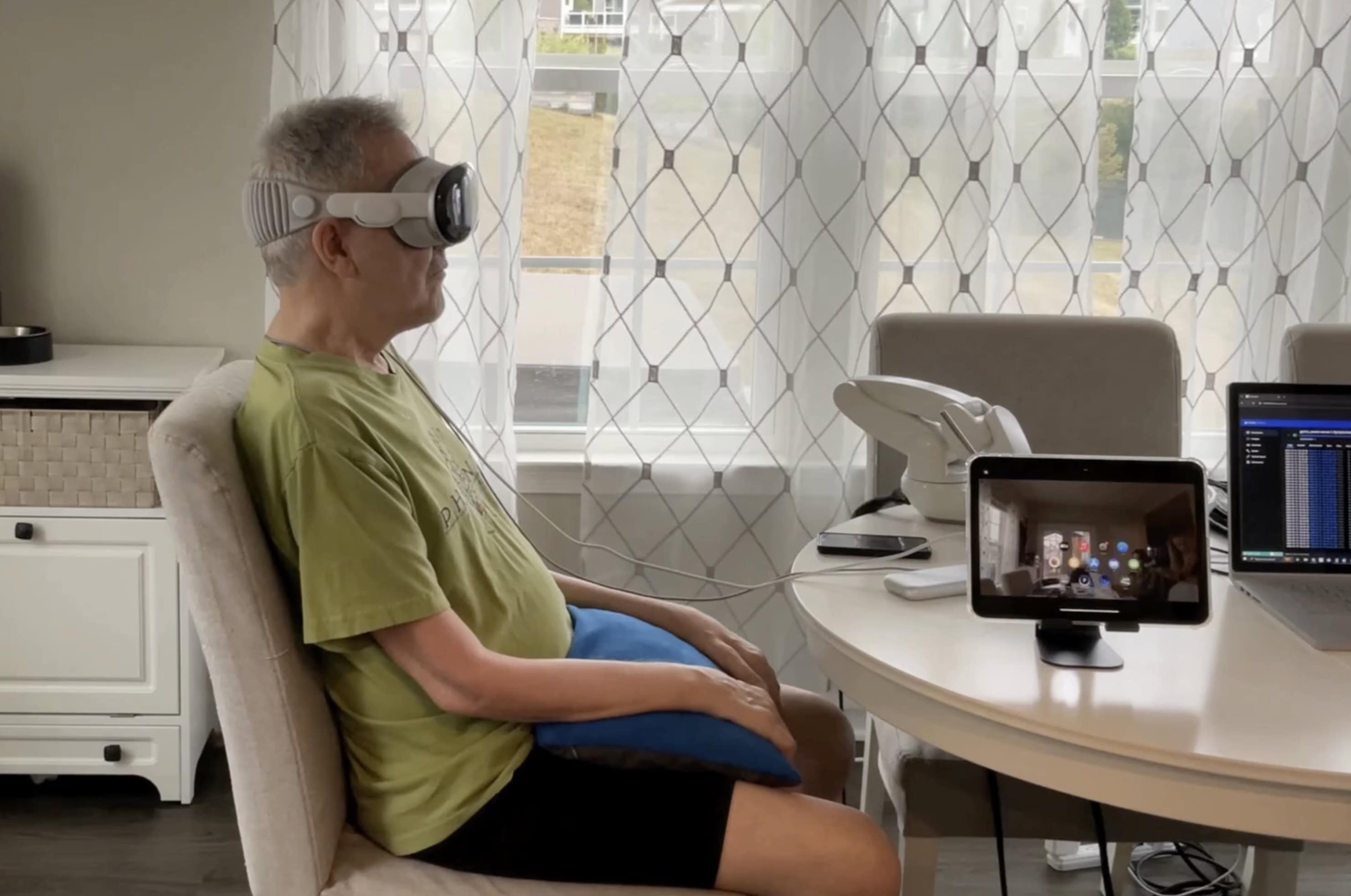
For Haggstrom, the longer-term vision is shaped by what can be built on top of the sensing data over time. “Even after years of use, patients are still discovering capabilities and ways of using the system that they did not have before,” he said. That makes platform integration central to Synchron’s strategy. “I think bringing big tech, such as Apple, into the discussion early on is really important,” Haggstrom added. “Ultimately, those are the platforms and operating systems we are connecting to.”
Synchron crossed the $1 billion valuation mark as only the second modern BCI company after Neuralink to reach that level. Since then, Science has reportedly reached a $1.5 billion valuation, China’s BrainCo has been reported above $1.3 billion, and Merge Labs emerged from stealth with an $850 million valuation. These companies are not pursuing the same product model, but together point to a more competitive BCI field, where commercial strategy is becoming central to the conversation.
For Synchron, commercial strategy is already shaping the next phase of development. “When you think about what the business model around a brain-computer interface company will look like, you have to think about the commercial footprint well ahead of time,” Haggstrom says. Reimbursement is one example. Patients are unlikely to pay for implanted BCIs directly, especially in healthcare systems shaped by Medicare. That means the company has to show more than safety and efficacy. “You have to show clinical utility,” he said.
.webp)
That is where the wider BCI field is starting to split. Precision Neuroscience’s partnership with Medtronic points toward a different model for cortical implants, where interfaces may be integrated into existing neurosurgical workflows, including mapping, monitoring, or intraoperative use. Haggstrom can appreciate that as “a very different business model,” one that is less about a long-term neuroprosthetic. “For us, though, we currently see more value in the long-term implant, and that continues to be our focus."
That does not mean Synchron sees the field as uncontested. Several companies are now pursuing long-term implants, each with different trade-offs around invasiveness, signal access, clinical pathway, and target use case.
According to Haggstrom, there is likely room for multiple players, because patient needs and product requirements vary across the field. “I do not think this is a winner-takes-all space,” he says. “That said, I absolutely do view them as competitors.” For Synchron, the central differentiator remains the minimally invasive path, and the bet that avoiding open brain surgery may matter for adoption as much as technical performance.
Read the full Neurofounders interview with Kurt Haggstrom.
Produced with support from

%20copy.jpg)




.svg)

