

Oil has made the Gulf wealthy beyond measure. But fossil fuel is not a long-term investment strategy, and so the region’s sovereign funds are starting to place capital into the technologies meant to define the next economy. Artificial intelligence, robotics, advanced healthcare, and biotech have already become part of that transition. Now, brain-computer interfaces are starting to appear in their portfolios.
This month saw the latest signal of that trend, as the Oman Investment Authority invested an undisclosed amount in Neuralink. Neuralink is also preparing clinical work in Abu Dhabi, while the Qatar Investment Authority previously backed Synchron, and NEOM (the "Line"), Saudi Arabia’s planned future city and economic development project, invested in Paradromics while planning a local "BCI Center of Excellence."
Earlier this month, the Oman Investment Authority invested an undisclosed amount in Neuralink, framing the move as part of its push into future medical technologies, innovative sectors, and deep tech. The investment also extends an existing pattern in OIA’s portfolio. Oman’s sovereign fund had already taken a stake in xAI and holds shares in SpaceX, making Neuralink part of a wider exposure to Elon Musk-linked tech companies in its bid to diversify the investment portfolio geographically and across sectors.
Neuralink is among the most heavily financed companies in neurotechnology. In June 2025, the company raised $650m as it moved deeper into human clinical trials, with the Qatar Investment Authority and Abu Dhabi’s G42 among the named investors. The company has been reported at a $9bn valuation before the latest financing. Neuralink previously said that new capital would support wider patient access and future device development.
Neuralink's Gulf connection is also clinical. In May 2025, Neuralink launched UAE-PRIME at Cleveland Clinic Abu Dhabi in partnership with the Department of Health Abu Dhabi, extending its international footprint beyond the US, Canada, and the UK. Cleveland Clinic Abu Dhabi has a dedicated Neurological Institute covering neurology, neurosurgery, rehabilitation, epilepsy, movement disorders, neurovascular medicine, and brain health, while the Department of Health has explicitly framed the trial as part of the emirate’s push into health innovation.
The Qatar Investment Authority doubled down on BCI last year. In June 2025, QIA was listed among the investors in Neuralink’s $650m Series E. Five months later, it appeared again in Synchron’s $200m Series D; a round that brought the company’s total funding to $345m, its valuation close to one billion, and is intended to support commercialization of the Stentrode platform and development of a next-generation endovascular interface.
The two companies represent different routes into the same market, solving similar functions for overlapping patient populations. Neuralink has become the public face of surgically implanted BCI, while Synchron is building around a less invasive endovascular system that avoids open-brain surgery. For QIA, the two investments suggest exposure not only to BCI as a category, but to competing clinical architectures inside it.
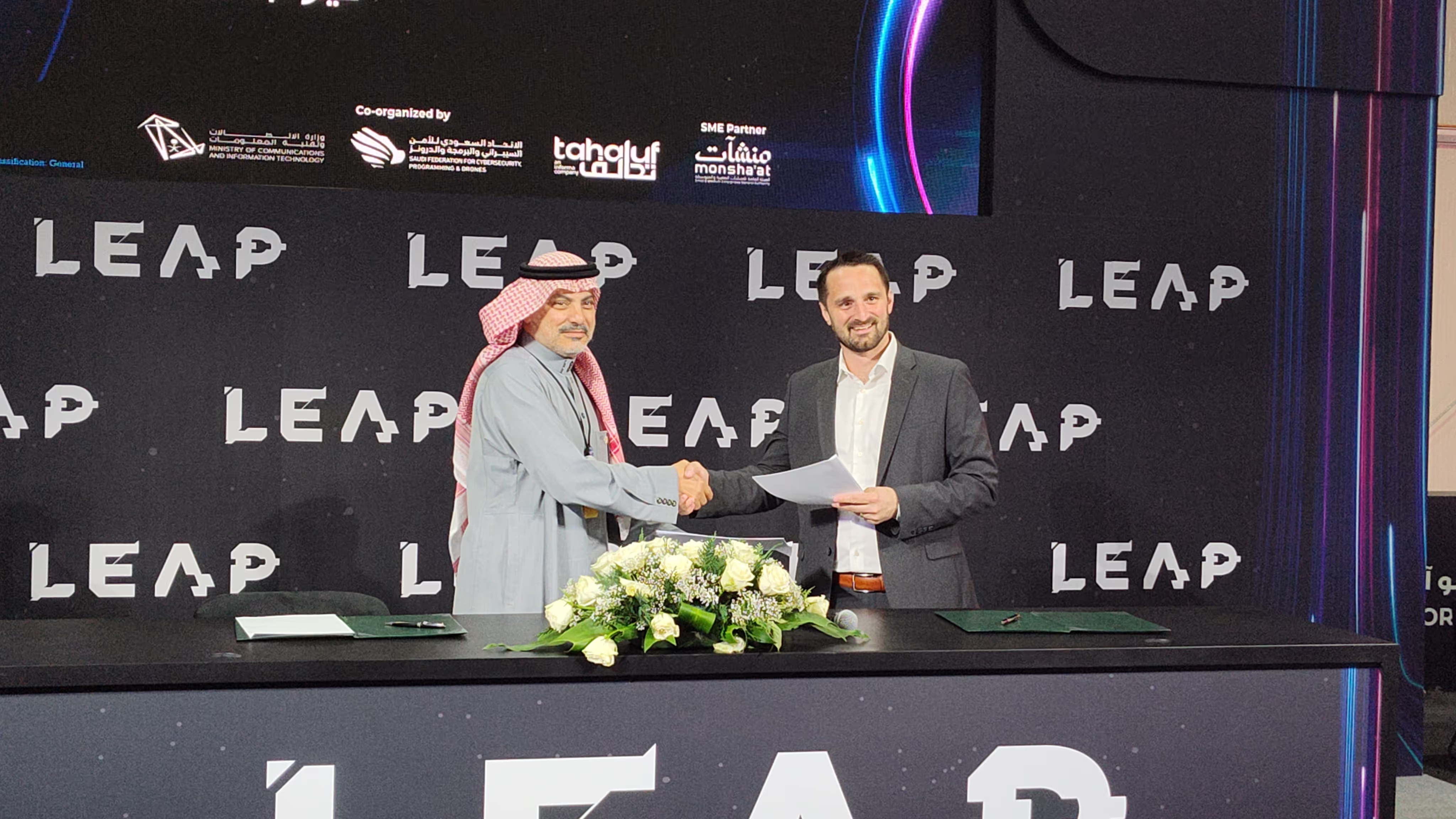
Paradromics is the clearest Saudi-linked BCI investment. In February 2025, the NEOM Investment Fund announced a strategic investment in the company, framing the partnership around BCI-based therapies for people with conditions that impair movement, communication, or cognitive function. NEOM is Saudi Arabia’s planned development in the northwest of the country, best known for its line design. NEOM's investment fund is designed to bring strategic technologies into the project’s wider economic, healthcare, and infrastructure agenda.
The story moves beyond the investment. As part of the agreement, Paradromics and NEOM plan to establish a Brain-Computer Interface Center of Excellence inside NEOM, aiming to support clinical research and eventually becoming a major center for BCI-based healthcare in the MENA region and beyond. In that sense, Paradromic’s deal shows that the Gulf sees potential in neurotech that extends beyond numbers on a balance sheet, investing explicitly into infrastructure that could one day become core in commercializing the category.
Note: While official confirmation lacks, it appears that construction on "The Line" project of NEOM has been suspended as of late 2025. What that means for the plans regarding the BCI center of excellence is unclear.
.svg)









%20copy.jpg)