

When it comes to Asian progress on brain-computer interfaces, most of the attention lands on China. But the importance of creating a domestic neurotechnology industry is understood across the continent. South Korea has been working this year to catch up. In August, the government launched a national BCI Alliance, bringing together companies, hospitals, universities and research institutes. It is the latest step in a push to make BCIs a strategic technology sector.
Most of that push is happening inside of government plans; South Korea’s clinical activity is still early. But the foundations are starting to take shape. Korean-developed cortical electrodes have entered clinical testing, while a national brain-to-robot program is working toward bidirectional systems. Around them, the government is investing in the research, regulatory, and industrial infrastructure needed to reach its goal of commercial BCI products by 2035.
South Korea's BCI Alliance launched on August 26 and will act as the coordination layer for the country's efforts to build a domestic BCI industry. Around 100 experts from companies, hospitals, universities and research institutes attended the launch. Three working groups were launched, focusing on R&D, commercialization and infrastructure. The first technology demonstrations and the start of clinical trials are targeted by 2029.
The policy groundwork was laid in March with the launch of a national R&D strategy for future brain industries. It identified seven BCI application areas, ranging from paralysis, brain disorder treatment and sensory restoration to prosthetics, robotics, immersive entertainment and defense. Alongside those programs, the government plans to invest in enabling technologies including implantable electrodes, neural-signal chips and decoding systems.
BCI was subsequently made one of 12 targets under K-Moonshot, a national R&D program using AI to accelerate difficult science and technology projects. Korea University professor Cho Il-joo was appointed BCI program director, with the Korea Brain Research Institute providing institutional support and Ybrain and Gbrain participating from industry.
Cho argues that Korea already has strong capabilities in electrodes and semiconductor design. “What we lacked was experience bringing all the core technologies together into a system,” he told Donga Science.
"Our realistic goal is to reach the technological level of Neuralink within five years. I consider that alone to be a complete success,” Cho announced.
In August, BCI was also included in Korea's 7 SEED strategy, which identifies seven technology areas as future growth engines. These range from quantum and aerospace to nuclear technologies and advanced biotechnology, where BCI sits.
More concrete development is expected to begin through the BrainLink Initiative in 2027. The program will support BCI development and product demonstrations for people with quadriplegia and neurological disorders. The government's 2027 budget proposal allocates KRW 19.5 billion, or roughly $14.5 million, to BrainLink.

On the clinical side, the clearest progress comes from Gbrain. In June 2025, Seoul National University Hospital implanted Gbrain’s 64-channel Phin Array in a patient with drug-resistant epilepsy, the first clinical use of a domestically developed invasive brain interface. The electrode remained on the cortex for around a week to record seizure activity before being removed. Gbrain is now developing Phin Stim, a fully implanted system combining cortical recording and stimulation.
A more ambitious clinical program began this year. Seoul National University Hospital is leading implant trials for a seven-year Brain-to-Robot project aimed at restoring movement and sensation after central nervous system injury. The system would decode movement intentions to control an Angel Robotics exoskeleton, while separate electrodes send force and pressure information back into the sensory cortex. Human trials of the integrated system are planned from 2028.
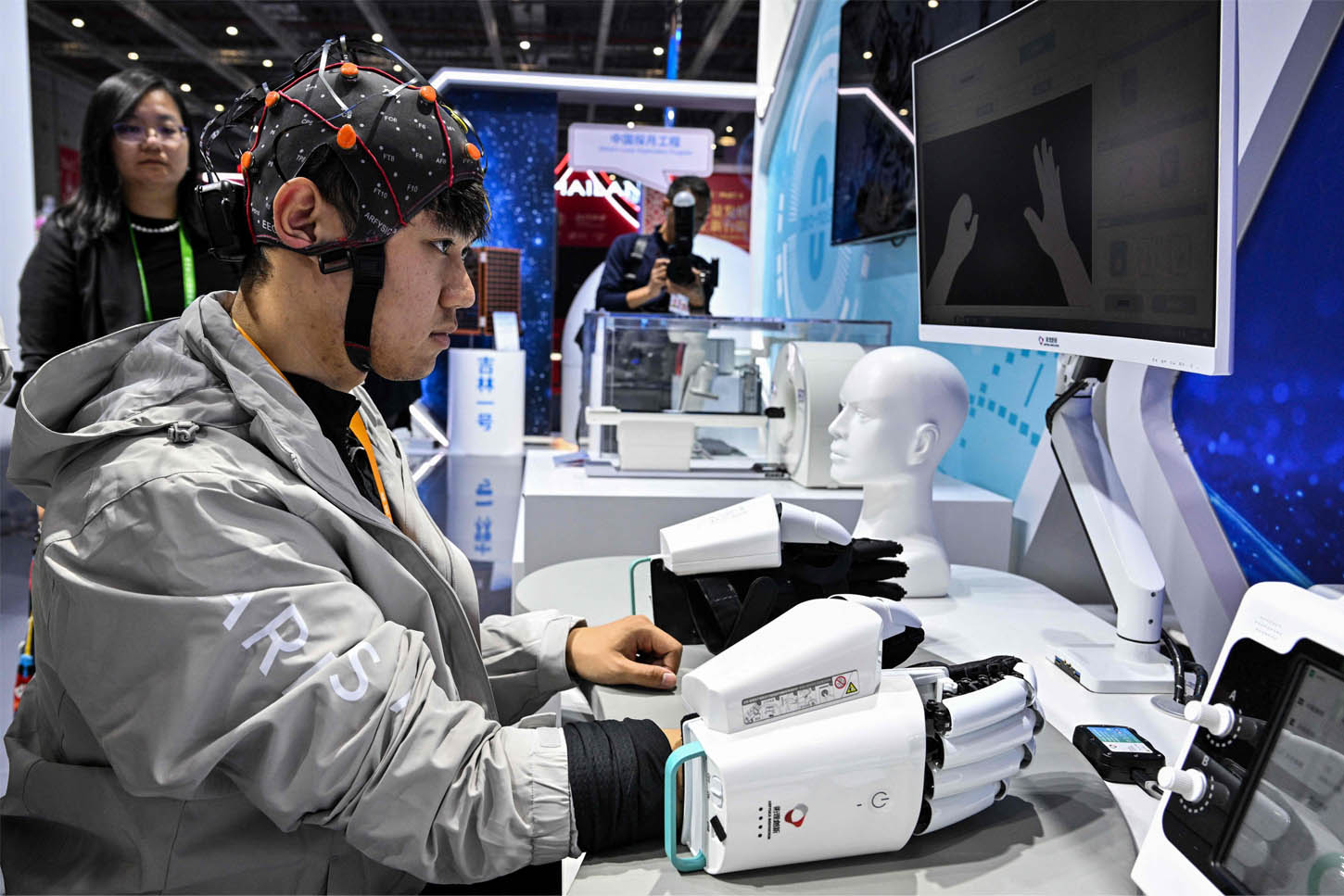
There is also activity from non-invasive neurotech companies. Ybrain, which already develops EEG and electrical stimulation systems, partnered with the Daegu Gyeongbuk Institute of Science and Technology in June on next-generation BCI research. It is also working with Dynamic Solution, which demonstrated an EEG-controlled robotic hand in August that translates motor signals associated with hand movement into robotic control.
Research groups are developing some of the hardware supporting next generation systems. In June, researchers at the Korea Institute of Science and Technology revealed an ultrathin transparent cortical electrode that can deliver optical stimulation while recording neural activity. In blind mice, the resulting cortical responses reached 78% similarity to normal visual responses.
Produced with support from

%20copy.jpg)


%20copy.jpg)



.svg)

