.jpg)
Few BCI use cases spark as much public interest as speech decoding. Once reserved for science fiction, neural interfaces can now translate brain activity into text and synthetic speech for those who have lost the ability to communicate naturally. Yesterday, Paradromics announced the first surgical implantation of its Connexus BCI as part of its FDA-approved early feasibility study, moving one of the field’s leading speech BCI platforms into longer-term clinical testing and a step closer to patients.
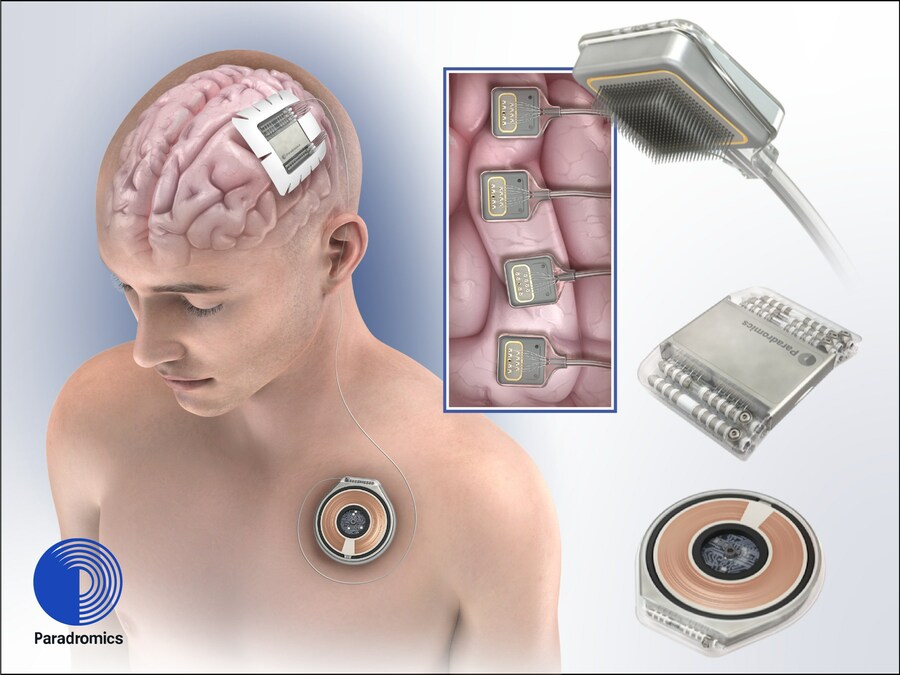
The procedure was performed at the University of Michigan on the first participant in Connect-One, Paradromics’ FDA-approved early feasibility study. Connexus, an intracortical wireless BCI, is designed to record neural activity through 421 microelectrodes and translate speech-related signals into digital communication. Connect-One will test whether the system can be used safely over time, while also looking at communication performance, computer control, and long-term reliability of the implant.
On June 17, Paradromics announced that neurosurgeons at University of Michigan Health had completed the first Connexus BCI implantation in a Michigan woman with difficulty speaking due to motor neuron disease. The procedure took around four hours and noted no adverse events. The woman will be followed for six years after implantation while continuing care for motor neuron disease at University of Michigan Health.
The implant is the first formal procedure of Connect-One, the early feasibility trial enabled by an Investigational Device Exemption approval granted in November 2025. Initial enrolment is small, beginning with just two participants who have impaired speech and limited extremity movement due to severe loss of voluntary motor control.
For Paradromics, the study follows a decade of work on high-data-rate neural interfaces for communication and computer control. The Austin-based company was founded in 2015, raised a $20 million seed round in 2021 before securing a $33 million Series A and FDA Breakthrough Device Designation status in 2023. Paradromics completed its first acute human recording in 2025. That earlier procedure showed that Connexus could be implanted, record brain signals, and be removed intact in under 20 minutes. The new study moves the system into a longer-term implanted setting.
Connexus is built around a high-density microelectrode array that records neural activity from the brain, sends the data to a chest implant, and then transmits it wirelessly through the skin to an external receiver. Paradromics’ technical thesis focuses on maximizing bandwidth. The company reported bandwidth reaching 200 bits per second in preclinical work, which it positions as central to enabling richer communication and future applications.
Along device control, speech restoration is developing as a natural first application for invasive BCI. Both uses have clear, concrete endpoint and little comparable treatment alternatives. Paradromics’ study is aimed at people with severe motor impairment and speech difficulties, including patients with ALS, brainstem stroke, dysarthria, and anarthria. Cursor control has already shown that BCIs can restore meaningful digital autonomy for this population, but speech is often regarded as the essence of human agency.
The last few years have shown strong research progress on speech restoration. In 2023, Stanford researchers decoded attempted speech from a participant with ALS at 62 words per minute using intracortical microelectrode arrays, about half the rate of natural speech. That same year, UCSF’s Edward Chang group reached a median of 78 words per minute using high-density surface recordings, while linking decoded speech to text, personalised audio, and avatar control. In 2024, UC Davis researchers reported a system that allowed a man with ALS to communicate with high accuracy within minutes of activation.
Paradromics sits at the more invasive, high-bandwidth end of that field. The company’s view is that speech decoding requires a level of neural data that only intracortical recording can provide, as natural communication depends on speed, precision, and information transfer. Connexus records from individual neurons through a dense microelectrode array. That may support richer decoding, but it also brings tradeoffs including surgical risk and questions regarding long-term stability in real-wrold settings.
Other approaches are moving in parallel. ECoG systems, which record from the surface of the brain, offer a less penetrative route with potentially greater long-term stability and have already supported major speech-decoding demonstrations in research. ABILITY Neurotech recently received approval to begin a first-in-human study of its implanted BCI in ALS patients, with communication and speech restoration as an initial uses. Neuralink has also received FDA Breakthrough Device Designation for severe speech impairment.
.svg)








%20copy.jpg)