
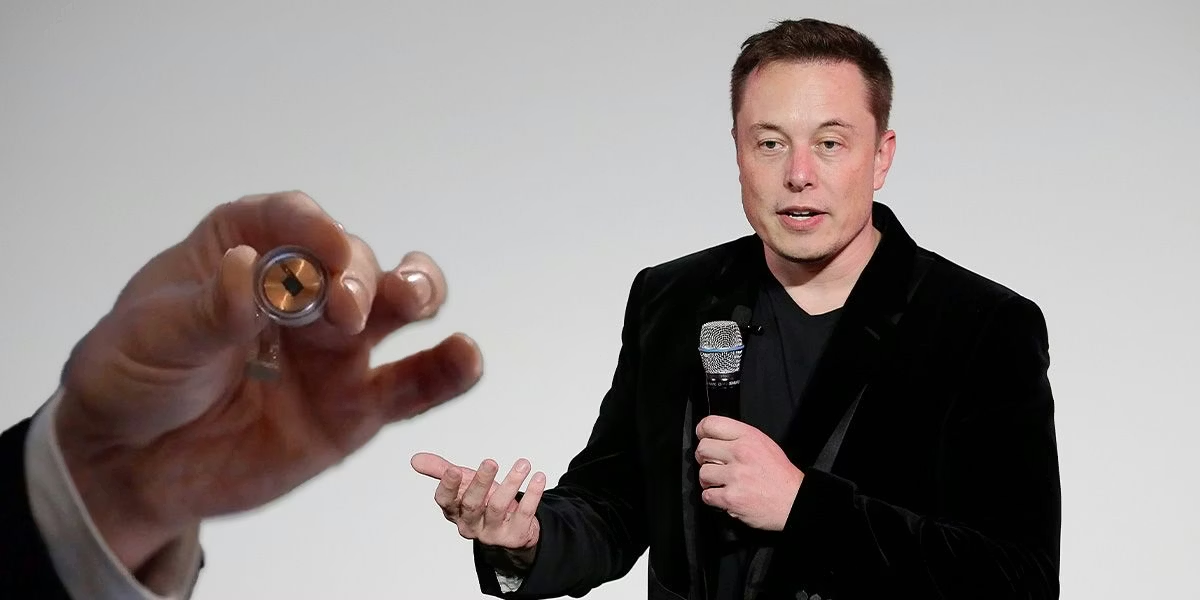
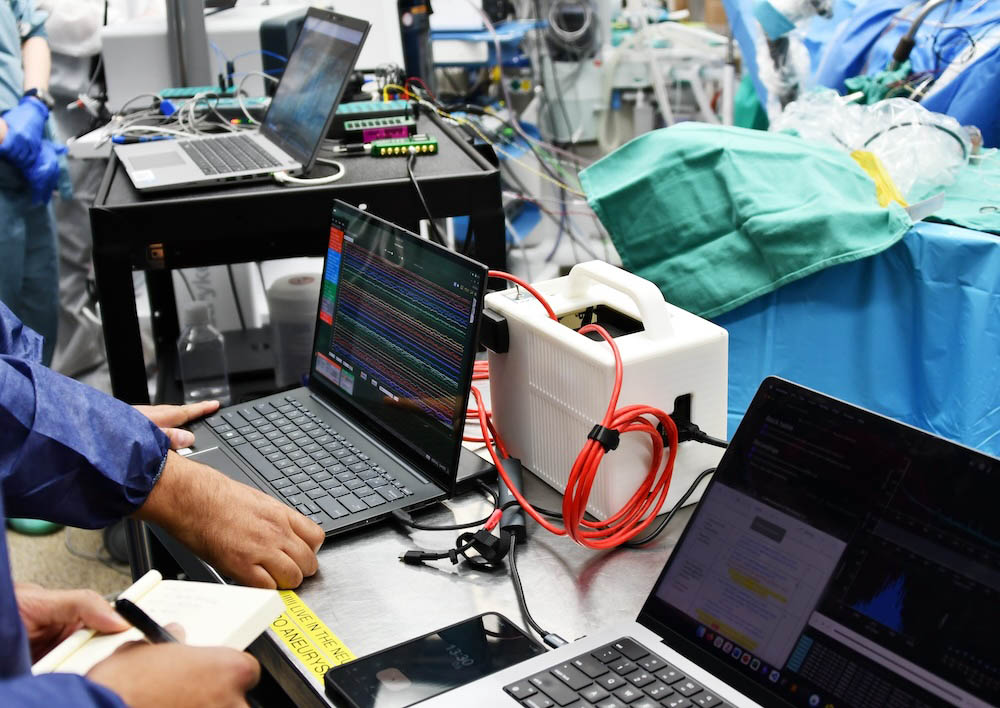
On the last day of 2025, Elon Musk tweeted that Neuralink would move to an "almost entirely automated" surgical procedure in 2026, with electrode threads passing through the dura, the brain's protective outer membrane, “without the need to remove it." On May 20, 2026, Neuralink tested the procedure in a person for the first time, using a transdural implantation method at Toronto Western Hospital to place its N1 device in a patient with amyotrophic lateral sclerosis (ALS).
Implantation of the Neuralink N1 device traditionally required cutting through the dura, the fibrous outer protective layer of the brain, in a step of the procedure called a durotomy. The company says removing the durotomy makes the procedure more standardized, and that standardization enables safety and repeatability at scale. This first procedure is the starting point for answering whether eliminating the durotomy actually lowers patient risk enough to support both safety and higher surgical volume.
The dura is a tough, fibrous membrane that sits directly beneath the skull, protecting the brain and containing the cerebrospinal fluid that cushions it. It is more than ten times thicker than Neuralink's electrode threads, which are thinner than a human hair. Because it’s also opaque, during each prior N1 implantation, a surgeon had to cut the dura open to see the brain beneath. The R1, Neuralink's robotic surgical system, would then insert electrode threads into the brain.
Neuralink pursues the transdural approach because removing a manual step presents a less invasive, more repeatable procedure. But doing so requires solving the problems an intact dura creates. First, the membrane hides the blood vessels beneath it, leaving surgeons no direct view of the vasculature the electrode threads need to avoid. Second, the dura can be thicker than the threads themselves, which are thinner than a human hair. Third, the brain itself is not a fixed target; it moves continuously beneath the dura, meaning the insertion point is never perfectly still.
Neuralink's engineering response targeted each problem directly. The original needle design could not reliably penetrate the dura, so engineers increased its diameter until the electrode threads could reach the cortex. New optical systems were developed to locate blood vessels obscured by the dura and to calculate the precise distance between the dural surface and the cortex. Solving both challenges required redesigning the surgical robot itself.
The transdural procedure does not eliminate the craniotomy, the skull removal step of the procedure. Surgeons still remove a section of bone about the size of a quarter to access the insertion site. For patients, the risks of brain surgery–anesthesia, infection at the skull incision, and recovery from a craniotomy–are unchanged. The durotomy is the only step Neuralink has actually eliminated, and it carries its own risk profile, tied to how the dura is closed and how well cerebrospinal fluid stays contained. Whether skipping that step lowers a patient's overall risk is not something a single patient study can answer.
Risk is only one axis Neuralink is being measured against. Musk’s 2026 prediction explicitly positioned the transdural procedure as part of automation and scale ambitions. In earlier reporting, Neurofounders argued that those ambitions would only intersect with medical reality if three conditions were met: shorter procedures, more sites, and gains in capacity. The transdural procedure is a first concrete data point to test against that framework.
But when judged against procedural optimization, Neuralink still trails two competitors that have removed the craniotomy entirely. Precision Neuroscience's surface array is inserted through a cranial micro-slit rather than a burr hole. Synchron's Stentrode, meanwhile, is delivered through the jugular vein by an interventional radiologist in a 20-30 minute procedure, rather than requiring a dedicated neurosurgeon.
A more defined benefit of going transdural is standardization. A precise, freehand incision near blood vessels and moving tissue is exactly the kind of skill-dependent step that varies by surgeon and team. In a procedure built for automation, removing that variability is a key step for expanding to more sites and reaching greater capacity.
Produced with support from

%20copy.jpg)




.svg)

