

The brain-computer interface race is becoming increasingly capital-heavy, giving privately-backed U.S. firms a clear advantage. Chinese firms, meanwhile, are starting to compete through structured institutional pushes. Yet a third category is emerging, a cohort of firms is trying to differentiate through materials design. Barcelona-based INBRAIN Neuroelectronics leads that push, building its platform around graphene-based neural interfaces.
Today, INBRAIN announced it has completed patient enrollment in its first-in-human study of a graphene cortical interface. Ten patients were recruited, while eight were treated surgically. During the study, INBRAIN reported no device-related adverse events and no device failures during use. The update follows a longer sequence of progress including a first human procedure in 2024, initial safety results last year, followed by collaborations with Mayo Clinic on U.S. clinical translation and Microsoft on agentic AI.
INBRAIN Neuroelectronics is a Barcelona-based neurotechnology company developing graphene-based brain-computer interface therapeutics. Its platform is built around ultra-thin, flexible graphene electrodes designed to decode neural activity and deliver targeted stimulation. The company’s focus is therapeutic rather than consumer-facing, with early applications pointed toward neurological disorders including Parkinson’s disease, epilepsy, and stroke rehabilitation.
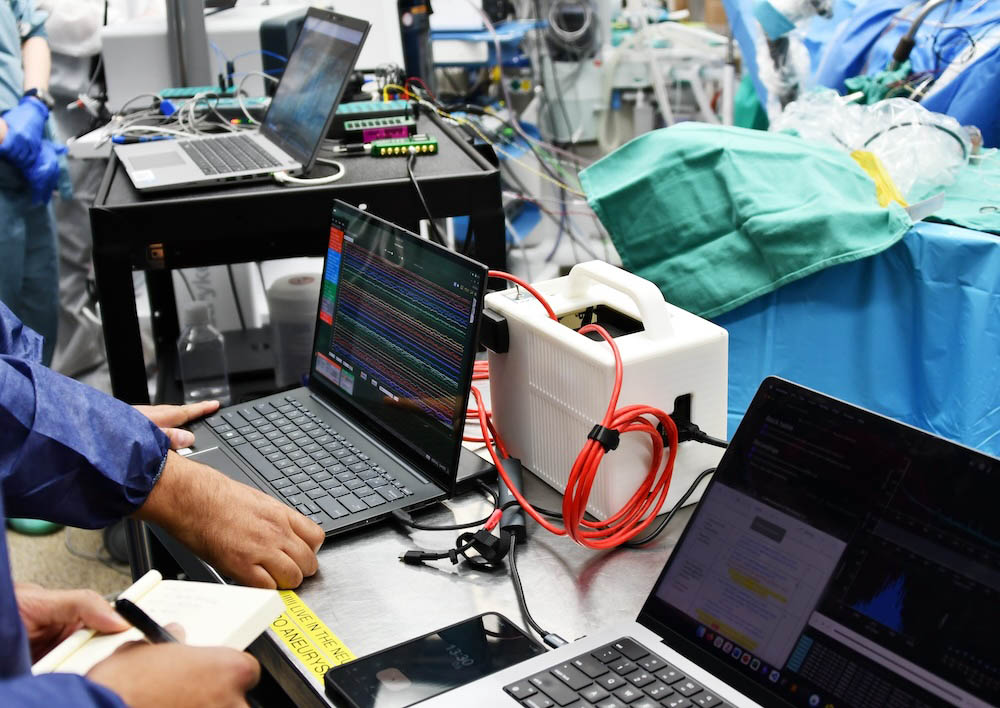
The completed first-in-human enrolment centered on INBRAIN’s graphene cortical interface during brain tumor resection procedures. The study recruited ten patients and treated eight surgically, with complete datasets obtained from all eight treated patients. It was designed primarily around safety, with additional endpoints focused on signal quality, stimulation capability, stability during surgery, and compatibility with standard surgical tooling and recording equipment. INBRAIN reported no device-related adverse events in the treated patients up to surgical discharge, and no device failures during use.
“The completion of patient enrollment in this first-in-human study marks an important step for INBRAIN and the field of neurotechnology,” said Carolina Aguilar, CEO and co-founder. “Graphene has the potential to fundamentally change how we interface with the brain, enabling higher resolution of neural function specific biomarkers, safer, and more intelligent BCI systems. We look forward to announcing the full results this year, as we advance towards commercialization.”

In select awake surgery cases, patients performed functional tasks such as object naming, allowing researchers to evaluate speech-related brain activity and functional mapping during surgery. The work also tested whether graphene electrodes could operate alongside standard-of-care monitoring systems in a live surgical setting.
The update extends INBRAIN’s claim that graphene can offer a different interface layer for clinical neurotechnology. Conventional electrodes are often limited by rigidity, size, and signal sensitivity, which can restrict how well they conform to the brain’s surface and capture fine-grained activity. INBRAIN’s graphene electrodes are designed to be ultra-thin, flexible, and highly sensitive, allowing them to adapt more closely to cortical anatomy while recording neural signals at higher resolution.
“This study demonstrates that graphene can safely interface with the human brain, and capture neural signals with exceptional fidelity and resolution to enable precise decoding of brain and speech-related patterns metals can barely see,” said Dr. Kostas Kostarelos, Co-Founder of INBRAIN Neuroelectronics and Chief Scientific Investigator of the study. “It marks a pivotal step towards translating a new enabling technology using neural signals into meaningful clinical applications and real-world patient benefit.”
The enrollment update builds on a clinical trajectory that started in 2024, when INBRAIN announced its first human procedure. At the time, the company said the interface could help differentiate between healthy and cancerous tissue with micrometer-scale precision. The 2025 interim analysis then added an early safety and signal-quality checkpoint, with no safety concerns reported in the initial cohort and neural signal acquisition shown during awake language mapping. The completed enrolment now extends that sequence from first procedure to a fuller first-in-human dataset.
That clinical progress also sits alongside INBRAIN’s move into U.S. translation. In September 2025, the company announced a non-exclusive collaboration with Mayo Clinic, under which Mayo clinicians would evaluate INBRAIN’s investigational BCI-Tx platform in IRB-approved clinical settings. INBRAIN also announced the formation of a U.S. subsidiary, with offices planned in Boston and on the West Coast.
The other layer is software. In November 2025, INBRAIN announced a collaboration with Microsoft to use Azure AI infrastructure, including time-series models, large language models, and analytics, to support an intelligent neural platform. The graphene is meant to capture higher-resolution neural data, while the AI systems will interpret those signals and help adapt stimulation over time.
Produced with support from

%20copy.jpg)


%20(2)%20(1)%20(1)%20(2)%20copy.jpg)



.svg)

