

Human capital has long been seen as a core pillar of economic prosperity, usually measured through education and physical health. These are the factors captured in the Human Capital Index. But the Global Brain Economy Initiative argues that this index overlooks one of the most important components of human output, the brain. It proposes a Global Brain Capital Index to provide a broader measure of a workforce’s economic potential.
Brain capital expands human capital to include brain and mental health, cognitive skills, creativity, innovation, adaptability, and the environments that support them. The concept has been advanced by the Euro-Mediterranean Economists Association, the Brain Capital Alliance, the Global Brain Economy Initiative, and a wider network of researchers and policymakers. Their work is being translated into the Brain Capital Index and Dashboard, which aim to compare indicators across countries.
Rym Ayadi, founder and president of EMEA and a leading figure behind the Global Brain Capital Index, traces the idea to a simple observation. “Our economies increasingly depend on the cognitive, emotional, creative and social capacities of people, yet these assets remain largely invisible in the way we measure economic performance and prosperity.” The index asks whether these capacities can be incorporated into economic measurement.
The Global Brain Capital Dashboard, launched in September 2023, and the Global Brain Capital Index, unveiled at Davos this year, are attempts to close that gap. The initiative brings together economists, neuroscientists, psychiatrists, educators, urban planners, employers, policymakers and investors around the view that brain health and skills contribute to productivity, resilience, innovation and social cohesion.
The underlying argument is that brain capital is not a stock accumulated once, but a condition that must be maintained. Unemployment, for example, can fall without productivity improving. Employment figures may look stronger even as mental health pressures or an ageing workforce weaken the underlying capacity of the population.
Some middle-income countries already perform well on specific brain capital measures despite limited resources, according to Ayadi, partly through investments in prevention, education and innovation. The framework also connects issues often treated separately. Ageing can increase cognitive decline across the workforce, while weak productivity may partly reflect population mental health rather than working hours alone. Brain capital may therefore offer another way to understand the forces underlying both trends.
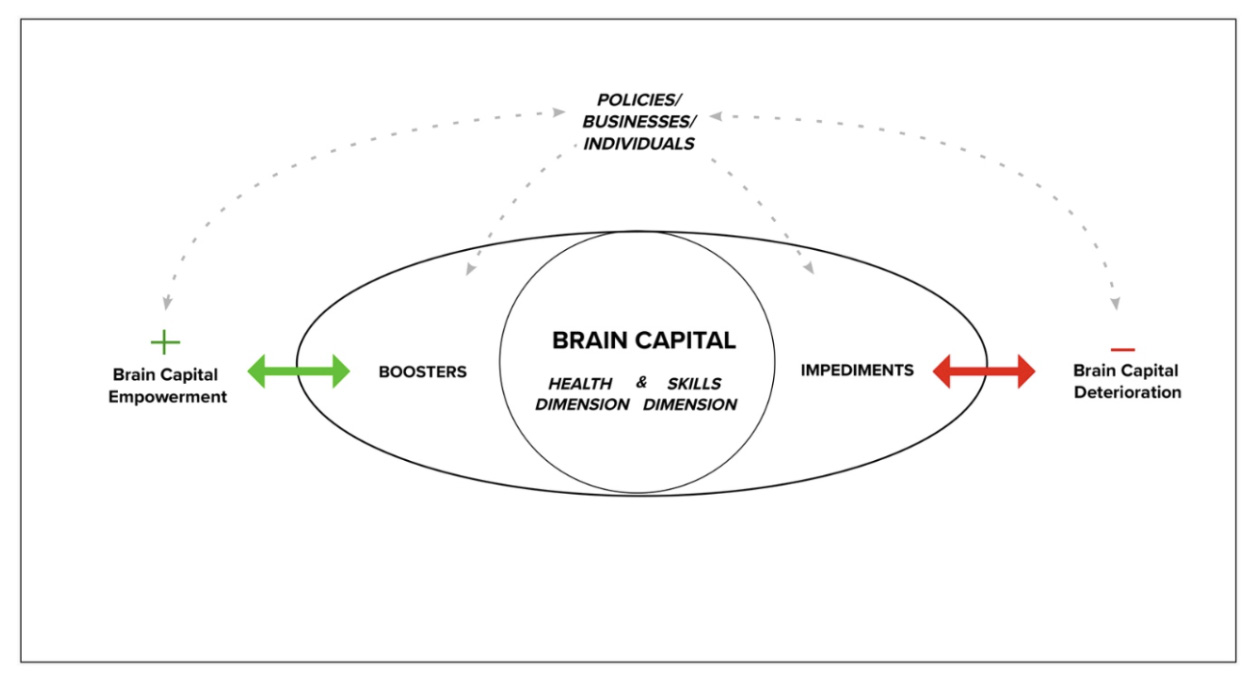
The Index and Dashboard currently draw on measures of education quality, skills, innovation capacity, labour market capability and aspects of brain health for which internationally comparable data already exist. As Ayadi explains, this “reflects what the evidence consistently tells us, that brain capital is multidimensional, and no single indicator can adequately capture it.”
The longer-term ambition is to move from static measurement towards what Ayadi calls a living observatory of brain capital. Brain health, brain skills and the conditions that support them are reported separately before being combined into the overall Index. This can show whether a country performs well in education but poorly in mental health, or has a strong innovation ecosystem but weak prevention. The Dashboard retains these individual dimensions to prevent stronger results in one area from obscuring weaknesses elsewhere.
The question is whether the framework adds enough beyond the Human Capital Index. On paper, it does. Mental health, creativity and cognitive resilience largely sit outside the HCI’s scope. Yet these are also among the hardest dimensions to measure. Where the strongest data already exist, including education, labour outcomes and physical health, the two frameworks cover similar ground.
The larger test is therefore whether concepts such as creativity and cognitive resilience can be quantified rigorously rather than simply included in the framework. Without stronger measures in these areas, the Index risks capturing what is already easiest to measure rather than what makes brain capital distinct.
Ayadi describes brain capital as a living measurement system. Through the Nature Medicine Commission on Brain Health for Economic Resilience, its indicators will continue to be refined as evidence improves. The aim is not to standardise people, but to understand how different societies create conditions that support cognitive potential and wellbeing.
Several areas remain difficult to measure, including cognitive resilience, creativity, social connectedness, emotional wellbeing, lifelong learning, work environments, and the effects of digital technologies and the physical environment on brain health. Digital biomarkers, longitudinal population data, AI and advances in neuroscience may improve the precision and timeliness of these measures. The framework is also expanding across Africa, Latin America, Asia and the Middle East, although uneven statistical infrastructure may limit the availability of comparable data.
The broader ambition is to position brain health and brain skills as economic, innovation and resilience policy rather than healthcare policy alone. This raises a practical question for policymakers over how the Index and Dashboard can be translated into investment priorities, public programmes and measurable outcomes.
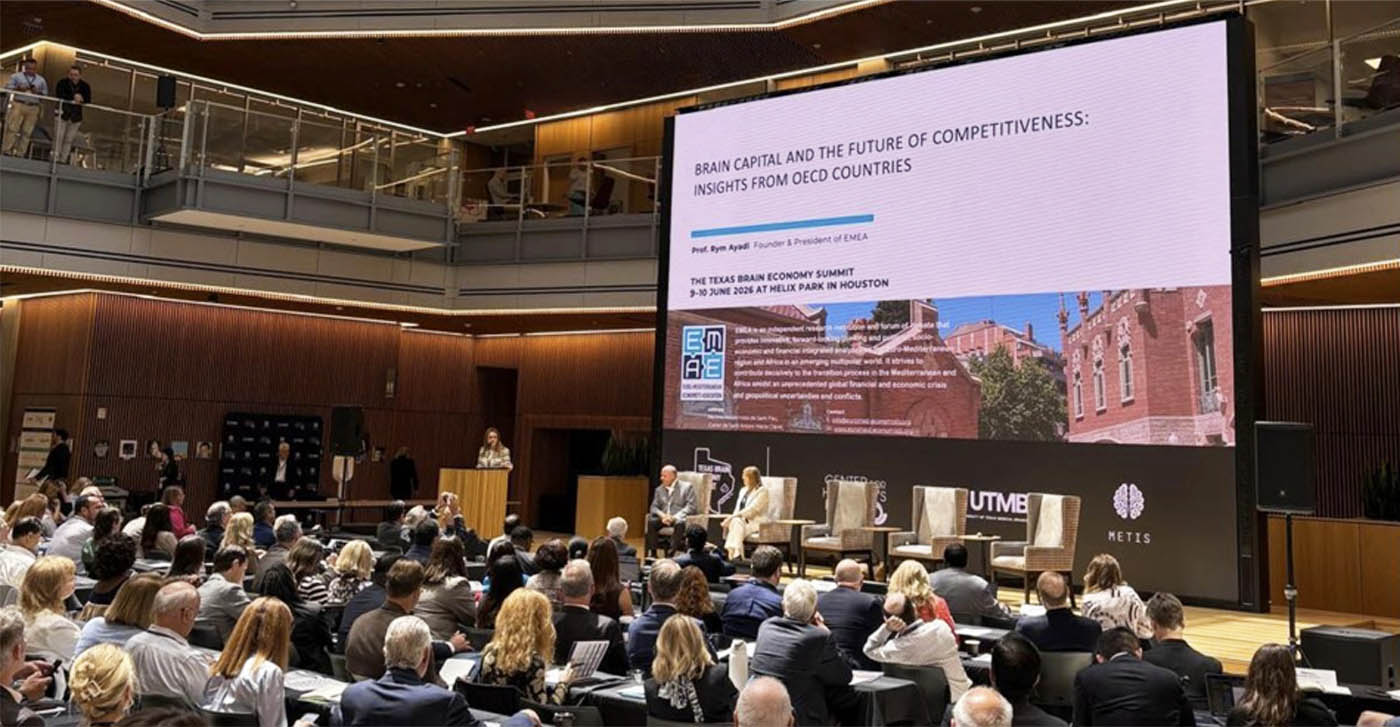
In the United States, this work is being advanced through the Global Brain Economy Initiative and the Texas Brain Economy Summit, where brain capital is increasingly discussed in relation to competitiveness and economic resilience. Canada has brought brain health into wider public policy discussions, while EMEA is supporting work in Spain on a National Brain Economy Strategy and Brain Positive Cities involving policymakers, municipalities, universities and businesses.
For Ayadi, success in five years would not be measured simply by the number of countries using the Index, but by a broader shift in how prosperity is understood. She wants policymakers to consider brain capital alongside GDP, productivity, employment and inflation when designing economic and health policy. Companies would treat it as a strategic investment rather than solely an employee benefit, while cities would support cognitive wellbeing through urban design, education, culture, environmental quality and healthier communities.
More broadly, she argues that “future generations should inherit economies that recognise people not simply as workers or consumers, but as the primary source of innovation, resilience and shared prosperity”. Success, in this view, would mean treating brain capital as a form of national infrastructure alongside transport, energy and digital networks. As Ayadi puts it, “brain capital is to the twenty-first-century economy what physical capital was to the industrial age. If we want economies that thrive in the age of AI, we need to invest in the brains that will shape that future.”
Produced with support from

%20copy.jpg)








.svg)

