

Chinese neurotech is starting to reach global audiences. In March, China was the first to approve an implantable brain interface. Neuracle’s NEO-ONE SCI is an implantable BCI designed to help restore hand movement in people with severe paralysis. But the approval is only one part of a much larger shift. Two of China’s most-funded neurotech companies are now preparing IPOs, each racing to become the country’s first publicly traded BCI company.
Chinese media report that Neuracle submitted IPO materials on June 11, planning to raise RMB 2.5 billion just months after its NEO approval. It is the second major IPO signal this year, after Bloomberg reported that BrainCo had confidentially filed for a Hong Kong listing. Behind those better-known names sits a broader wave of financing. Chinese outlets report 34 neurotech funding rounds in the first half of 2026, totaling more than RMB 4 billion. Neurofounders reviewed public round announcements and identified 12 neurotech-adjacent companies with RMB 100 million-plus funding rounds this year.
Currency note: RMB 100 million converts to roughly $15 million at recent exchange rates. RMB 2.5 billion equals roughly $370 million, while RMB 4 billion is roughly $590 million. Conversions are approximate and rounded.
Neuracle, sometimes translated as Boraycon, is one of China’s more established BCI companies. Founded in 2011, the Shanghai-based firm built its business across EEG systems, research tools, and clinical neurotechnology before moving deeper into implantable systems. Chinese media reports cumulative financing at around RMB 781 million, or roughly $116 million, giving Neuracle a broader financial base to build on.
The company’s public profile changed in March, when China approved its NEO-ONE SCI system for market use. The implant is designed for people with cervical spinal cord injury, decoding motor cortex signals to enable external hand-movement control. It became one of the first invasive BCI systems available outside a clinical-trial setting. Its inclusion in Shanghai’s medical consumables catalogue gives hospitals a formal route to procure the device, although reimbursement is not yet formally established.
Neuracle is now moving that regulatory momentum into the public markets. Chinese media report that the company completed IPO counseling on June 9 and submitted listing materials on June 11 for Shanghai’s STAR Market. The application documents outline a planned RMB 2.5 billion raise to support R&D and industrialization. Together with a reported RMB 3.5-4.0 billion post-money valuation, Neuracle is becoming an early test case for implantable BCI as a publicly traded medical device business.
BrainCo is the other major IPO candidate of the East, but it sits on a different side of the neurotech market. Founded in 2015, the company develops non-invasive brain-computer interface technologies, including bionic hands, EEG training devices, and other consumer-grade neurotechnology tools.
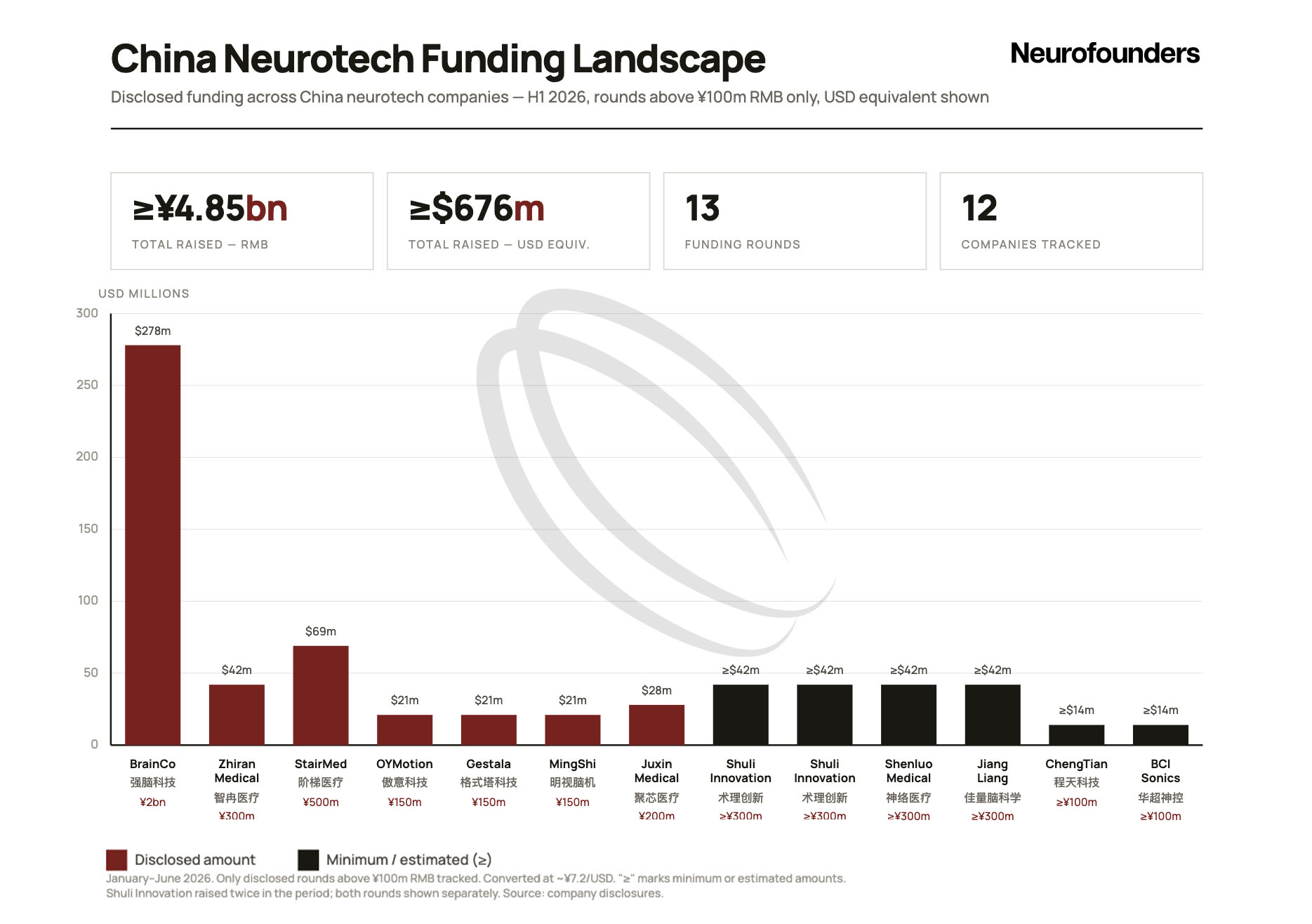
Earlier this year, the company raised the largest private funding round to date in Chinese neurotech, closing a RMB 2 billion (roughly $280 million) pre-IPO round co-led by IDG Capital and Walden International. The round brought BrainCo’s cumulative financing to over RMB 2.5 billion and included an investor base of industrial and hardware-linked groups–key to scaling the supply chain and manufacturing post IPO.
Around the same time, BrainCo reportedly filed confidentially for a Hong Kong IPO. The deal could raise several hundred million dollars, although no public prospectus has been released. Its path differs from Neuracle’s medical device route; BrainCo sits closer to a Hong Kong growth-tech listing, with non-invasive BCI, assistive hardware and consumer-facing neurotechnology as the commercial base.
Neuracle and BrainCo’s IPO plans sit inside a flurry of funding activity. Chinese industry media has counted 34 BCI financing events in the first half of 2026, with disclosed financing reaching over RMB 4 billion. Neurofounders reviewed public round announcements of that cohort and identified 13 neurotech-adjacent rounds of RMB 100 million across 12 companies. The snapshot excludes smaller rounds and near-RMB 100 million disclosures, focusing only on the upper end of the market.
The chart shows a market that is spreading across technical paths. BrainCo’s RMB 2 billion round dominates the landscape, while StairMed’s RMB 500 million strategic financing is notable for bringing in Alibaba and Tencent-linked capital. Below them, large rounds across Zhiran Medical, Shuli Innovation, Shenluo Medical, Jiang Liang, OYMotion, Gestala, MingShi, Juxin, ChengTian and BCI-Sonics show funding across invasive BCI, non-invasive systems, ultrasound interfaces, neurorehabilitation and adjacent hardware platforms.
The financing wave is moving alongside a more formal state agenda. Beijing has moved BCI from a future-industry priority into a standalone industry category, backed by central policy guidance, standards work and medical-device terminology from the NMPA. A separate Neurofounders Deep Dive details 14 of the most striking Chinese neurotech companies, analyzed against the state-oriented backdrop.
Produced with support from

%20copy.jpg)


.jpeg)



.svg)

