

The brain has long been recognised as the body’s most complex organ, but it is now being reframed as something more than a biological marvel. The brain is increasingly seen as an economic force shaping productivity, innovation, and long-term growth through an emerging concept called the “brain economy.”
In this interview, Harris Eyre, a physician, neuroscientist, entrepreneur, and co-lead of the Global Brain Economy Initiative, reframes the brain as the essential infrastructure of the 21st-century economy. He discusses how strengthening brain systems may be key to addressing some of today’s most pressing economic and societal challenges and unlocking up to $6.2 trillion in global economic value.
Launched at the World Economic Forum in Davos earlier this year, the Global Brain Economy Initiative is built around a broad economic argument that countries should treat brain health and cognitive skills as core national assets.
The initiative launched alongside a report from the World Economic Forum and the McKinsey Health Institute. Its central concept is “brain capital,” a framework that brings together two related ideas. The first is mental and neurological health. The second is brain skills, such as learning, problem-solving, communication, adaptability, and productivity.
Together, these are presented as part of the cognitive infrastructure of modern economies. In this framing, brain health is not only a healthcare concern but a variable that shapes education, workforce capacity, innovation, resilience, and long-term economic growth.
For Eyre, this shift is partly inspired by the natural capital movement. That movement helped change how ecosystems were understood, from resources sitting outside the economy to foundational assets that support economic life. Eyre argues that the brain should be viewed similarly.
“I wanted to bring convergence science, modeled on the Medici family’s strategy that fueled the Renaissance, to bear on these brain challenges,” he said.
The broader argument is that economic systems are moving away from purely extractive models and toward more regenerative ones. In that context, Eyre sees brain capital as part of a wider shift in how societies measure value, with long-term human and planetary flourishing becoming more central to economic strategy.
The Global Brain Economy Initiative starts from a simple premise. Modern economies are increasingly constrained by declining cognitive and mental health. Eyre describes this as a “brain economy recession,” a population-level loss of cognitive capacity with measurable economic costs.
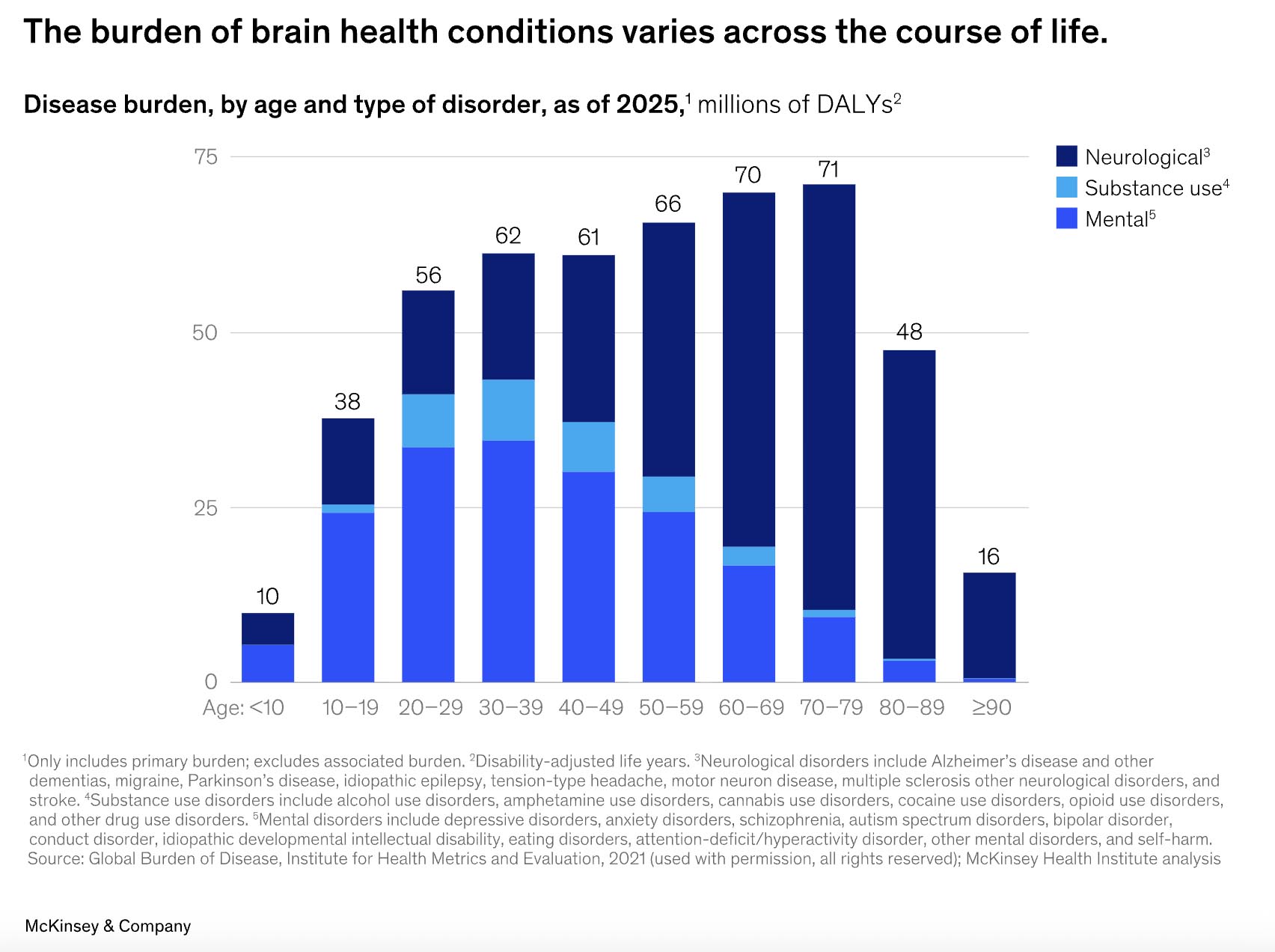
He estimates that impaired brain health already costs the global economy $8.5 trillion each year, largely through lost productivity and rising care needs. Brain health disorders, including mental health conditions, dementia, stroke, and traumatic brain injury, affect more than 3 billion people globally, with prevalence rising as populations age and risk factors such as stress and chronic disease increase.
The consequences extend beyond healthcare. Brain-related conditions reduce labour participation, weaken productivity, and increase pressure on public finances. By 2030, global losses linked to these conditions are expected to exceed $16 trillion annually. In ageing economies, this burden is amplified by rising pension and healthcare costs, a shrinking tax base, and growing pressure on fiscal sustainability.
These trends are unfolding alongside the rapid rise of artificial intelligence, which is beginning to reshape work, productivity, and the distribution of economic value. As cognitive work becomes more automated and augmented, societies may depend even more on the resilience, adaptability, and learning capacity of their populations.
A new economic framework needs ways to measure what it claims to value. Natural capital became more influential as an asset class once it was tied to metrics, disclosure frameworks, and capital allocation. Brain capital is now moving in a similar direction.
In 2026, the Euro-Mediterranean Economists Association developed the Global Brain Capital Index to track cognitive, emotional, and social capabilities across populations. The aim is to make brain health and brain skills more visible in economic policy, and to guide investment toward education, mental health, and resilience rather than relying only on GDP.
Policy is beginning to follow. In 2025, Argentina became the first country to pass national legislation explicitly focused on brain health promotion. The law goes beyond advisory, creating enforceable obligations that span administrations, including education-based awareness campaigns, expert governance structures, and annual reporting to Congress. It reframes brain health as part of public health and human development, rather than a set of isolated clinical conditions.
The law was spearheaded by Professor Facundo Manes, an Argentine neurologist and politician. For Manes, the goal was to move from fragmented care toward prevention. “We needed to stop treating brain health as isolated diseases and start treating it as a national priority,” he said. The model is now being studied across Latin America as a possible blueprint for brain health governance. Manes frames the challenge directly.
“The gap between science and policy is not knowledge, it is courage.”
For CEOs, Eyre frames the issue in direct terms. “Your most important asset walks out the door every evening. It’s the brains of your employees,” he says. When employees are fatigued, stressed, or poorly supported, productivity, creativity, and decision-making decline. In this framing, brain health is a core part of organisational performance.
Some companies are beginning to apply this logic to the built environment. JLL, the global commercial real estate and workplace strategy firm, has integrated workplace neuroscience into office design and operations. HKS, an international architecture and design firm, has also developed “brain-healthy” environments intended to support focus, recovery, and cognitive performance.
Eyre argues that the conversation is moving from general interest to implementation. “We are moving from asking ‘is this nice to have?’ to ‘how fast can we operationalise this?’” he says. Tools such as the HERO Brain Health Scorecard and frameworks from the McKinsey Health Institute are already helping companies translate brain health into measurable workplace strategy.
Scaling the brain economy will require public-private partnerships, and Eyre is aware that “this isn’t a single-sector problem, it sits at the intersection of health, education, technology, and finance.” No one sector has the full stack. Governments bring policy and scale, the private sector brings innovation and capital, and philanthropy helps de-risk early ideas. The challenge, Eyre argues, is alignment.
“In practice, these partnerships are not just collaborations; they are market-making mechanisms,” Eyre says. This means building ecosystems, supporting real-world pilots, and designing investment pathways. “That’s how brain capital moves from concept to investable system.”
Eyre acknowledges that brain capital still faces major barriers across healthcare, education, employers, and government. “There are cultural barriers, where brain health is still seen as a ‘soft’ issue rather than core economic infrastructure,” he says. “There are regulatory silos across healthcare, education, and labour policy that don’t naturally align. And there are structural challenges around measurement and capital allocation, where brain capital has historically been invisible.”
For Eyre, those gaps define the opportunity. The field now needs shared language, clearer metrics, and stronger evidence linking brain health to productivity, resilience, and growth. It also needs mechanisms that can move capital into brain health, education, prevention, and workplace resilience at scale.
He often returns to a simple idea. “Luck is what happens when preparation meets opportunity.” In his view, much of the preparation is now in place through frameworks, indices, and cross-sector coalitions. The next phase is implementation.
One example is the $3 billion Dementia Prevention and Research Institute of Texas bill, which has helped catalyse initiatives such as Houston Project Metis. Eyre also points to a county-level U.S. Brain Capital Index and the possibility of a national U.S. Brain Economy Project aligned with the country’s 250th anniversary. “The brain economy is more than just an idea; it’s a plan with a roadmap,” he says.
The grand task now is to turn that roadmap into deployment across cities, health systems, startups, workplaces, and public institutions. If productivity, innovation, and decision-making depend on the quality of population brain health, then the economic question is not only how to build systems that scale. It is also how to sustain the brains that run them.
.svg)





.jpeg)


%20copy.jpg)
%20copy.jpg)