

Brains and computers have long been used as metaphors for one another. Computing borrows the language of neurons, learning, and memory, while neuroscience borrows the language of circuits, signals, and computation. With the rise of biocomputing, which uses living neurons as part of a computational system, that metaphor is becoming more literal. Over the past few years, several biocomputing companies have begun bringing the field into public view.
Australia-based Cortical Labs is a forerunner in this emerging field. Since 2019, the company has been building the hardware and software needed to integrate neurons with computing systems. The startup made headlines a few years ago for teaching a neuronal culture to play Pong. Now, with the launch of Cortical Cloud, which gives researchers and companies remote access to Cortical’s biocompute platforms, the company is placing access, experimentation, and collaboration at the centre of its approach to biological computing.
After leaving clinical medicine and exiting a medtech startup, Cortical Labs founder Dr. Hon Weng Chong turned his attention to machine learning and found himself drawn to a neuroscience-inspired approach. He wandered into a neuroscience building and asked scientists what got them out of bed in the morning. They excitedly showed him neurons growing on microelectrode arrays, research tools that can stimulate living neural circuits and record their electrical activity, commonly in the context of drug discovery.

Chong saw an opportunity. “We know that brains can exhibit intelligence and compute. Therefore, the neurons must be doing some form of computation to have this intelligence,” he explains to Neurofounders.
That insight led to the company’s founding question and helped secure Cortical Labs its first cheque. “Why hasn't anyone tried to get the neurons on a chip to also exhibit some sort of intelligence? If we could harness these neurons to perform some intelligence, then we have unlocked a computing capability of these biological substrates.”
Cortical Labs describes this new computing paradigm as “wetware”, with living neurons used as an active computational substrate. Unlike silicon computing, wetware cannot simply be plugged into today’s computing ecosystem. There is no biological equivalent of NVIDIA for chips, Apple for integrated devices, Microsoft for operating systems, or AWS for cloud access.
Cortical Labs has therefore had to build the full stack itself. This includes the machines that keep neurons alive, the hardware that connects to them, the software that communicates with them, and, more recently, cloud infrastructure and an SDK that let others around the world experiment with the system.
Cortical’s early research platform, DishBrain, demonstrated the wetware concept by placing a culture of 800,000 neurons in a closed-loop simulated game environment. Electrical stimulation represented the position of a Pong ball, while the neurons’ activity controlled the paddle. The experiment showed that these cultures could improve their performance over time, helping establish Cortical Labs’ core thesis that living neural systems can be studied not only as cells, but also as information-processing systems.
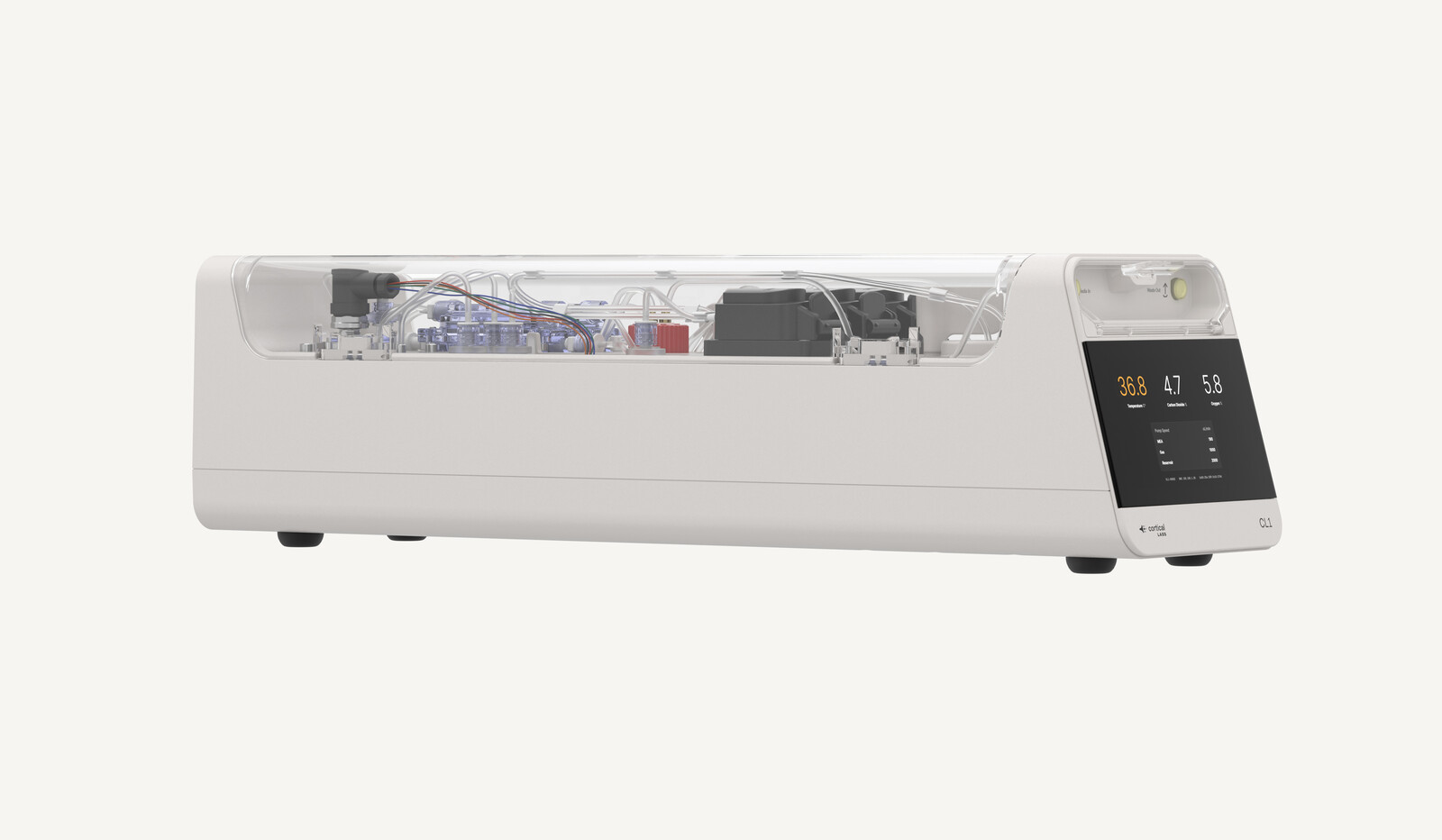
The company has since moved from a research demonstration towards commercial infrastructure. Its flagship product is CL1, a self-contained biological computer announced in 2025. The system integrates lab-grown human neurons on an electrode array within a unit equipped with pumps, gas mixing, temperature control, and filtration, designed to keep the neurons alive and functioning for months.
Alongside CL1, Cortical Labs offers Cortical Cloud, a “Wetware-as-a-Service” model that lets researchers access biological neural networks remotely through a Python SDK and browser-based tools, without needing a specialised wet lab of their own. Underpinning both is the company’s biOS, or Biological Intelligence Operating System. It creates simulated environments, sends information to the neurons through electrical signals, and reads their responses back into the system as part of a closed feedback loop. As a proof of concept, a team in the US recently used the cloud to train a system to play Mario Kart.

Cortical Labs is not driven by industry demands or trends, but by where the science leads. Central to Cortical’s mission is open science and a strong belief that breakthroughs cannot be orchestrated alone. “A lot of [success] is a combination of factors that founders and people building core fundamental technologies can’t control,” says Chong.
Chong points to the AlexNet moment in the history of AI as an example. The modern deep learning boom did not emerge from a single invention. Neural networks had existed for decades, while GPUs were originally built for graphics. Large datasets, largely absent in the 1980s and 1990s, were accumulating online. In 2012, those elements converged when Alex Krizhevsky, Ilya Sutskever and Geoffrey Hinton used GPUs to train AlexNet, dramatically outperforming older computer vision methods and helping launch the modern AI era.
Wetware may follow a similar path. Cortical Labs does not claim to know which application will define biological computing. Instead, it is focused on creating the conditions for breakthroughs by making its tools accessible to people with different questions, backgrounds and assumptions.
“The best way to improve any chance of success is to increase the entropy,” Chong says. For Cortical Labs, openness goes beyond being a cultural value, forming the basis of its discovery strategy. Widening access to the platform, encouraging collaboration and allowing unexpected applications to emerge may help create the field’s AlexNet moment.
Making the technology accessible has already revealed demand from a wide range of users. Cortical Labs’ early customers include corporate R&D labs, biopharmaceutical companies, robotics and AI companies, and individuals exploring uses in health, longevity and even cryptography. Chong is especially keen to see new ideas and ambitions enter the field, and hopes to see three to five commercially viable applications emerge over the next five years.
Biological computing brings together terms such as “living neurons”, “sentience”, “brain-on-chip”, “intelligence” and “cognition”. For those unfamiliar with neuroscience or academia, that language can evoke dystopian images of brains in jars or conscious machines.
Cortical Labs sees part of its role as educational, explaining what its systems are, what they are not, and how they differ from more familiar cell-culture or AI technologies. Many labs have long grown neurons in petri dishes or on multi-electrode arrays, stimulating and recording them for drug discovery, disease modelling and basic neuroscience. Cortical Labs has built out the infrastructure around this system, creating a bidirectional interface between living cells and digital hardware.
Whether this should be called a “brain” depends partly on what society means by the word. Some would say a brain is an organised organ embedded in a body, shaped by development, sensory input, physiology and behaviour. By that standard, a neural culture connected to a digital environment is not a brain in the ordinary sense. It does not have the structure, body, developmental history or lived context of a biological brain. But it may still be able to process information, respond to feedback and learn in simplified ways. As such, it cannot be treated solely as hardware or software.
The company is careful not to position itself as the sole authority defining the field. Rather than controlling the narrative, Cortical Labs has advocated for open discussion and called for consensus around the concepts and terminology that biological computing will rely on. In a dedicated paper on disagreements over language, the company highlights the growing importance of this issue beyond biocomputing, as intelligent systems emerge across multiple substrates, from artificial intelligence and autonomous systems to organoids.
Without shared definitions, Chong argues that the field risks being shaped by misunderstanding before the science has matured. Clear language will be essential not only for public trust, but also for scientific progress. Researchers, companies, ethicists and regulators need to know whether they are talking about cognition, intelligence, sentience, consciousness or something else entirely.
Cortical Labs may not know which application will define biological computing. The company is betting that by grounding progress in scientific discovery, making tools accessible and encouraging collaboration, it can create the conditions for biocomputing’s AlexNet moment. First, however, it is encouraging the community to reach greater consensus on key concepts and contribute to the ongoing ethical discussion, including conversations that other industries such as neurotechnology will also need to engage in.
Produced with support from

%20copy.jpg)





.svg)

