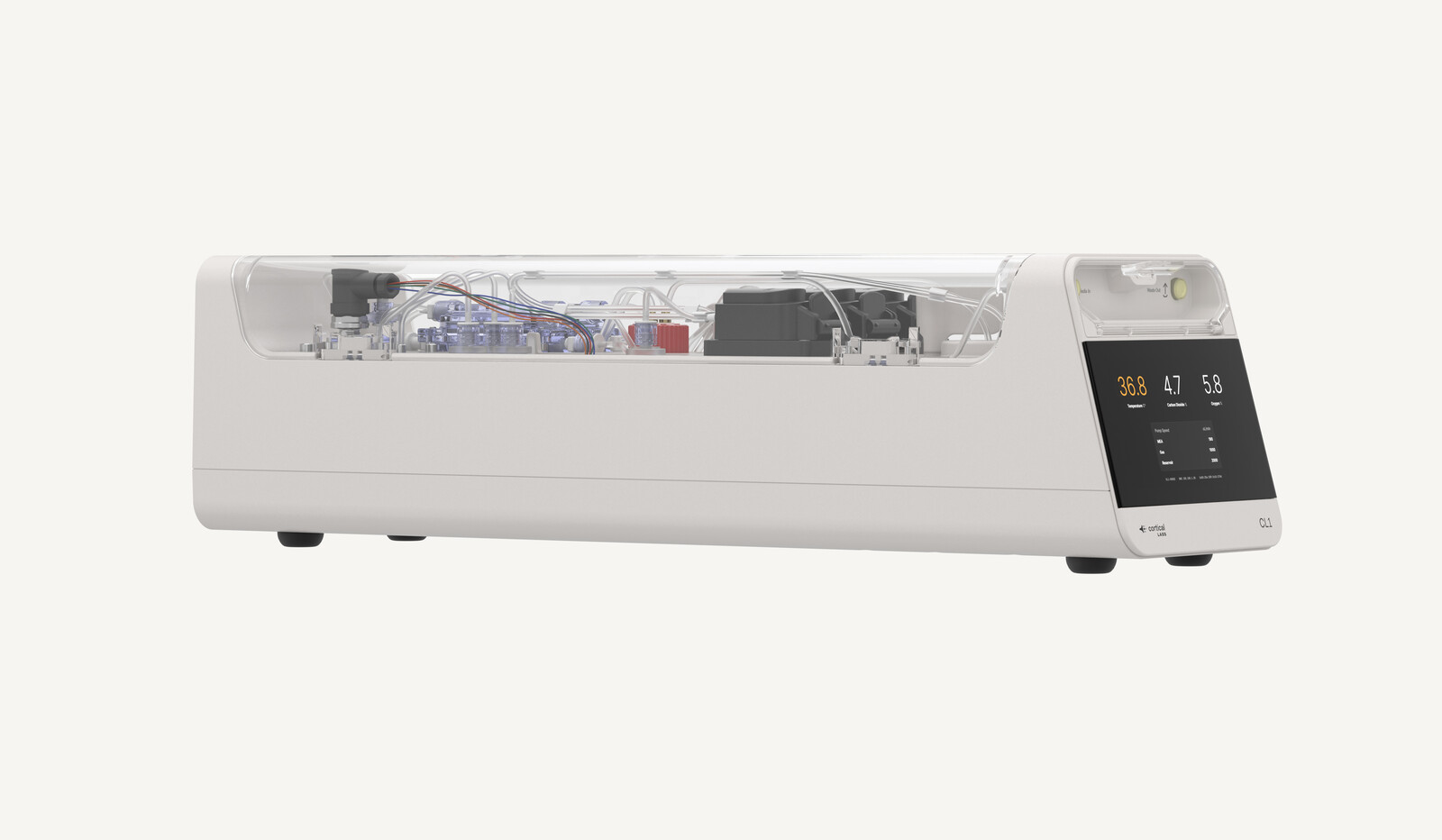

Brain-computer interfaces have come to dominate the public imagination of neurotechnology. But alongside that headline-grabbing world, another corner of the field has been flipping the script. Instead of putting chips into the brain, it puts brains on a chip: specific neural cells arranged on a carefully designed platform to recreate a circuit, pathway, or interaction found in the body.
These brains-on-chips, also called neural organoids, are built to answer bounded questions that are key in preclinical research: how a new compound changes neural activity, whether drugs damage a circuit, or how a patient’s own cells react to interventions. Using human cells, organoids offer a model that more closely reflects our biology than animal models currently used; a key innovation, as pressure grows to improve how we test drugs, model disease, and generate data beyond what animal models can provide.

One of the firms pioneering this field is NETRI, a French company that shows how brain-on-chip is moving from academic proof-of-concept toward usable drug discovery infrastructure. Founded in 2018 by Thibault Honegger, a scientist who left academia to develop new tools for neurological disease research, the company treats neurons as sensors, turning the electrical activity of organs innervated by sensory neurons into functional signatures that can flag toxicity, predict side effects, and anticipate compound failure weeks or months earlier in development than current methods allow.
NETRI operates a 1,100m² production facility in Lyon capable of manufacturing up to 500,000 devices per year; less a research lab than an industrial-scale platform for brain-on-chip testing.
The name invites misconceptions. There are several flavours of ‘brains’ and several flavours of ‘chips’. The ‘brain’ is not a full replication of the human brain, but specific neural cells integrated into a carefully engineered platform designed to model a circuit, pathway, or connection found in the body.
Earlier versions of these systems emerged through microfluidics work such as that of Anne Taylor at UCI. For neuroscience researchers, they offered a more reliable alternative to the painstaking process of preparing dishes to guide neuron growth, then destroying the cells to analyse them. Neuron-on-chip systems could be fabricated faster, more consistently, and enabled real-time imaging. Just as important, their compartmentalised design let researchers isolate different sections of the neuron and better distinguish local effects.
Over time, single-neuron models gave way to systems that included multiple neural cell types, allowing researchers to recreate more complex circuits such as the basal ganglia loop. As NETRI founder Thibault Honegger puts it, “Neural cells are not really useful if they don't take a message, process it, and send it on. You need the loop.”
Modern models can incorporate excitatory and inhibitory neurons, central and peripheral cells, and supporting glial cells. They can also be extended beyond neural tissue alone, linking neurons with liver, lung, or skin cells on chips. NETRI takes this a step further by using neurons themselves as sensors, with electrical activity serving as a real-time readout of what is happening in the organ.
The chip itself has also evolved with the introduction of multi-electrode arrays, or MEAs: grids of electrodes embedded in the base of the device that record signals from the cells.
The significance of continuous electrical recording is that it changes the kind of data these systems can produce. Standard biological assays are often destructive. To measure what is happening inside a cell, researchers may need to lyse it and analyse its contents, producing a snapshot while destroying the sample itself. MEAs make it possible to follow activity over time instead, observing how cells respond to drugs while preserving the option for downstream readouts such as omics and imaging afterwards.

Brain-on-chips sound compelling, but what can they actually be used for? “They are models. They are here to answer a specific question. Not to model the entire body,” Honegger says. One clear application is preclinical drug screening. NETRI’s devices are designed to be simple, standardised, and high-throughput because, as Honegger notes, for “most of the pharmaceutical industry, they don’t need a system more complex than a model of the circuit”.
What they need is a reliable readout that can predict whether a compound contributes to peripheral neuropathy or disrupts inhibitory signalling in a dopamine circuit. These are bounded questions that do not require the entire cortex to answer.
Compared with animal systems, these models may offer a closer view of human biology because they can be derived from human samples. That does not mean animal testing is disappearing. Honegger expects it to remain part of drug development for at least another 20 years. But NETRI’s work points to a supplementary tool: a human-relevant system that can interrogate what a compound does to a neural circuit in real time, before a single patient is enrolled.
NETRI has already shown the potential of its platform to anticipate whether a chemotherapeutic compound will cause neuropathic pain. By exposing circuits of sensory neurons and skin to drugs known to induce pain, and recording the resulting neural activity, the company can identify which activity patterns correlate with pain. Investigational compounds can then be compared with those known pain-inducing profiles. There is no direct animal equivalent to this kind of readout. At best, animal pain is still inferred through human interpretation of behaviour.
This is one of NETRI’s core offerings, and it is notable for two reasons. First, it advances the idea that neural activity itself can serve as a rich source of biological insight, what NETRI calls the Neuron as a Sensor. Each compound produces a distinct electrophysiological signature, helping build a map of how neuronal responses shift under drug exposure, whether in firing patterns, burst duration, or excitability.
Second, that library becomes training data for AI, which can learn to interpret the functional meaning of different activity patterns and, eventually, predict where a compound is likely to fall on that map and what it is likely to do in a human system.

For Honegger, adoption looks like “a standardised methodology approved by regulatory bodies that could anticipate failure.” If drug discovery platforms like NETRI can reliably predict which drug candidates are likely to fail in clinical trials, they become immediately more useful than animal models for certain preclinical questions.
Standardisation and high-throughput capability are the other side of that equation. The field has produced many elaborate and academically interesting devices, but pharmaceutical companies need something simple that can run at scale. That is why NETRI and others are already working to standardise 96-well plate formats.
The regulatory environment is shifting too. In December 2022, the FDA Modernization Act 2.0 removed the animal testing mandate that had been in place since 1938, formally allowing preclinical data from cell-based assays, organs-on-chips, and AI-based methods to support progression toward human trials. It was an important signal. Now, time will tell what role organ-on-chip systems can play in pharmaceutical development and beyond.
“We will not be able to reproduce an entire body-on-chip,” Honegger says, referring to the more ambitious promises that circulated a decade ago. But the field is moving toward multi-organ systems, connecting different organ models through innervation and vascularisation to better understand how they interact. In that sense, the technology is returning to its original premise as a scientific instrument.
In the near term, NETRI is working with European regulatory bodies to use its platforms to anticipate the neurotoxicity of pesticides. Honegger believes that within a few years these systems could be used alongside AI to iterate more quickly on molecular design; a feedback loop in which the chip shows what a compound does, and the model suggests what to change.
There is also a more radical implication, one that touches another active frontier in neurotechnology: personalised medicine. Today, treatment for some neurological and psychiatric conditions still involves significant trial and error, with patients cycling through drugs until something works. In the future, that process could look different. Take a patient’s skin cells, reprogram them into neurons, grow a patient-specific circuit on a chip, and test compounds on those cells to predict responses before a prescription is written.
Honegger also points to biocomputing as another direction in which brain-on-chip may develop. Extending the idea of Neurons as a Sensor, neural circuits would not only act as models of biology, but as processing substrates in their own right, systems tasked with performing computational functions.
What is happening in brain-on-chip today is not the arrival of science fiction. It is the gradual emergence of a serious technological category. Less about building a brain, and more about building tools that help us understand one.
.svg)