
By now, most people know what a large language model is. Used by nearly a billion people each week, LLMs have reached this point by building on troves of publicly available text. Neurotech presents a harder version of the same model-building challenge: brain foundation models. The field is building towards large neural-data models that can generalize across populations and bring brain signals into daily life. But unlike text, brain data is not available to scrape online.
Brain sensing is increasingly moving into real-world environments. EEG systems can already support task-specific classifiers for sleep staging, seizure monitoring, workload measurement, and more. But classifiers are tied to the setup they were built for. Brain foundation models are more flexible, pretraining neural encoders on large datasets and integrating brain-body-context signals to create rich, generalizable applications. The main question now is how to collect real-world, longitudinal brain data at scale ethically.
EEG has been used in research for more than a century. For much of that history, analysis focused on detecting recognizable signal features such as band power, power spectral density, time-frequency patterns, and establishing correlations between those features and external variables. Feature-based analysis is grounded in decades of neurophysiological research. It remains central across many applications, where features such as frequency bands and event-related responses can serve as useful endpoints.
But with the rise of machine learning, these features increasingly became inputs for classifiers. Algorithms combine multiple measurements and translate them into outputs that are easier for users or product teams to interpret. Sleep models classify sleep stages. Workload models estimate cognitive demand. Motor imagery models translate imagined movement into control commands. These outputs cannot be read directly, requiring models that learn the relationship between signal patterns and labels across larger datasets.
Classifiers are now used across neurotechnology. Trained under controlled conditions, with clear tasks, labels, and recording setups, their outputs can be narrow enough to reach product-level reliability. In EEG, this has enabled systems for sleep staging, seizure monitoring, workload measurement, fatigue detection, attention tracking, and more. The same logic is applied in the rapidly evolving BCI field, where electrical brain activity is decoded into external commands or communication outputs. In each case, the classifier works because the question is constrained enough for the model to answer.
Yet the narrowness of classifier models is also their largest downside. EEG is rarely as clean or stable as, for example, a heart-rate measurement. Electrode placement, fit quality, skin contact, movement, environment, device specifications, and noise all introduce variability. And so, a model trained in one condition often needs adaptation in another. Foundation models are the proposed next step. Rather than rebuilding each classifier around each context, they create reusable neural encoders that adapt across tasks, devices, and users.
Instead of starting with one task and training one model, brain foundation models are pretrained on large neural datasets and then adapted to a range of downstream tasks. In EEG, this often involves self-supervised learning, where a model learns from large amounts of signal data without a human labelling every segment. One common approach is to hide part of a recording and train the model to predict what is missing.
The core idea follows the same broad logic as language and vision models. Larger and more diverse datasets should help models learn representations that transfer beyond one task, user, or recording setup. Several examples already exist.
LaBraM, or Large Brain Model, was pretrained on roughly 2,500 hours of EEG from around 20 datasets and evaluated across abnormal detection, event classification, emotion recognition, and gait prediction. CBraMod learns spatial and temporal structure from EEG and adapts across downstream BCI tasks. NeuroLM applies a language-model-style approach with EEG token sequences, while BrainOmni attempts to unify EEG and MEG across different sensor layouts.
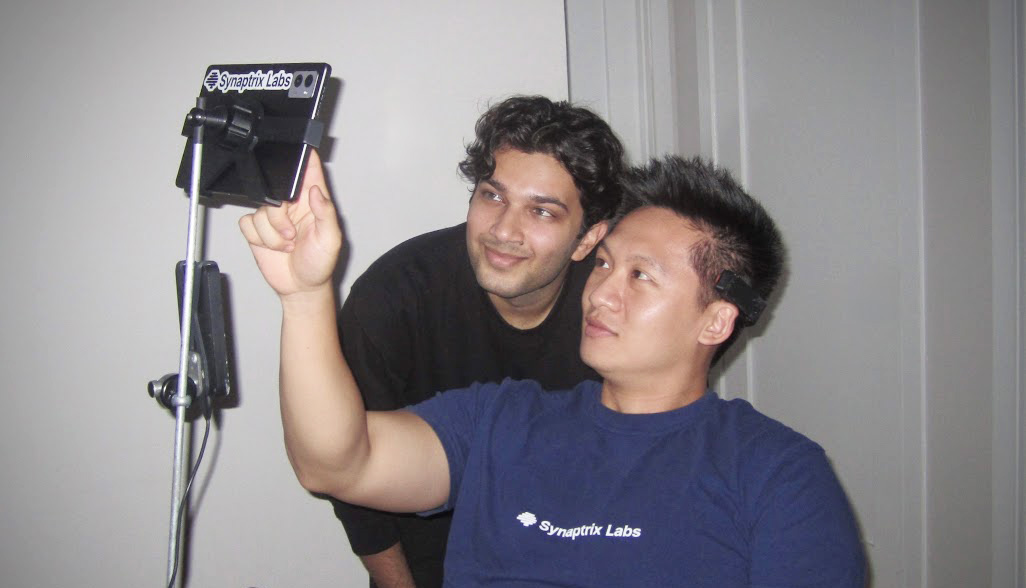
A more productized example comes from New York-based Synaptrix Labs. The non-invasive BCI firm is developing AI systems for neural decoding across a range of applications. Synaptrix defines itself more as a software company than its hardware-centric peers. Its first use case decodes motor imagery to enable wheelchair control for people with paralysis. Synaptrix envisions users controlling motorized wheelchairs throughout the day and across environments, requiring models that can adapt beyond a narrow lab-trained classifier.
As brain foundation models develop, a clearer set of challenges is emerging. Strong performance on one EEG task does not guarantee success on another. Yet the rapid proliferation of models has made direct comparison difficult. Initial reviews and benchmarks present a balanced view. In some domains, specialist models remain competitive with foundation approaches, especially when foundation models are trained on smaller, fragmented, or inconsistent datasets.
The largest challenge in scaling foundation models is the data bottleneck. Text and images already exist at scale online, feeding language and vision models. EEG must be collected through physical hardware, one user at a time. Beyond the signal itself, data requires context: what task was the user doing, which environment were they in, and were other signals such as IMU, audio, PPG, or heart rate recorded? A larger dataset can create a more generalizable model. A richer dataset extends what the model can interpret.
Beyond the logistical challenge, there is a sharp ethical boundary. LLMs already faced scrutiny for training on written expression. Brain foundation models record neural activity itself, creating a sensitive data problem. Governance therefore has to sit close to operations, with neurotech firms increasingly expected to adopt explicit consent, privacy, and data-use protocols. UNESCO’s 2025 Recommendation on the Ethics of Neurotechnology formally raised the stakes, treating neural data and data that can infer mental states as requiring special safeguards around privacy, consent, security, anonymization, and responsible use.
EEG is only one measure of the body, and not even the only brain signal that can support foundation-model work. Richer datasets can create richer applications, especially when brain signals are combined with body and context signals. In this direction, EEG signals can be triangulated with physiological data and contextual clues.
The rise of wearable sensors has made large-scale physiological data collection more accessible. Google’s wearable foundation model shows what type of scale can now be reached. The model was trained on up to 40 million hours of in-situ wearable data, collected from more than 165,000 people. The model integrates signals such as heart rate, HRV, electrodermal activity, accelerometer data, and skin temperature.
Big tech has also attempted to scale brain models. In March, META’s Fundamental AI Research group, FAIR, released TRIBE v2, a tri-modal foundation model designed to predict human fMRI responses to video, audio, and language. The model was trained on more than 1,000 hours of fMRI data collected across 720 subjects. According to FAIR, TRIBE v2 outperformed baselines and could reproduce established neuroscience findings in simulation. It follows Brain2Qwerty, an earlier FAIR model which decodes typed sentences from non-invasive EEG and MEG while participants typed memorized sentences.
Scaling EEG foundation models in a similar direction will require broad consumer adoption of EEG wearables. That raises the question of which form factor can actually reach daily use. For IDUN Technologies, the answer is in-ear EEG. Earbuds are already worn throughout the day, sit close to the head, and can combine EEG with motion, audio, and other sensor inputs. Apple’s latest AirPods Pro show the direction of travel, adding heart-rate sensing while patenting a rich EXG stack design for a future iteration.
For IDUN, the foundation-model shift starts with the data layer. The ETH Zurich spin-off was founded in 2017 and has built much of its stack around the materials, sensor integration, and software infrastructure needed to scale consumer in-ear EEG. Its dryode® material is designed to measure high-quality ExG through soft, flexible electrodes and has become a core component in IDUN’s brain-sensing earbud platform.
Earlier this year, IDUN previewed Guardian 4, the latest version of its earbud platform. The system combines an earbud form factor with Qualcomm’s S7 audio platform, microphones, ANC, Analog Devices’ bio-sensing front end, dual-channel EEG, IMU, and edge processing. In its next iteration, Guardian 5, the company is working toward a true-wireless EEG form factor built around the same stack, with a low-latency, high-privacy edge-cloud architecture.
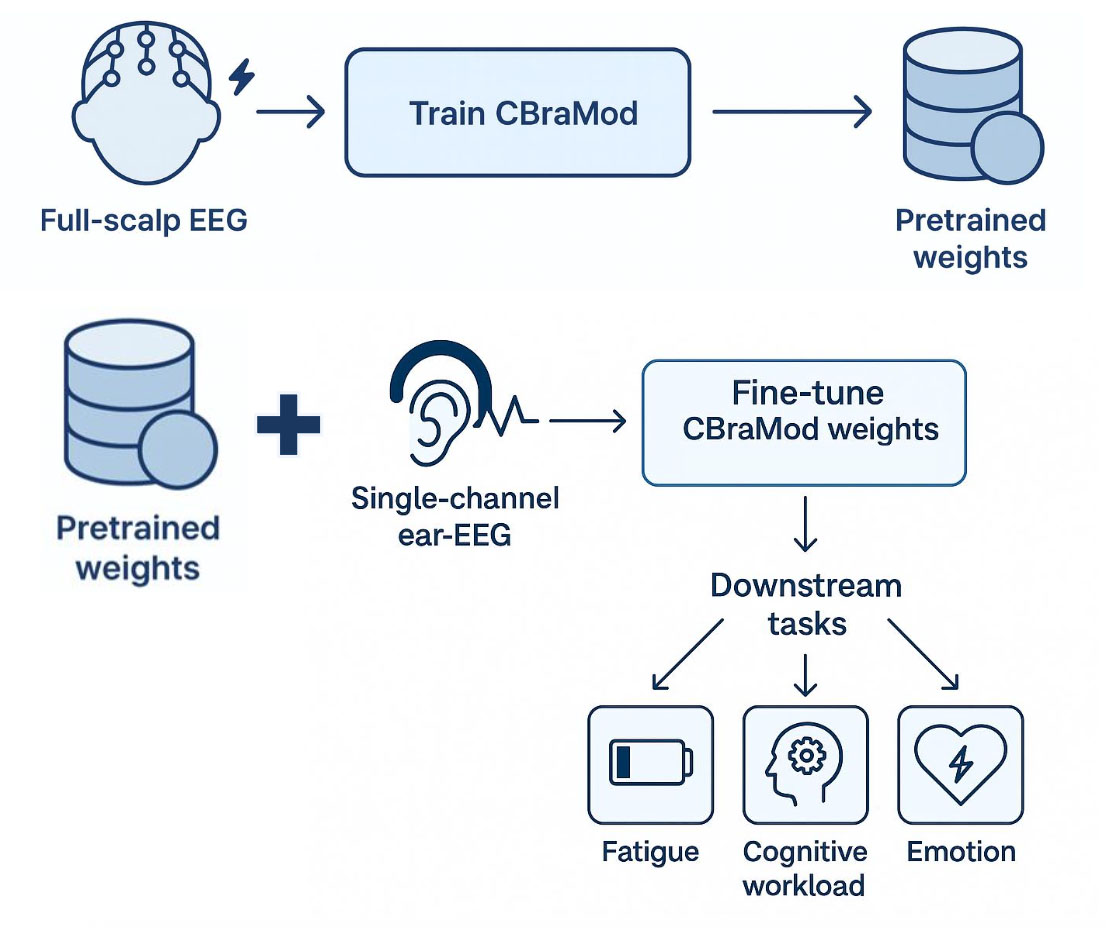
IDUN has previously worked with French AI startup Sigma Nova to test whether a brain foundation model can be adapted to consumer EEG. The team took an EEG foundation model trained on scalp EEG and fine-tuned it using IDUN Guardian recordings for sleep-stage classification. The model reached a Cohen’s kappa of 0.727, within 0.08 of PSG recordings, which are the gold standard in sleep staging. In that pilot, IDUN found that subject diversity mattered more than recording depth, concluding that adding more subjects provided more value than adding extra sleep recordings from existing users.
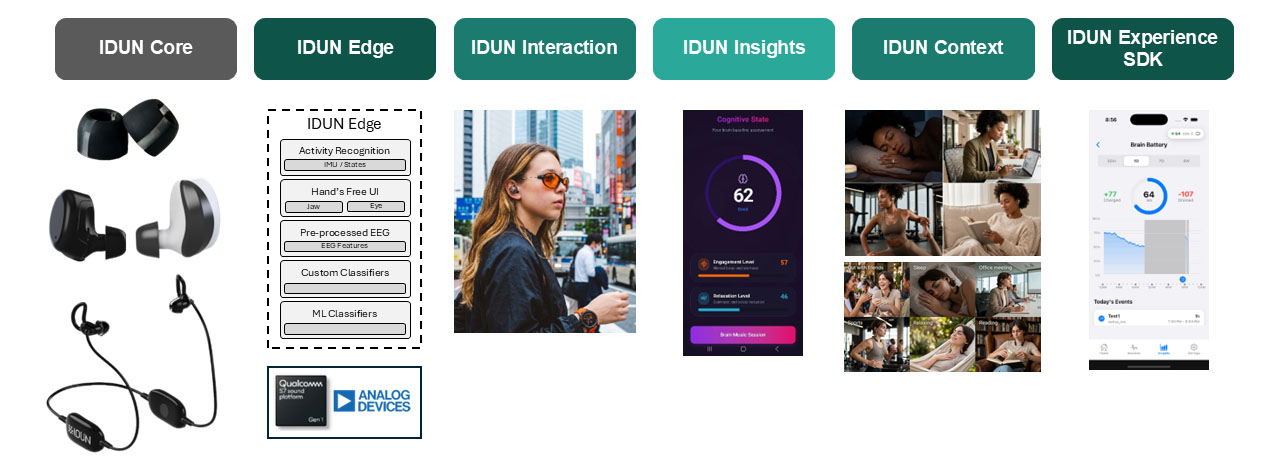
IDUN’s product stack goes beyond dry-electrode earbuds. Its Brain Sensing Integration Package starts at hardware design through IDUN Core, then extends into embedded EEG and audio processing through IDUN Edge. From there, IDUN moves toward consumer-ready use cases. Interaction covers EEG-enabled hands-free UX, Insights turns abstract neuroscience into concrete outputs, and Context connects measurements to lifestyle and app context. For product teams, the final layer is Experience, an SDK that helps partners build neuroadaptive products without needing to become EEG experts.
EEG is moving from handcrafted features and task-specific classifiers towards generalizable neural encoders. Over time, these models will likely become multimodal, combining brain signals with physiology, behavior, and environmental context. But brain foundation models are still early. Benchmarks show promise while also revealing unresolved problems in generalization, evaluation, device transfer, data quality, and labelling. Model architecture matters, but the field is shaped just as much by data access, deployment, privacy, and trust.
For these models to approach the same adoption curve as language models, the field needs real-world brain data at scale. That requires sensors people can wear repeatedly, across daily contexts, with enough comfort, signal quality, and consent to support longitudinal learning. Earbuds are one of the more plausible routes, as they are already used at scale. If in-ear EEG can become part of that everyday layer, brain signals may move from isolated experiments into systems people use throughout their day.
Exploring In-Ear EEG is a five-part article series exploring the current landscape of consumer in-ear EEG technology. The series is produced in partnership with IDUN Technologies, a Swiss start-up leading the push for full-wireless in-ear EEG technology. The series covers the core use cases of in-ear EEG today, the main form factors of consumer ExG, and the overall market in 2026.
Read the full series.
.svg)