

BrainCo has just closed one of the largest financing rounds in the history of neurotech. The Hangzhou-based company raised roughly RMB 2 billion (±$285 million), a sum that is second only to Neuralink in BCIs. The scale of the round is striking not just for its size, but for what it represents: a non-invasive BCI company, built around EEG, education-adjacent training tools, neurofeedback, and rehabilitation hardware, now operating at a capital level typically reserved for invasive platforms.
For years, BrainCo has occupied an ambiguous position in global neurotech coverage. Inside China, its headbands and prosthetic systems are widely deployed and closely watched. Outside it, the company is often treated as a less serious consumer EEG outlier, peripheral to the main BCI narrative unfolding around surgical implants and hospital trials. This raise collapses that distinction. It pulls BrainCo into the same funding tier as the field’s most visible players and exposes how incomplete prevailing BCI rankings remain when China’s scaled, commercially deployed systems are left out of the frame.
The financing round was announced last week and totals roughly RMB 2 billion, or about $280-286 million at current exchange rates. Reporting indicates the round was led by China-focused venture capital, with participation from industrial partners tied to optics and electronics manufacturing, reinforcing BrainCo’s positioning as a hardware-intensive neurotech company embedded in domestic supply chains. The capital is expected to support continued research and development alongside expanded production capacity and commercial rollout. In parallel, Bloomberg reporting hints at BrainCo secretly filing for an IPO on the Hong Kong exchange, adding even more momentum.
BrainCo, formally known as 强脑科技 (Qiangnao Technology), was founded in 2015 and is based in the Hangzhou area of Zhejiang province. Its early development is often traced to the Harvard Innovation Lab, where initial work on EEG-based interfaces was reportedly carried out before the company shifted much of its operational centre to China. While details of its early capitalization and ownership structure are unevenly disclosed, the company has benefited from proximity to China’s hardware ecosystem and regional government support, allowing it to move quickly from prototypes into large-scale deployment.
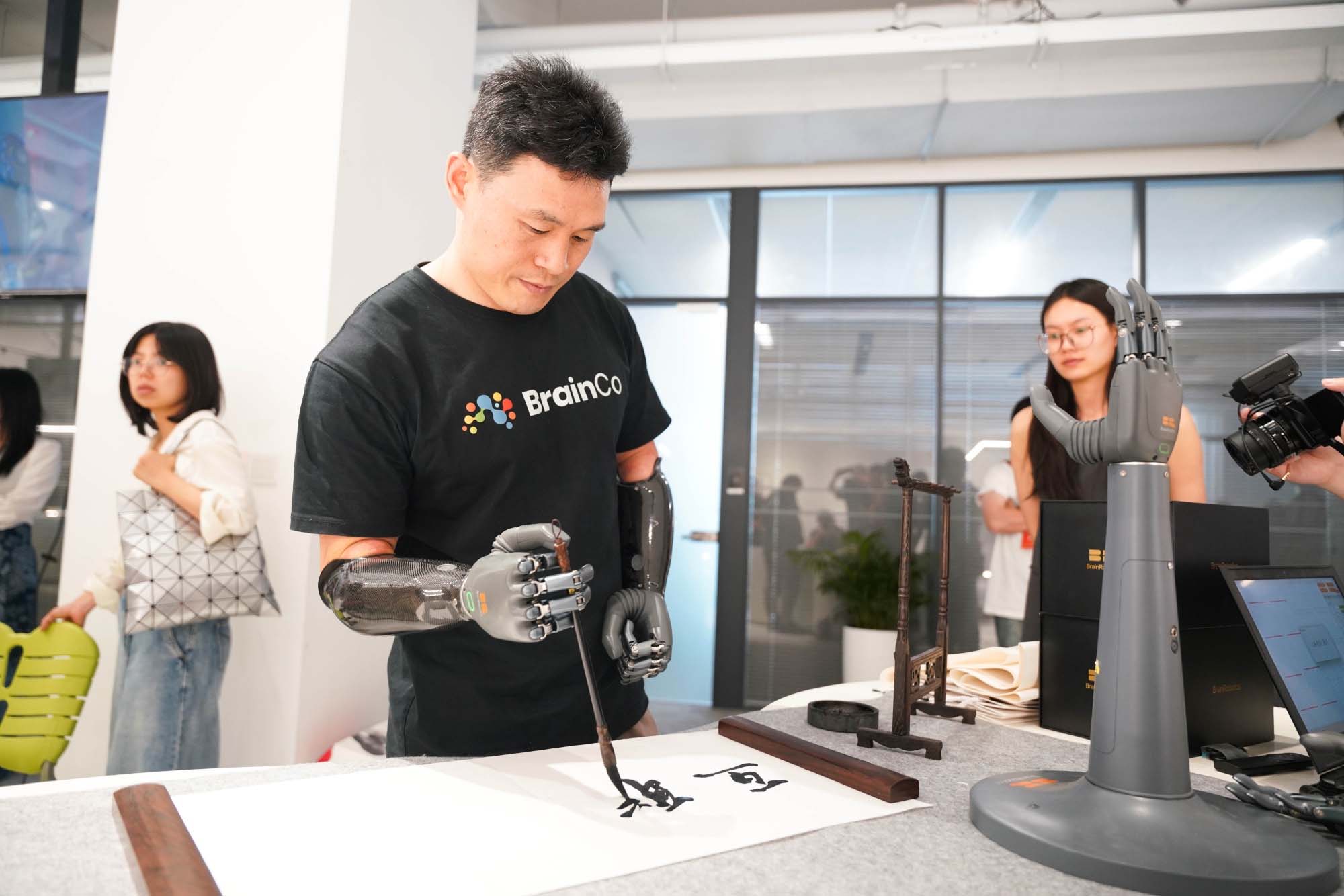
Its product portfolio reflects that trajectory. BrainCo’s best-known products are non-invasive EEG headbands paired with software dashboards designed to track attention, relaxation, and cognitive states, positioned for use in training, neurofeedback, and education-adjacent settings as well as consumer wellness. Alongside these systems, the company has developed a rehabilitation and assistive technology line, most visibly a myoelectric prosthetic hand marketed as an intent-decoding device. Taken together, BrainCo’s products sit outside the conventional implant-centric definition of BCI, aligning instead with large-scale EEG systems and assistive control rather than clinical neural interfaces.
BrainCo’s scale and speed has also brought scrutiny. In 2019, media reports described classroom pilots in parts of China where BrainCo EEG headbands were used to stream real-time indicators of student attention to teachers. Following parental concern and public debate around privacy and consent, several of these trials were reported to have been halted or suspended. Public reporting did not uncover how data were stored, shared, or governed over time. The episode remains part of the public record around BrainCo and is often cited in discussions about the company as its systems move beyond controlled pilots into institutional settings.

This latest funding round can materially alter BrainCo’s operating constraints. At this level of capitalization, the company is no longer forced to justify each product decision against short-term market pull. Hardware development, manufacturing scale, and deployment can proceed in parallel. In non-invasive BCI, where technical capability has advanced faster than market structure and demand, this is a meaningful advantage. Many Western EEG and neurofeedback companies remain capital-constrained and are pushed toward narrow, opportunistic use cases to sustain revenue. BrainCo can afford to build into a category that is expected to mature, rather than contorting itself to fit today’s fragmented demand.
That posture aligns with a broader pattern seen in Chinese technology companies that later compete internationally. Domestic scale is established first, supported by patient capital and institutional adoption, before products are refined for export markets. BrainCo’s portfolio reflects this logic. Its EEG systems are already deployed across training, neurofeedback, and institutional contexts inside China, generating manufacturing volume and operational data at a scale that would be difficult to achieve elsewhere.
China’s local ecosystem reinforces this trajectory. Close ties to electronics suppliers and contract manufacturers shorten development cycles and reduce costs in ways that are hard to replicate elsewhere. Devices can be rolled out in volume through domestic institutional channels such as schools, training programmes, and rehabilitation settings, rather than being confined to small pilots or limited trials. This allows companies to operate at scale earlier in a product’s life cycle. The risk does not disappear, but it shifts away from immediate viability toward questions of governance, positioning, and long-term market-fit.
BrainCo’s ability to compete internationally will depend on how selectively it applies this scale advantage. Rehabilitation and assistive devices are the most straightforward to translate across markets, since they are judged on functional outcomes and fit established clinical or quasi-clinical evaluation frameworks. These products tend to face fewer cultural sensitivities and clearer regulatory pathways than systems that make claims about cognition or behaviour.
Training and neurofeedback tools sit in a more ambiguous space. Outside China, products that infer attention or cognitive states face stricter expectations around evidence, data protection, and user consent, particularly when deployed in institutional settings. School-based attention monitoring is especially sensitive in the US and Europe, where privacy regulation and public scrutiny are higher. As a result, BrainCo’s international prospects will depend on how clearly it segments its portfolio and adapts each product line to different local expectations around evidence, ethics, and institutional use, rather than on hardware performance and price alone.
Produced with support from

%20copy.jpg)






.svg)

