

Capital is clustering in invasive BCIs. Last week, Synchron closed a $200M Series D to push its endovascular Stentrode toward commercialization, bringing total funding to about $345M. Precision Neuroscience also added a new strategic investment from SCI Ventures, reinforcing confidence in subdural ECoG as a scalable path. And these moves come in a year that previously saw Neuralink's $650M Series E and has only grown more intensive. For the Big 6, it's bigger checks, clearer milestones, and accelerating progress.
This piece zooms out from last week’s headlines to map the current funding landscape around the Big 6 of invasive BCIs: Neuralink, Synchron, Precision Neuroscience, Paradromics, Blackrock Neurotech, and Science Corp. We’ll note when and where each was founded, how much capital they have raised, and where their clinical and regulatory posture sits today.
Founded in 2016 in California, Neuralink is the pace car for fully invasive BCIs: a high-channel intracortical implant paired with a surgical robot, aimed at brain-to-cursor control now and broader closed-loop uses later. The company raised a $650M Series E in June and is commonly reported to have around $1.3B in lifetime funding, as it expands human enrollment after first implants in 2024–2025. Neuralink’s strength lies in controlling every layer of the technology, from chip to robot to clinical workflow, which could push performance and scale in ways that modular setups might not.
Established in 2012 in Melbourne and now headquartered in New York, Synchron’s endovascular Stentrode is placed via the jugular, keeping the procedure familiar for hospitals and widening adoption funnels. Last week, it closed a $200M Series D, bringing total funding to about $345M, with the cash pointed at trials and early commercialization. The bet is procedural pragmatism: lower surgical burden, faster site training, and credible paths to coverage.
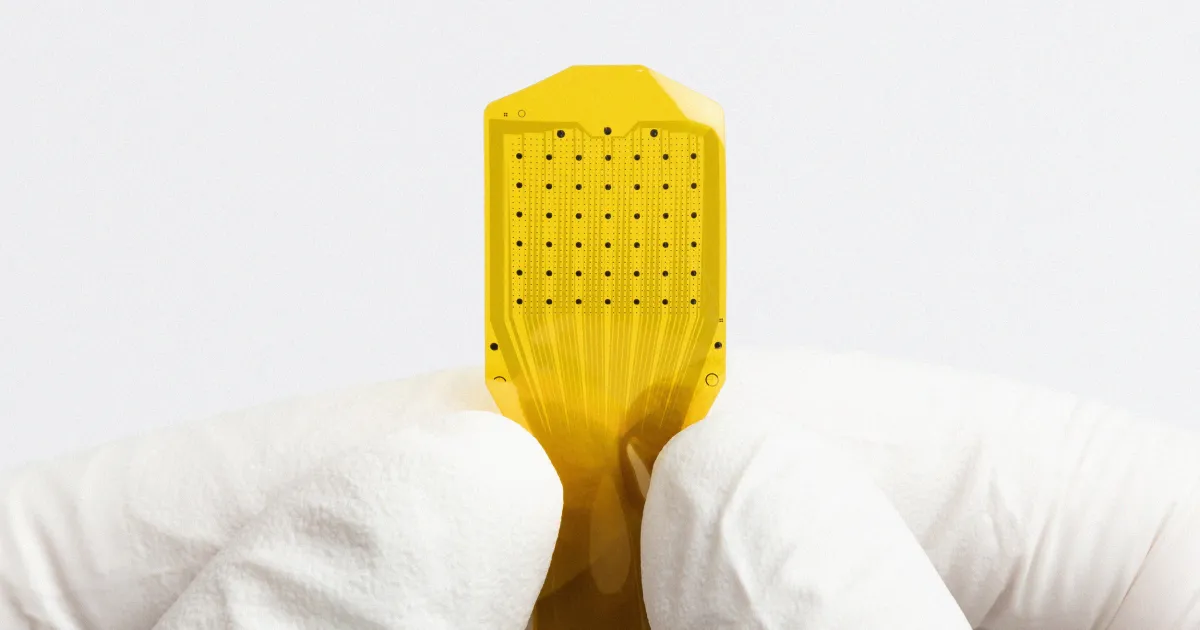
Launched in 2021 in New York City, Precision is building subdural ECoG sheets that aim for a middle lane: higher signal quality than non-invasive approaches with a lighter surgery than penetrating arrays. The company closed a $102M Series C in December 2024, bringing total funding to about $155M, and this week added a new strategic investment from SCI Ventures, a paralysis-focused fund. Precision sits in early human testing and is progressing toward IDE approval. The next proof points are longitudinal signal stability and scalability of implantation.
Founded in 2015 in Austin, Paradromics builds a high-throughput implant aimed at speech and intent decoding, with an I/O stack designed for clinical partners. In June 2025, the team completed its first human recording during an epilepsy procedure, moving from animal work into the clinical lane. The company reports over $100M in venture funding plus ~$18M in NIH/DARPA grants, positioning it to start longer-term implants and benchmark decoders on real vocabularies. What matters now is reliability at home and words-per-minute with large vocabularies.
Blackrock started in 2008 in Salt Lake City and spent a decade as the infrastructure incumbent behind many academic BCIs. In April 2024, it took a $200M majority investment from Tether, explicitly to push from research tools into regulated clinical products and scale manufacturing. That capital makes Blackrock the picks-and-shovels player most likely to compound if BCIs commercialize. What could be key is future shifts to productization and hospital-ready packages, not just components.
Founded in 2021 in Alameda, Science is building a biohybrid BCI platform starting with retinal neuroprosthetics, positioning vision restoration as the first clinical beachhead. In April 2025, it raised $104M led by Khosla Ventures, bringing total external capital reported to roughly $250–290M across rounds. With human trials underway on the vision side and exciting results so far, the future question could be how fast the platform generalizes to broader BCI use.
More capital is coming to invasive BCIs. The checks are getting larger and more selective, and they are flowing to teams that can turn first-in-human moments into repeatable programs. Investors are looking for proof that a system can be implanted the same way every time, produce stable signals at home, and move through a clear regulatory lane. That favors platforms with disciplined surgical playbooks, robust manufacturing, operational pragmatism, and clear plans for payer conversations rather than one-off demos.
The concentration is rational. Regulatory pathways are clearer after multiple U.S. human programs. Clinical momentum is visible across cohorts, not just single-subject stories. Procedural pragmatism matters: endovascular and subdural routes broaden the hospital funnel, while intracortical keeps the performance ceiling. In parallel, quiet advances in materials, packaging, and sterilizable hardware have reduced risk in places investors used to discount.
Together, these shifts point to a field leaving its experimental phase behind. Capital is no longer chasing proof of concept; it’s underwriting execution.
.svg)









%20copy.jpg)