

The tongue is one of the most dexterous muscles in the body, capable of complex movements and fine control, yet it rarely appears in discussions of human-computer interaction. Keyboards, touchscreens, eye trackers, and brain-computer interfaces typically dominate that conversation. Augmental’s MouthPad brings in a different idea: an intraoral touchpad mounted on the roof of the mouth that turns tongue movements into precise digital control, in a way that sits alongside today’s dominant input modalities.
Instead of decoding neural activity, the MouthPad treats the palate as a protected, always-available control surface. A custom retainer-like device houses a touch-sensitive layer that detects tongue position and gestures, then relays those signals wirelessly to phones, tablets, or computers. The system behaves like a conventional pointing device, with the cursor driven by tongue motion. It is a useful example of a neuro-adjacent design, targeting many of the same problems as BCIs, including communication and computer use for people with motor impairments, while staying outside the neural recording stack.
BCIs are often framed around decoding intent from neural activity, with progress measured in bandwidth, robustness across environments, and the richness of motor or cognitive states captured. In parallel, a separate wave of work focuses on high-signal, low-friction input surfaces elsewhere on the body: eye tracking, head pose, muscle activity, and now intraoral motion. These interfaces still depend on voluntary motor control, but they can be more practical for many use cases, especially when the goal is reliable pointer control or discrete selections rather than full motor restoration. MouthPad sits in the second category.
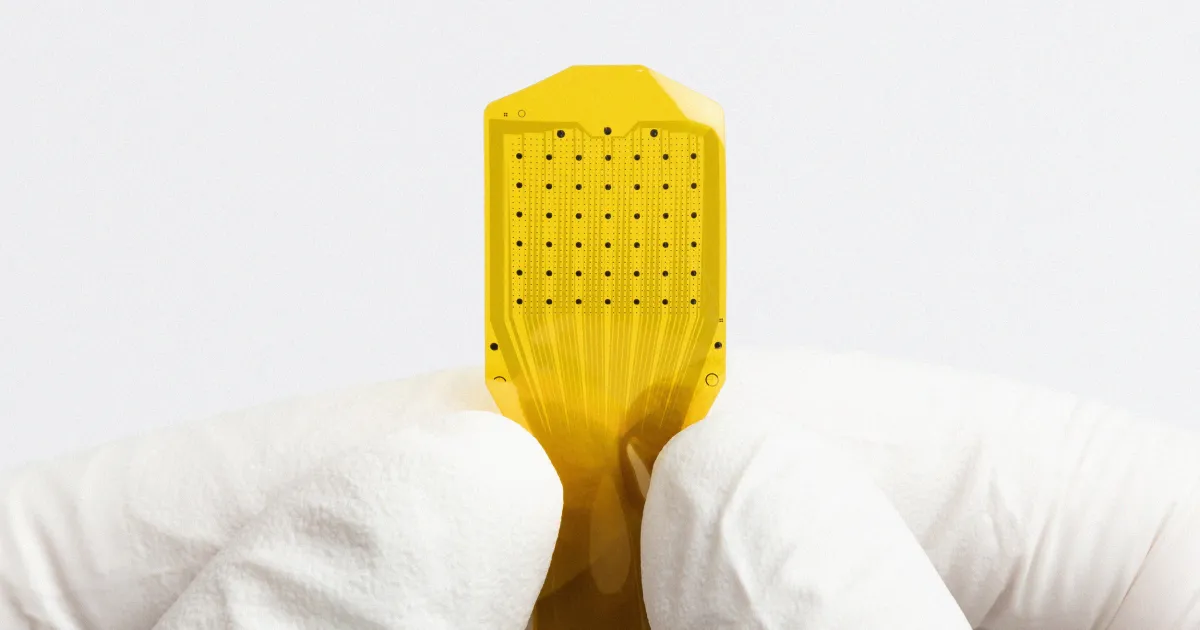
Augmental is developing MouthPad as a custom-fit mouthpiece that functions as a wireless pointing and control device. The hardware resembles an orthodontic retainer worn on the upper palate, and it embeds a thin capacitive touch-sensitive surface that detects tongue position, movements, and gestures. The tongue effectively becomes a surrogate for a finger on a trackpad, translating repeatable motion into cursor control and other on-screen interactions.
At a system level, the MouthPad behaves like a standard human interface device. It connects to phones, tablets, or computers via common wireless protocols and relays control signals in a way that fits existing operating systems and input workflows. This keeps the stack deliberately simple: the device translates physical gestures into control signals without an intermediate decoding layer. That choice has implications for reliability, power consumption, and regulatory scope, and it reflects a design philosophy that prioritizes robust, interpretable signals and compatibility over novelty in sensing.
“We’re focused on enabling seamless, always-available control, creating technology that adapts to people, not the other way around,” Augmental co-founder Tomás Vega said. “The mouth is an overlooked but powerful interface, and by tapping into it, we can expand what accessibility and interaction really mean.”
The core design move is to treat the palate as a protected, high-resolution control surface. The device is custom-fitted to a user’s dental anatomy and anchors to the upper teeth like a retainer, supporting comfort and positional stability, while a capacitive layer on the underside tracks tongue position and motion and translates continuous trajectories and discrete gestures into control commands. Swipes can move a cursor, while taps or sustained presses can register as clicks or other mapped actions.
Because the mouth is a confined, moisture-rich environment, the engineering constraints are nontrivial, including ensuring reliable sensing across variable saliva conditions, mechanical loads from speaking and swallowing, and tight limits on battery size and heat dissipation. Rather than layering in increasingly complex sensing modalities or on-board intelligence, the MouthPad’s architecture centers on a single, consistent input channel that operating systems already know how to accept.
For users with limited upper-limb mobility, cursor control and text entry are not abstract interface problems. Basic navigation across mobile and desktop environments often requires layered assistive setups such as sip-and-puff devices, head tracking, or switch scanning, each with tradeoffs in speed, fatigue, and privacy. An intra-oral interface changes the starting point by offering hands-free control that does not depend on arm or hand motion, and remains usable across postures and environments where camera-based or head-mounted systems become inconsistent.
The physiological advantages are part of the point. Many people who lose fine hand function retain precise tongue control, and the mouth is a relatively stable mounting point that moves less than the head or shoulders during daily activity. If the device can remain comfortable over long wear times and maintain performance under real-world conditions involving saliva, speaking, and daily routines, it can reduce the number of external components required for computer access, where consolidation often matters as much as raw control bandwidth.
Augmental’s trajectory contrasts with the large venture rounds that anchor much of the neurotechnology narrative. Since spinning out of MIT’s Media Lab, the company has raised on the order of low single-digit millions in pre-seed and seed capital, including backing from MIT’s E14 Fund and other early-stage investors. That total is modest compared with invasive BCI programs, but it has been sufficient to move MouthPad from concept into commercial deployment.
Augmental launched with an early access program, collaborating with individuals with spinal cord injuries and other mobility impairments to refine device design, gesture controls, and user onboarding. After receiving FCC clearance, the company began U.S. sales through a managed waitlist, prioritizing users with the greatest needs while gradually expanding production. Distribution relies on a dental workflow using digital mouth scans and custom fabrication through partner dentists and rehabilitation centers, so expansion depends on building these local clinical partnerships.
Regulatory positioning is also evolving in parallel. As a Bluetooth input peripheral, MouthPad initially entered under the same umbrella as other consumer human-interface devices, with radio-frequency and safety testing but without a full medical-device approval process. Augmental has signaled plans to pursue FDA clearance for use cases such as powered wheelchair and robotic-arm control, where the device becomes part of a clinical assistive pathway. That shift could open the door to reimbursement, but it also raises the bar for reliability, durability, and clinical evidence, tightening the link between funding, commercialization, and regulatory strategy.
The promise of an intra-oral trackpad comes with adoption challenges unique to devices worn in the mouth, where comfort, wear time, and hygiene are central. Even minor fit issues such as pressure points, gum irritation, or bite changes can become unacceptable for users who wear the device for hours each day, and maintaining cleanliness requires materials that resist buildup, staining, and odor plus a routine that users can sustain. Customization improves stability and accuracy, but it also limits scalability, since each device requires dental scans or impressions, fabrication, and possible refits that affect cost, turnaround time, and distribution channels, especially for clinical or reimbursed use.
Regulatory positioning further shapes commercialization. Claims related to disability, therapeutic outcomes, or medical benefit can shift the device’s classification and the evidence required for safety and durability, and together these factors define what “production-ready” has to mean beyond early adopters. MouthPad matters in that context because it shows how far interface innovation can go without direct brain access, while still targeting many of the same access problems that motivate BCIs. By turning subtle tongue movement into usable digital control, it sits on the spectrum between neural implants and practical, human-centered input devices, with the same underlying goal: restoring agency and expanding access.
[Cover image: Augmental]
.svg)





-1.jpeg)


%20copy.jpg)