
Non-invasive neurostimulation in depression is moving into regulated care. In the last six months, Flow’s tDCS headset and Neurolief’s system won FDA approvals. But depression still has few options that can reach deep, disorder-relevant brain targets without surgery or implants. Paris-based SonoMind is building in this gap. “Today, one in three people with depression do not respond to any available treatment. We refuse to accept this as inevitable,” said CEO Jérémy Bercoff.
Last week, SonoMind raised €20 million in Series A to advance that thesis into clinical testing. The round was led by Critical Path Ventures and Bpifrance, and follows a €3 million seed round closed in 2025. The company is developing a low-intensity focused ultrasound system designed to stimulate specific brain regions with high spatial precision, targeting regulatory clearance across multiple markets by 2029.
SonoMind’s core claim is that depression care still lacks a non-invasive way to stimulate deep brain structures with patient-specific precision. As Bercoff explains, deep brain stimulation can reach relevant targets but requires surgery. TMS avoids implants but is largely limited to cortical regions. The newly approved drug Esketamine, meanwhile, acts systemically, creating a different trade-off profile. SonoMind positions focused ultrasound as a way to narrow that gap.

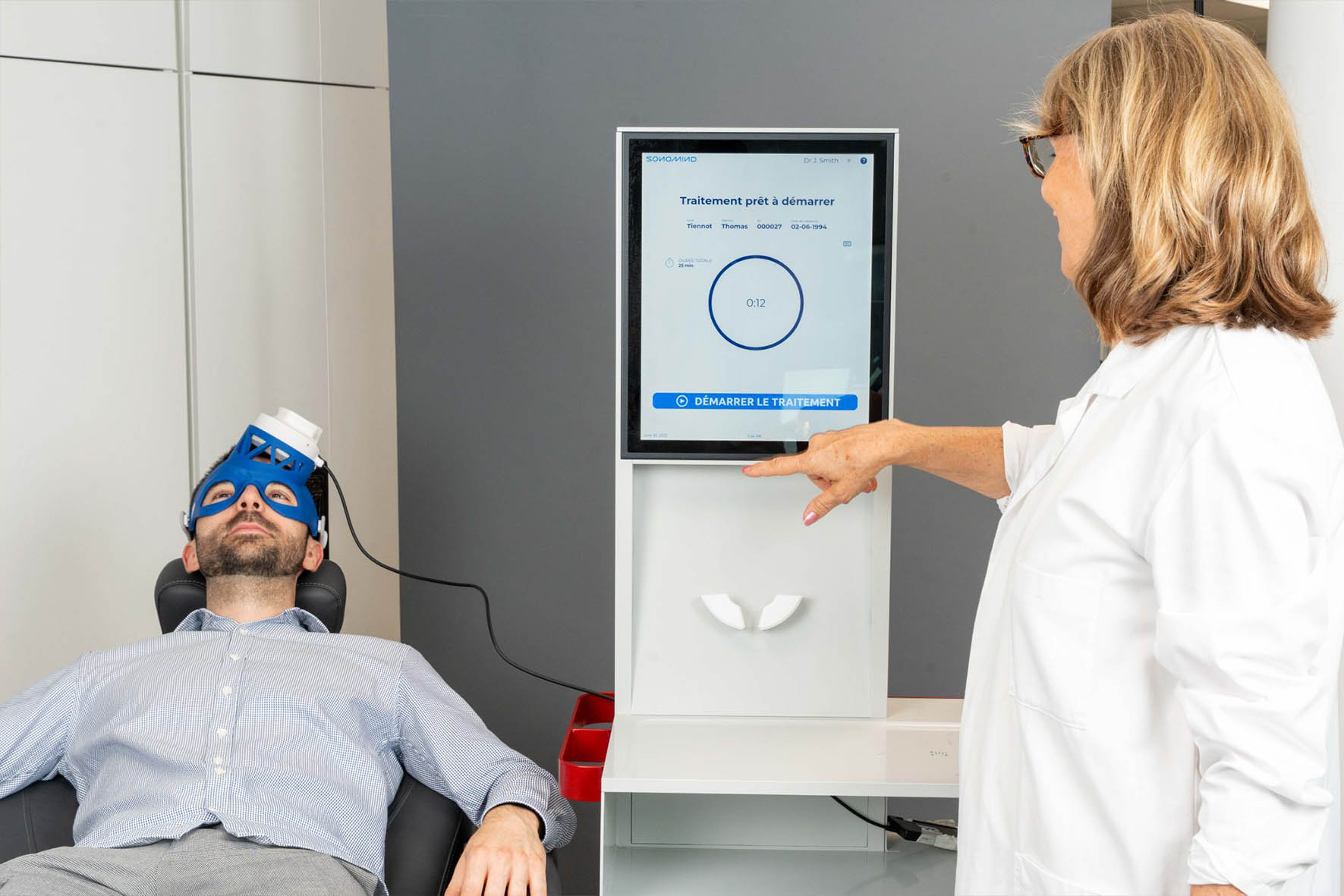
The company’s system uses low-intensity focused ultrasound, or LIFU, to direct sound waves toward specific brain regions linked to depression. SonoMind's system uses a patient-specific acoustic meta-lens, which Bercoff describes as “the heart” of the technology. Built from each patient’s CT and MRI data, the lens is designed to compensate for the way the skull distorts ultrasound waves. That correction enables millimetre-level targeting of deeper structures without surgery, anaesthesia, or implants.
The clinical proposition is built around that precision and usability. “We worked a lot to make our device extremely simple and fast to use, almost plug and play for the psychiatrist,” says Bercoff. The treatment is delivered in one hour per day over five days. Early work from the Physics for Medicine laboratory and Hospital Sainte-Anne reported a 60% reduction in depression symptoms after five days of treatment.
SonoMind traces its technology to 25 years of research at the Institute of Physics for Medicine in Paris, a joint laboratory of Inserm, ESPCI Paris–PSL, and CNRS. Two of the company’s founders, Mickael Tanter and Jean-François Aubry, helped lead that work, with CEO Jérémy Bercoff completing the founding team. The company’s approach draws on the lab’s work in focused ultrasound, acoustic wave control, and image-guided targeting.
The scientific rationale builds on research linking depression to disrupted connectivity across specific brain circuits, including deeper regions that conventional non-invasive stimulation cannot easily reach. Bercoff points to Helen Mayberg’s work in deep brain stimulation as one of SonoMind’s reference points. At the same time, he acknowledges that depression remains heterogeneous, making patient selection a central question. Phenotyping depressive patients, he says, is one direction SonoMind wants to pursue through collaborations with psychiatrists and neurologists.
The €20 million Series A was led by Critical Path Ventures and Bpifrance. SonoMind will use the capital to initiate larger sham-controlled clinical trials and move the platform into its industrial development phase. The company is targeting market authorisation around 2029.
Depression is the first indication, but SonoMind is not positioning focused ultrasound as a single-disease product. The company has pointed to potential future applications across anxiety, addiction, Parkinson’s disease, essential tremor, post-stroke recovery, and chronic pain.
Bercoff frames the technology as part of a wider shift toward precision psychiatry. “Given the complexity and diversity of neuropsychiatric disorders, the more there are high-quality and high-performance solutions to tackle them, the better for patients,” he said. For SonoMind, the immediate test is whether focused ultrasound can become one of those solutions.
.svg)





.jpeg)