Across the world, around 27 million people sustain a traumatic brain injury each year. For many with moderate-to-severe injuries, cognitive deficits can persist for years. Last week, Minnesota-based ReEmerge emerged from stealth with an oversubscribed $37 million Series A. The firm is advancing a new approach to treating these chronic impairments, applying targeted stimulation to the central thalamus.
ReEmerge’s Cognitive Network Restoration Therapy (CNRT) builds on years of academic work in central-thalamic deep brain stimulation. Early feasibility work has already shown improvement is possible years after sustaining chronic moderate-to-severe TBI. The new funding will support a multicenter study of up to 40 patients, alongside further development of the patient-specific imaging, modeling, and stimulation approach behind CNRT.
ReEmerge's $37 million Series A was co-led by U.S. Venture Partners and Santé, with participation from Oxford Science Enterprises, 415 Capital, IAG Capital Partners, The Vertical Group, and Dendrion Ventures. ReEmerge will use the funding for its first multicenter clinical study, further development of CNRT, and expansion of its clinical and regulatory operations.
The company builds on research led by co-founder Nicholas Schiff at Weill Cornell Medicine alongside collaborators at Stanford and the University of Utah. Cornell helped protect the underlying intellectual property before licensing it exclusively to ReEmerge. The firm is led by Todd Langevin, who previously ran DBS developer Functional Neuromodulation and earlier led Medtronic’s DBS movement disorders business.
The firm will first target chronic moderate-to-severe TBI, where cognitive impairments can persist for years after recovery has plateaued. “Many patients make gains through rehabilitation but eventually reach a point at which further recovery is limited. There is currently no established therapy designed to directly reactivate the large-scale cognitive networks underlying those functions,” ReEmerge told Neurofounders. The variation between those injuries also provides an early test of the company’s patient-specific approach.
ReEmerge is now preparing a prospective, single-arm multicenter study of up to 40 patients. The study will primarily assess device and procedural safety, while tracking cognitive and functional outcomes that could inform a later efficacy trial. Longer term, ReEmerge sees potential in other conditions where impairment is partly driven by underactive but viable brain networks. “Our immediate priority is to rigorously evaluate CNRT in chronic TBI and allow the evidence to guide where the platform may go next.”
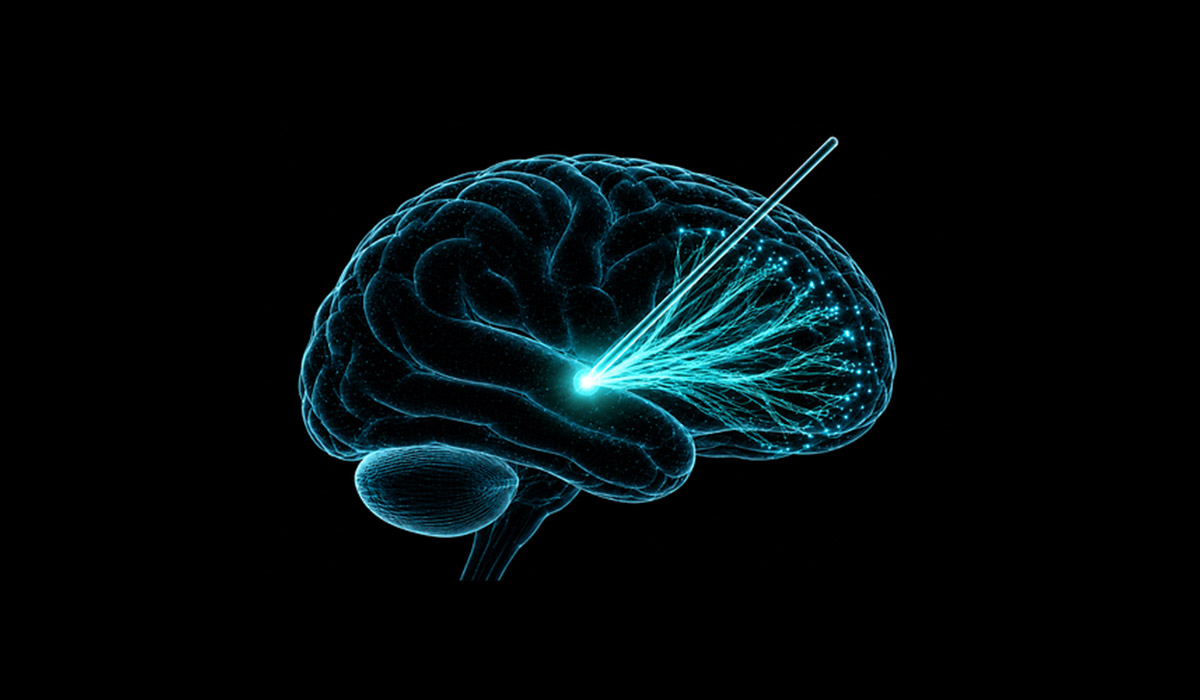
CNRT is based on the idea that TBI can disrupt communication across the brain while parts of the underlying cognitive networks remain intact. ReEmerge targets the central lateral nucleus of the thalamus, which connects to frontal and striatal regions involved in attention, processing speed, working memory, and executive function. “The technical thesis is that this stimulation can increase the functional activation of underperforming networks, allowing the brain to use its remaining capacity more effectively,” ReEmerge explains.
The therapy uses deep brain stimulation, with electrodes implanted in the central thalamus. ReEmerge’s proprietary layer centers on patient-specific targeting and programming. Specialized MRI, thalamic segmentation, and tractography map the relevant anatomy, while biophysical models predict how different electrode positions and settings will activate surrounding pathways. Modern programmable DBS systems then allow stimulation to be refined after implantation.
A 2023 early feasibility study implanted six people with moderate-to-severe TBI, three to 18 years post-injury, with five completing the protocol. All five exceeded the prespecified 10% improvement threshold on Trail Making Test Part B, a measure tracking processing speed, attention, and executive control. Improvements ranged from 15% to 52%.
ReEmerge acknowledges that “the findings are encouraging, but come from a very small study. ReEmerge's upcoming multicenter clinical study is intended to build a more robust evidence base, characterize functional outcomes and help determine which patients are most likely to benefit.”
A 2026 analysis of the same five participants found an average 45.9% increase in autobiographical memories recalled during treatment, while four participants who underwent more detailed testing improved 18.7% on memory specificity. Participants and families also reported changes in everyday memory and cognitive function. So much so that “cognitive improvement can create new challenges, as patients and families adapt to greater capability and changing expectations.”
.svg)