
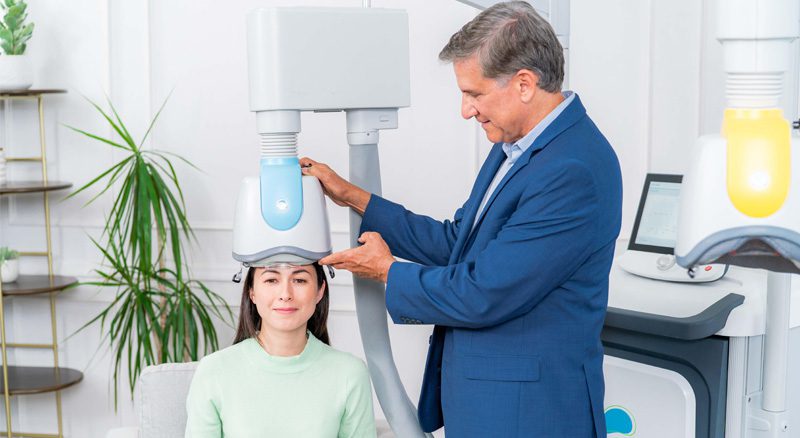
This year’s betting average of publicly traded neurotech companies has not been great. An equal-weighted portfolio of the 21 public companies tracked on the Neurofounders Startup Map would currently be down around 12% YTD. Still, some clear success stories are emerging. After recent Q2 earnings, BrainsWay jumped 10.8%, extending its gain for the year to roughly 69%, while electroCore rose 20.8% and is now up around 119% YTD.
As many of the remaining stocks continued their downward slope, Q2 earnings added more fuel to the fire for BrainsWay and electroCore. BrainsWay, an Israeli-founded TMS producer, grew quarterly revenue by 35% to a record $17.1 million, as system shipments increased 42%. electroCore, a New Jersey-based developer of non-invasive vagus nerve stimulation, grew revenue 28% to $9.5 million, driven largely by US prescription sales in the Veteran community. Both companies produce non-invasive neuromodulation, offering early examples of financial momentum in neurotechnology that does not pierce the skin.
Note: Stock prices as of market close on August 14, 2026.
BrainsWay is a well-known name among the publicly traded companies on the Neurofounders startup map. Founded in Israel in 2003, the company develops Deep TMS, using its proprietary H-coil architecture to stimulate broader and deeper cortical targets than conventional TMS. Its first FDA clearance came in 2013 for major depressive disorder, followed by obsessive-compulsive disorder and smoking addiction.
That long development history is now translating into a maturing commercial business. Revenue grew from $41 million in 2024 to $52.2 million in 2025. This year has seen the growth spurt continue. In Q1, BrainsWay reported revenue of $15.5 million, up 35% year over year, alongside a 44% increase in system shipments and more than doubling adjusted EBITDA.
Part of that growth is coming from wider adoption of its existing platform. Last year, BrainsWay received FDA clearance for SWIFT, an accelerated Deep TMS protocol for depression. This year, the firm has focused on adding reimbursement coverage, while continuing a trial in alcohol use disorder and working to expand Deep TMS into PTSD.
BrainsWay's installed base continued to expand, reaching almost 1,950 systems by the end of Q2. New systems have been quoted in the range of $120,000 to $180,000, depending on configuration, although BrainsWay also offers leasing and financing options.
BrainsWay is starting to use its stronger financial position to expand beyond its core TMS business. It has invested $11 million in Neurolief, whose wearable ProlivRx system received FDA Premarket Approval in January as an at-home adjunctive treatment for major depressive disorder. BrainsWay retains an option to acquire the company and could invest another $5 million if Neurolief reaches a revenue milestone. In July, it also invested $3 million in Radial Health, which supports a network of US mental-health clinics using treatments including TMS.
The latest Q2 results added further momentum. Revenue reached a record $17.1 million, up 35%, while system shipments increased 42% to 125. Adjusted EBITDA more than doubled to $3.5 million, operating income rose to $2.4 million, and BrainsWay generated $6.3 million in operating cash flow. The company subsequently raised full-year revenue guidance to $68-70 million, helping push its stock roughly 69% above where it started the year.
ElectroCore’s recent rally follows a more complicated history on public markets. The New Jersey company listed on Nasdaq in 2018 at $15 per share, but its stock subsequently fell sharply enough that it completed a 1-for-15 reverse split in 2023. On a split-adjusted basis, that original IPO price would be $225 today. Shares started 2026 at just $4.55, before more than doubling to $9.97 by August 14. The stock now sits close to a 52-week high.
Founded in 2005, electroCore develops non-invasive vagus nerve stimulation, delivering electrical stimulation through the neck without an implant. Its core gammaCore device first received FDA authorization in 2017 for acute treatment of episodic cluster headache, with migraine and additional headache indications added in the years that followed. The business has since expanded beyond gammaCore, launching consumer wellness device Truvaga in 2022 and acquiring NeuroMetrix last year.
A large part of the recent growth has come through the US Department of Veterans Affairs. gammaCore is now purchased across roughly 200 VA facilities, with around 16,400 veterans having received the device by the end of Q2. electroCore has also started pushing NeuroMetrix’ Quell platform through the same network, with $3.8 million of its first $4 million in post-acquisition Quell sales coming through the VA. The channel has become central enough that the company expects the majority of its 2026 revenue to come from the VA.
.jpg)
The latest quarter visualized that growth. Q2 revenue reached $9.5 million, up 28% year over year, bringing first-half sales to $19 million. US prescription sales accounted for $7.45 million, while Quell generated $1.3 million and Truvaga another $1.3 million. Quell sales were up roughly 700% year over year following the acquisition, while Truvaga grew 27%, despite electroCore reducing advertising spend as media costs increased.
electroCore is not yet profitable, but its losses are narrowing alongside the revenue growth. Its Q2 net loss fell 17% to $3.1 million, while adjusted EBITDA loss improved 26% to $1.8 million. The company raised its 2026 outlook to more than 30% revenue growth and is targeting positive adjusted EBITDA in Q3 2027. Investors again responded strongly, with shares jumping around 21% in the first session after Q2 results, adding further momentum to one of neurotech’s strongest stock rallies this year.
.svg)