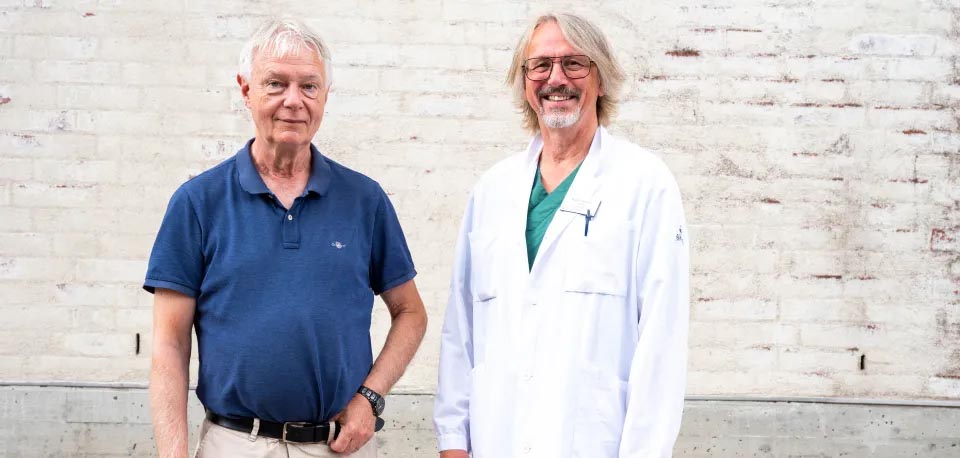
A $50 million funding round at a reported $600 million valuation. Capital earmarked to develop a beanie that can turn your thoughts into speech. It's the interface of the future, a wearable that connects minds directly to computers and AI. Sabi looks like the biggest neurotech story of the year.
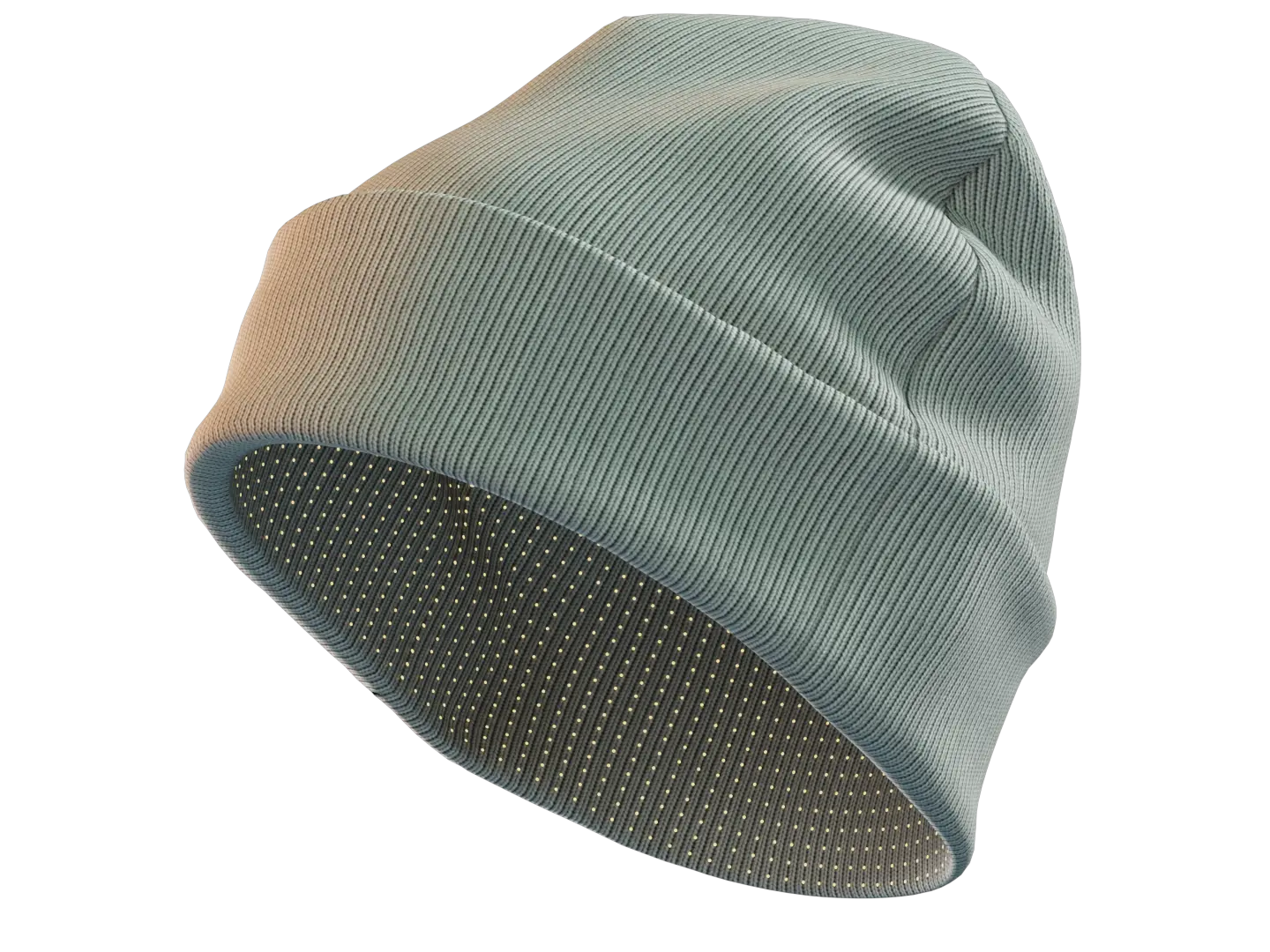
The beanie, packed with up to a hundred thousand EEG sensors, emerges from stealth in a polished WIRED article, published on the 16th of April, 2026. And the reception is ravenous. Thousands of likes across social media, millions of views, legendary investors like Vinod Khosla buying in. Sabi arrives with a splash.
So why is it that when I start researching the company a few months later, I find little more than two relatively unknown founders, a few lightweight incorporation documents, some recent grads in Bengaluru doing EEG experiments, and a polished website?
Sabi reports a $600 million valuation and claims to hold a never-seen-before, one-hundred-thousand-sensor wearable prototype that can turn thoughts into speech. Where is the lab, the team, the patents, the preprints, the validation papers?
Silicon Valley is known for housing ambitious creators with ambitious visions. Much of its entrepreneurial culture is built on the legacy of Steve Jobs, a visionary who promised the impossible and then did everything in his power to somehow deliver on that promise, time and time again.
That legacy inspired a generation of entrepreneurs. Neuralink and Tesla founder Elon Musk makes similarly audacious promises. And while he does not always strictly abide by his public timelines, Musk also has a track record of delivering on some remarkable ambitions.
But then, once in a while, there is a founder who promises something simply outside the realm of possibility.
So what is happening in neurotech right now? Is Sabi the industry’s best-kept secret? Are the founders sitting on potential gold, though perhaps a bit too ambitious about their current timelines? Or are we looking at a neurotech promise that is simply too good to be true?
The story of Sabi begins on the ninth of May, 2024. Rahul Chhabra and Atmadeep Banerjee incorporate a company called Neuralace in Delaware. A few days later, Andrew Arruda, a deep tech investor running Maniac Ventures, invests in the brand-new venture. Sabi is born, though the world won't know it by that name for another two years.
At the time, Chhabra, a twenty-something-year-old electrical engineering graduate from the Birla Institute of Technology and Science in Pilani, India, has limited startup experience. During his studies, he ran the BITS Pilani student-run startup accelerator. He also reportedly spent some time researching machine learning models at Stanford. After graduating, he worked on a social networking app for Indian university students.
He teams up with his former BITS roommate, Atmadeep Banerjee. A computer science graduate, Banerjee had spent the previous years working as a research assistant and had just co-authored a seminal paper on using fMRI to retrieve and reconstruct viewed images from brain activity. The research inspires the pair. What if information extracted from the brain could become an input for everyday computers?
In San Francisco, Chhabra works from a desk at Solaris, a coworking space. He operates there for a few months around Neuralace’s founding, before the company moves its operations to India. When a local reporter visits Solaris, Chhabra complains about the high costs of the coworking desk and explains that Sabi will be conducting data collection in India’s tech epicentre, Bengaluru.
After moving across the globe, Chhabra starts building out a small research team. Among the first hires I can identify are two operations managers, likely overseeing some of the data collection efforts. Both previously worked at Awign, an Indian work-as-a-service platform. And soon after Chhabra arrives in India, Neuralace jobs start appearing on that platform.
The job advertisements are specific. Neuralace is looking for English-speaking men aged 25-35 to participate in EEG data collection. The gig lasts one to two months, requires a shaved head, and involves completing tasks related to video, audio, or text stimuli.
Participants earn up to ₹42,000 per month, about €400. Neuralace also lists an IT technician role, though they earn a maximum of just ₹24,000 per month, about half as much as the participants. Chhabra later tells Forbes that more than 100 contractors were hired to carry out these tasks.
To carry out the research, Neuralace seems to hire a handful of research assistants. Several list stints at Sabi on LinkedIn. All are recent graduates of local universities, with little professional experience beyond internships or research assistant roles.
In total, I trace eight individuals to Neuralace’s data collection operations in India through LinkedIn. Two operations managers and six research assistants. All six research assistants graduated with a bachelor's or master's degree within 24 months of starting their positions.
The search is hindered by the fact that Sabi has no LinkedIn page. So when you click through to the company behind these profiles, you either find nothing at all, or you end up at a company called 'Label Sabi': A Mumbai-based homemade fashion brand operating a webshop and Instagram account with a few thousand followers.
On paper, Neuralace returns to California on the ninth of September, 2025, when the Delaware-incorporated company registers to do business in the state. The paperwork reveals little. Both the initial filing and a follow-up submitted in December list a Delaware address with Wilmington as the city but a Dover ZIP code. Neither lists a California office address.
Around that time, Neuralace also begins expanding its team more aggressively. Among the hires appearing in public profiles are a founding engineer, who joins in October 2025, and a go-to-market manager, who appears to be among the company's first Bay Area-based employees.
More appointments follow in early 2026, spanning commercial operations, hardware, and research. These include a former Accenture analyst joining as VP of Strategic Partnerships, an industrial design graduate working as a hardware engineer, and a research consultant who is also active as a research assistant at Stanford.
On paper, it's a relatively junior group. The two publicly identifiable engineering hires have little apparent experience developing high-density EEG systems or custom neural-sensing chips. And by October 2026, both have left. The hardware engineer departs in September, followed by the founding engineer a month later.
Meanwhile, behind the scenes, Neuralace's founders are working on something else. The transformation of Neuralace into Sabi, the beanie designed to read your thoughts.
On the sixth of April, 2026, less than two weeks before the public launch, Neuralace Inc. files an intent-to-use trademark application for “SABI”. It appears the team abandoned "Neuralace", a term that Blackrock Neurotech, unsuccessfully, tried to trademark years before. The filing also includes a Palo Alto address, at a building that had been advertised for lease the previous year.
The new name is only part of the transformation. To introduce Sabi to the world, Neuralace enlists some experienced outside help.
Among its external collaborators is a senior consumer go-to-market and brand strategist who previously worked on the team that brought the Ray-Ban Meta glasses to market.
The company also contracts a creative director with more than a decade of experience, including projects for Tesla, CBS, and Disney, to shape the visual identity of the upcoming launch.
And there is Atomik Growth, an agency specialising in viral launch strategies for tech firms, brought in to help spread the word.
An impressive cast of talent, assembled to bring Sabi's vision to the world.
To the outside world, Sabi seems to arrive out of nowhere. On the 16th of April, 2026, Rahul Chhabra’s announcement post shows up on my LinkedIn feed. It includes a beautiful video, more reminiscent of an Apple product launch than a neurotech lab coming out of stealth.
“you can now control things with your brain. literally.” Chhabra writes, in all lowercase.
“we're building the most wearable BCI on the planet, with Sabi, backed by Khosla Ventures, Accel Initialized Capital, Kevin Weil & Ascend.
we collected the world’s largest neural dataset and trained the most capable Brain Foundation Model.
then we invented a new class of biosensors powered by custom ASICs.
type without typing. click without clicking. a cap that lets your brain do the work.
we’re sabi.”
The one-minute video attached is beautiful. It's marketing unlike anything I've seen before in neurotech. “THINK. The brain computer interface, in a hat.” Sensor-lined mockups flash across the screen. Beanies follow. “This isn't the next frontier. It's the last. And we're building it.” The video ends on “I think, therefore I can.”

In a second LinkedIn post, Chhabra shares a WIRED article featuring interviews with him and lead investor Vinod Khosla. The post racks up over 2,500 likes and 400 comments. Sabi is launching big, and I am paying attention.
But something seems off. And the first signs are not hard to find. Because who, exactly, is commenting on this post? It's not my usual neurotech network. While some comments seem perfectly normal, I later find a big batch that all follow the same strange formula.
All are surprisingly positive. All come from people outside neurotech. The language is formulaic and formal, reminiscent of AI-generated text. Many explicitly reference the WIRED article, as if it were technical validation.
“This is a remarkable blend of wearable tech and neuroscience; congrats on the coverage in WIRED.” writes a tech founder.
But scrolling down a bit further, I see the exact same comment, posted by another account.
“The design demonstrates how wearable tech can evolve from fashion to functional health monitoring.”
Another comment, again posted by two different users. In total, I count 52 unusual comments from 50 users. One of them simply writes “Done”.
Atomik Growth, the agency involved in Sabi's launch, calls the campaign a great success, reporting over 8 million views across platforms. In a blog post, the agency describes a strategy involving tailored creators, meme accounts, and paid collaborations.
I later learned that Atomik also approached someone in my network, offering to pay them to promote its launch campaigns. In an email, the agency writes: “Quick question: Are you good with $750 per Quote reshare + comment and $1000 per dedicated post to begin with?” The recipient declined.
The case study has since disappeared from Atomik's website.
The posts on Chhabra's account remain live.
It is the WIRED piece, more than the glossy video, that really piques my interest. The article describes something truly groundbreaking, a stylish beanie that can decode your inner monologue and turn it into text to control computers and AI.
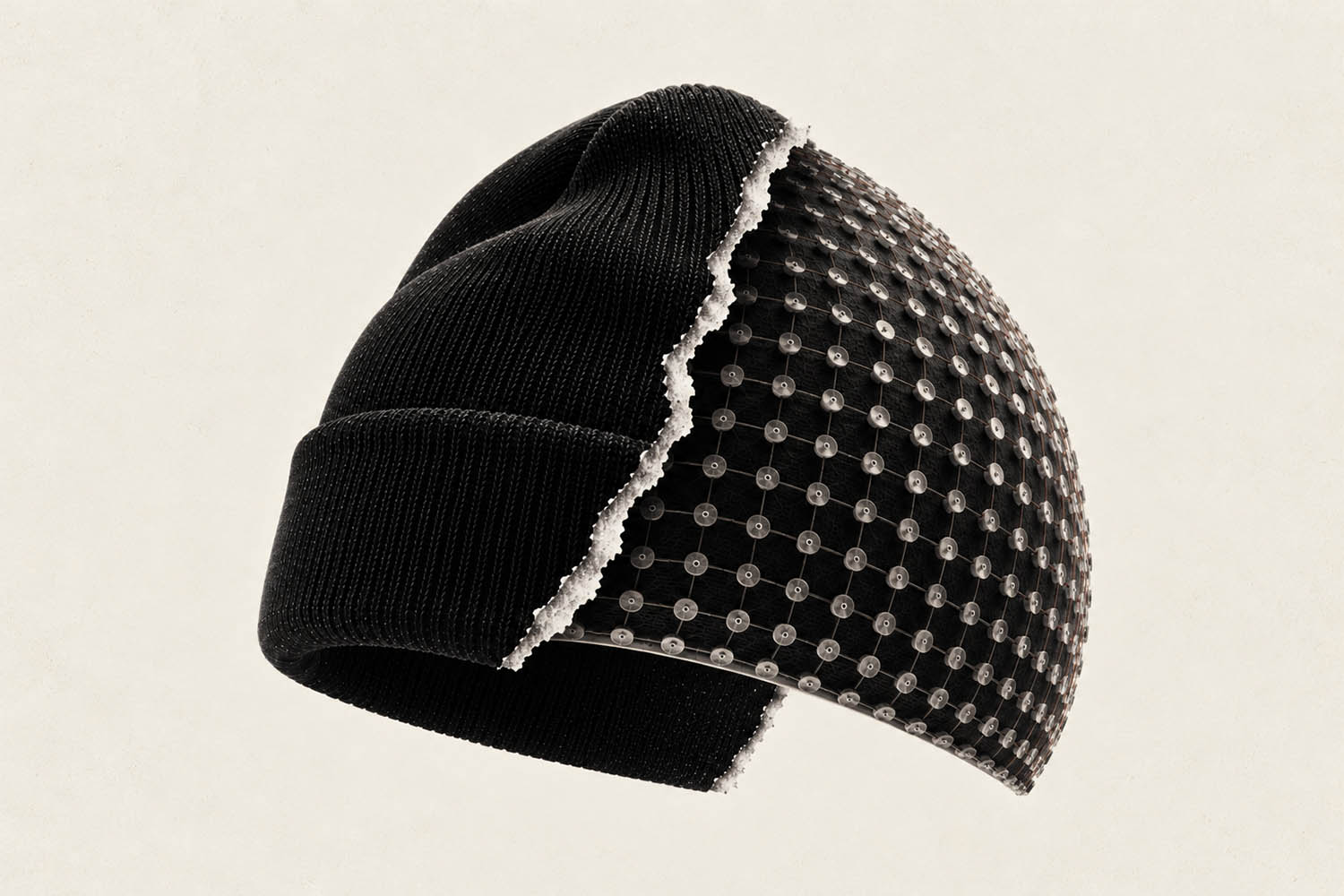
The technical claims in the article are remarkable. Chhabra explains that the beanie, scheduled for release by the end of 2026, will contain between 70,000 and 100,000 miniature EEG sensors. That high-density sensing, Chhabra explains, “pinpoints exactly what and where neural activity is happening,” allowing Sabi to decode what a person is thinking.
Chhabra explains that the company is aiming for an initial typing speed of about 30 words per minute, a number that should improve as users spend more time wearing the device. To develop its brain foundation model, Chhabra says Sabi has already amassed 100,000 hours of brain data from 100 volunteers, what it calls “the world’s largest neural decoding dataset”.
Big claims, the type we should cover on Neurofounders. I do not want to simply copy WIRED's reporting, so I send Chhabra a message on LinkedIn, asking if he has time for a quick call. Chhabra is a fan of Neurofounders and would love to speak.
On the 20th of April, 2026, four days after the WIRED article, we connect. I haven't prepared particularly technical questions. I want to focus on covering the launch and get some insight into Sabi's mission, vision, and the elusive neural beanie.
The conversation is far from exciting. Chhabra comes across as a nice guy and mostly talks about his mission to remove the traditional mouse and keyboard and directly connect the brain to AI. When we get to the science, his explanations remain noticeably vague.
So I start asking more direct questions. How does Sabi deal with the noise and poor spatial resolution common to EEG recordings? Chhabra points to high-density sensors and advances in brain foundation models. He compares the challenge to AI. “GPT-1 was not as good as GPT-4, but GPT-4 is pretty, pretty good.”
He tells me about Sabi's origin story, explaining that the co-founders trained the first model back in 2023, capable of decoding seen images from EEG. The work was inspired by Banerjee's fMRI research, published that same year, which, Chhabra explains, helped open up an entirely new field of noninvasive neural decoding.
Since then, the team has grown considerably. Sabi now employs “40-ish” people, Chhabra says, including some of the best talent from Apple, Meta, and leading chipmakers. Quite the team, though the company has yet to publish a roster.
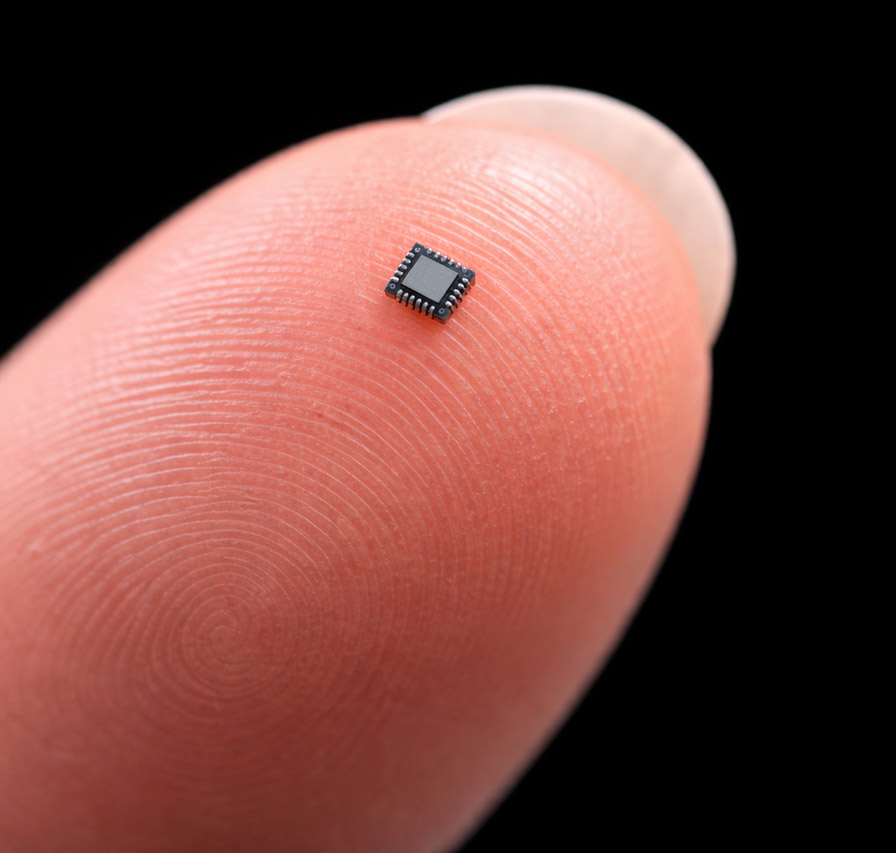
But 100,000 sensors? Normal EEG often has less than a hundred sensors. 512 sensors is a lot, 1,024 is barely ever seen outside of specialised research. And research using these ultra-high-density suggests that increasing electrode counts has diminishing returns.
I discuss the claims with EEG engineers, speech-decoding researchers, and BCI founders in my network. I am mostly met with confusion. Even among people working directly in the field, there seems to be little understanding of how Sabi could achieve what it claims.
Why, and more interestingly, how, has Sabi managed to strap a hundred times more sensors than we have ever seen into a consumer beanie?
I ask Chhabra whether those are really individual sensing elements. He assures me that a 100.000-sensor prototype exists and that the sensors line the inside of the cap, each occupying a footprint of about one millimetre.
The extreme density, he explains, allows Sabi to better triangulate the sources of neural activity, something he calls the spatial scaling law for neural decoding.
The number of sensors is not the only innovation. Chhabra says Sabi has developed sensors with a much lower noise floor, capable of capturing high-frequency biopotentials generally inaccessible to conventional EEG systems.
So what can this device do? When I ask about the 30-word-per-minute target reported by WIRED, Chhabra confidently asserts, “We get 30 words per minute.” Some users, he adds, have even exceeded that speed. The company is now working towards more than 90% word accuracy, though he does not disclose its current accuracy.
I have my doubts. Speech decoding is one of the holy grails of neurotech, often pursued using invasive brain implants by research labs at some of the world's finest universities. And his answers do little to take those doubts away.
But there is more. Chhabra tells me that the final product will be waterproof, impact-resistant, washable, breathable, and equipped with thermal control and active diagnostics. Even if individual components fail, the device should continue functioning.
“All of those are capabilities of the beanie in our lab,” he assures me. The team also assures the device works across different hair types and demographics.
And all of this should be affordable. “It turns out silicon is actually not that expensive at scale,” Chhabra explains. Sabi is targeting a standard consumer wearable price, something regular people can buy and use alongside their existing devices.
Finally, what about the privacy concerns of a device that reads thoughts? Chhabra assures me that Sabi encrypts neural data on the device, processes encrypted data in the cloud, and has assembled consultants from Stanford and other institutions to audit its security architecture.
“[This] basically means that nobody, not even our team, can ever understand or see what you were actually doing,” Chhabra says.
It is an extraordinary collection of claims.
When I start drafting my article a few days later, I am unsure how to go about it. I look at an image of a tiny sensor lying on a fingertip, shared in the WIRED article. Could a hundred thousand of these fit in a beanie? Quick math tells me no. But you cannot fake coverage from WIRED. And an investment from Khosla surely means something?
I write up the piece, with my skepticism baked in, and post it. Chhabra doesn't interact. I think little more of it. And after that, things go mostly quiet.
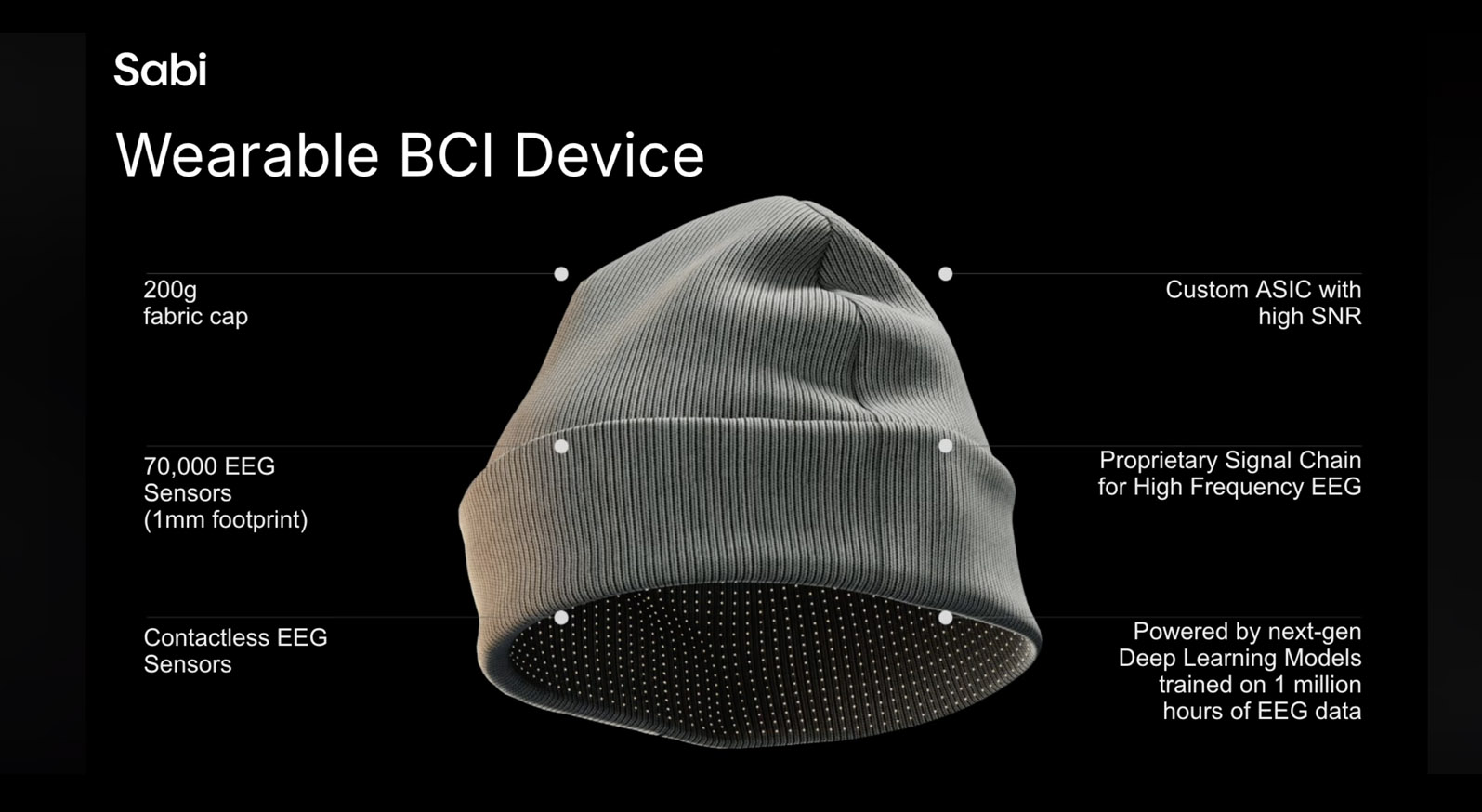
Chhabra makes only a handful of further public appearances, including at a keynote organised by Khosla Ventures. There, a new number suddenly appears. According to Chhabra and the presentation slide, Sabi's beanie is:
“powered by next-gen Deep Learning Models trained on 1 million hours of EEG data”.
A million hours. Ten times the dataset reported by WIRED just a month earlier.
In the months that follow, Sabi mostly goes quiet. The website remains static, there is still no company LinkedIn page, and the co-founders share little public details. No familiar names appear among the new hires, and no additional details about the technology emerge.
Outside of the social channels, a different kind of update surfaces. Job listings.
Sabi is looking for a lead sensors engineer in San Francisco, with at least ten years of experience. The company is also recruiting a lead product designer, again requiring a decade of experience.
Five more engineering positions pop up. Lead electrical engineer, lead firmware engineer, lead audio engineer, lead camera engineer, and lead reliability engineer. All require at least ten years of experience, all list astronomical salaries, ranging from $300,000 to $400,000, plus equity and bonuses.
The hiring extends beyond engineering. Sabi is also recruiting a remote Head of Direct-to-Consumer Marketing and a Performance Marketing Manager.
It's unclear when the advertisements first appeared, but coming out of stealth, Sabi seems to have money to spend. As of October 21, 2026, the original nine positions were still open.
In October, six months after its launch, Sabi returns to my feed. Forbes reports that the company has closed a $50 million seed round, led by Khosla Ventures, with Accel, DST Global, Initialized Capital, and former OpenAI executive Kevin Weil also participating. According to a person familiar with the deal, the round values Sabi at $600 million.
The announcement arrives through an inconspicuous press release and a Forbes article. Once again, the story of the article centres on the vision of connecting the brain directly to computers and AI. “Very simply, thought-to-computer input is a sexy idea,” investor Vinod Khosla tells Forbes.
The technical claims are familiar too. Sabi again reports having a prototype containing up to 100,000 sensors, each a one-to-five-millimetre chip. Its brain foundation model is, again, described as having been trained on 100,000 hours of labelled neural data.
There are some changes to the story, though. The beanie has now become a baseball cap. And for the first time, we get an accuracy figure. According to Chhabra, an early helmet-like prototype, connected through multiple wires, can transcribe thoughts with up to 77% accuracy among users who have trained with it for more than two weeks.
77% accuracy at what, exactly? Individual words? Sentences? Commands? The article offers little detail.
Chhabra spends little time explaining the science. In high level terms, he explains that thinking about a particular concept activates an area of the brain as small as one square millimetre. By mapping those activations to concepts, Sabi, he says, can figure out what a person is thinking. For more complex thoughts, such as asking an AI agent to book a flight, the model fills in the gaps, predicting words that might be implied but never explicitly thought.
Sabi’s launch timeline has shifted. Chhabra now expects to ship the consumer device in 2027, with a first demonstration planned at CES in January.
And it seems plenty of people are eager to get their hands on one when it drops. Forbes closes its article with one final number. Sabi's waiting list has reportedly grown to more than 10,000 people. "More than just billionaire venture capitalists are bought in," Forbes writes.
Two weeks into my investigation, I return to the question that started it all. Is Sabi the industry’s best-kept secret? Or did Chhabra promise a product that simply cannot be made? I have my thoughts. But I’d love to be proven wrong.
Produced with support from