
Advances in neural decoding and foundation models are expanding what can be extracted from non-invasive brain recordings. A growing group of neuro-AI startups is now exploring whether scalp EEG can support capabilities previously associated with invasive BCIs. Among them is San Francisco-based Alljoined, which recently introduced AIR-O, a model that generates images corresponding to physical objects a person is focusing on.
Founded in 2023 by Jonathan Xu, Alljoined has been working toward its latest demonstration through several research projects. Earlier this year, it introduced ENIGMA, a model that reconstructs images viewed on screens from EEG recordings, alongside a dataset containing more than 1.6 million visual stimulus trials. We spoke to Xu about AIR-O's capabilities, its potential applications in human-AI interaction, and the limits of non-invasive neural decoding.
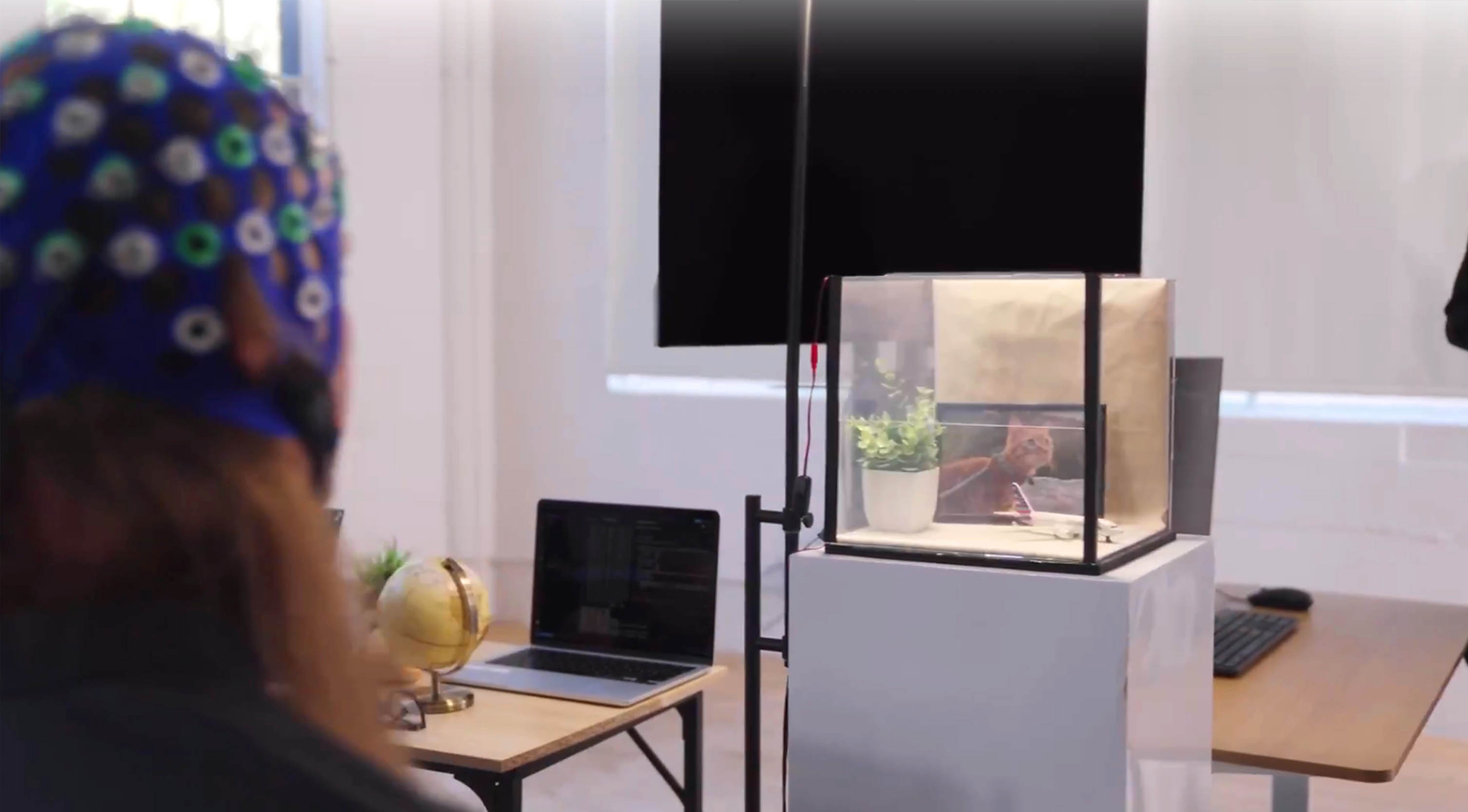
Alljoined's AIR-O uses an EEG cap to record neural activity while a participant looks at physical objects. A deep learning model converts these signals into a set of 1,024 numbers using CLIP, an AI model developed by OpenAI that links images with written descriptions. An existing image generator then uses this representation to produce an image, capturing the general concept of the scene rather than exact visual details.

The approach builds on Alljoined's earlier ENIGMA model, which reconstructed images briefly displayed on a screen. AIR-O extends this into real-world physical environments. "AIR-O works on real objects in an unconstrained setting, where the orientation, lighting, movement, and background noise change every time," Xu explains.
Xu says that across approximately 20 objects used in training, AIR-O achieves over 90% accuracy, although performance declines with unfamiliar orientations and objects.
"The surprise was that it handled multiple objects at once despite never being trained on multi-object data."
Alljoined also uses recordings from multiple participants to pretrain its models before fine-tuning them on an individual. In its experiments, this reduced the calibration data required from around 20 hours to 15 minutes, partly through improvements in model architecture and training. "For foundation models, it tells us that although every brain is different, a lot of the structure in EEG is shared across people," says Xu.
Despite recent AI-fueled progress, scalp EEG faces fundamental limitations. Electrical signals become blurred as they pass through the skull and scalp, limiting the detail available for decoding. Xu shares some of the skepticism around claims that larger datasets and better AI could overcome these physical constraints. "Some well-funded companies claim that EEG plus scale plus AI will read thought at full resolution, and that's simply wrong."
"Perceived content is more than 10 times easier to decode than spontaneous internal thought, and internal thought is what we care about," Xu explains. The AIR-O demonstration itself is approximately eight months old, with the company's more recent work focused on this next challenge.
Alljoined sees most real-world utility in human-AI interaction. "Brain data gives a model a read on what someone wants and how they're reacting, without words and without interrupting them," says Xu. Potential applications include more intuitive computer control and richer human feedback for training AI models.
In the longer term, Alljoined envisions neural decoding as a tool for keeping increasingly capable AI systems aligned with human preferences. In this view, Xu emphasizes the importance of neural data ownership. "We want to build the layer of understanding between biological and artificial minds, so that technology becomes more intuitive and people stay in the loop."
Produced with support from