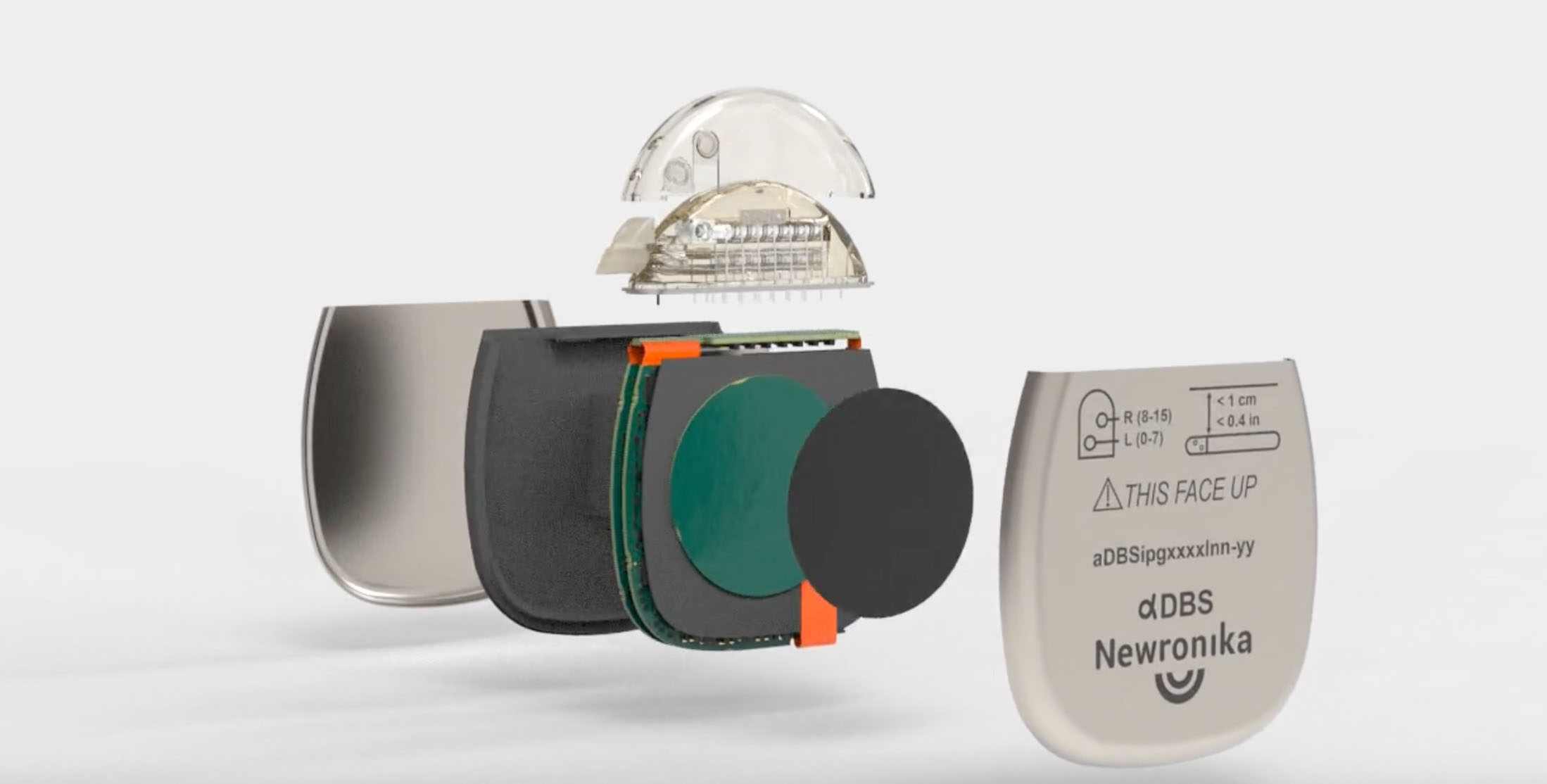
Nia Therapeutics is preparing for first-in-human studies of its closed-loop neuromodulation implant for memory disorders. The Smart Neurostimulation System (SNS) records neural activity from brain networks involved in memory and delivers tailored stimulation to modulate areas with impaired activity. The system has now demonstrated in vivo performance in sheep, positioning Nia to initiate first-in-human clinical studies later this year.
By capturing and modulating distributed neural activity from 60 channels across four brain regions, Nia’s SNS offers a larger information footprint than currently marketed options. By comparison, more focused solutions like NeuroPace RNS system, FDA-cleared for epilepsy, and Medtronic’s Percept adaptive DBS system record from no more than six channels. The multi-dimensional sensing and control system developed by Nia is designed to support modulation of higher-order functions such as memory, which depend on coordinated activity across distributed networks rather than localized abnormal signals.
Preclinical validation of the SNS device was demonstrated in a freely moving large-animal model. In a study conducted in three sheep, the device showed favorable biocompatibility, with no adverse tissue response compared with a commercially available control. The SNS demonstrated dose-dependent modulation of alpha and gamma neural activity and reliably distinguished between movement and stillness brain states. These results provide initial support to the system’s technical translational readiness.
The SNS builds on more than a decade of research by the Nia Therapeutics team into memory-related brain state modulation. In 2017, the team demonstrated that memory encoding fluctuates between distinct brain states, with some states associated with more effective memory formation and others with reduced encoding performance. They subsequently showed that direct brain stimulation could shift neural activity between these states.
Stimulation was then personalized to each participant’s unique pattern of brain activity by predicting memory-related brain states in real time and using these predictions to guide stimulation delivery. A proof-of-concept study published in 2023 showed that AI-guided, closed-loop stimulation of the temporal lobe was associated with improved verbal memory performance in participants with TBI. Together, these findings provided the conceptual and technical foundation for the recent large-animal study, which offers the first implantable system-level validation of this approach.
While no implantable system is currently approved to enhance memory, several clinically deployed DBS platforms have been repurposed in investigational studies targeting memory circuits. Human studies have stimulated the fornix, entorhinal cortex, and hippocampus using repurposed DBS systems, primarily from Medtronic, Boston Scientific, and Abbott, in patients with Alzheimer’s disease and epilepsy-related memory impairment. These studies underscore both the clinical interest in memory modulation and the limitations of adapting systems originally designed for other indications.
As Nia Therapeutics co-founder and CEO Michael Kahana noted, “Most brain implants were developed for conditions in which a localized abnormal signal drives symptoms.” The SNS takes a different starting point. Rather than focusing on a single pathological locus, it was engineered to detect coordinated activity across distributed networks, an approach that more closely reflects the known neurobiology of memory and motivates its design as a purpose-built system for memory restoration.
Memory disorders continue to place a growing burden on patients, caregivers, and healthcare systems, yet effective options for restoring function remain limited. Nia Therapeutics’ approach centers on the neural dynamics underlying memory itself, aiming to modulate network-level activity rather than slow degeneration alone. In this context, the SNS may emerge as a complementary strategy alongside pharmacological treatments, particularly where drugs have delivered limited functional benefit.
.svg)