Deep brain stimulation is among the most established clinical interventions in neurotechnology. But conventional DBS systems rely largely on fixed clinician-programmed settings, even as symptoms and neural activity change throughout the day. That limitation has pushed the field toward adaptive systems that can sense brain activity and adjust stimulation accordingly.
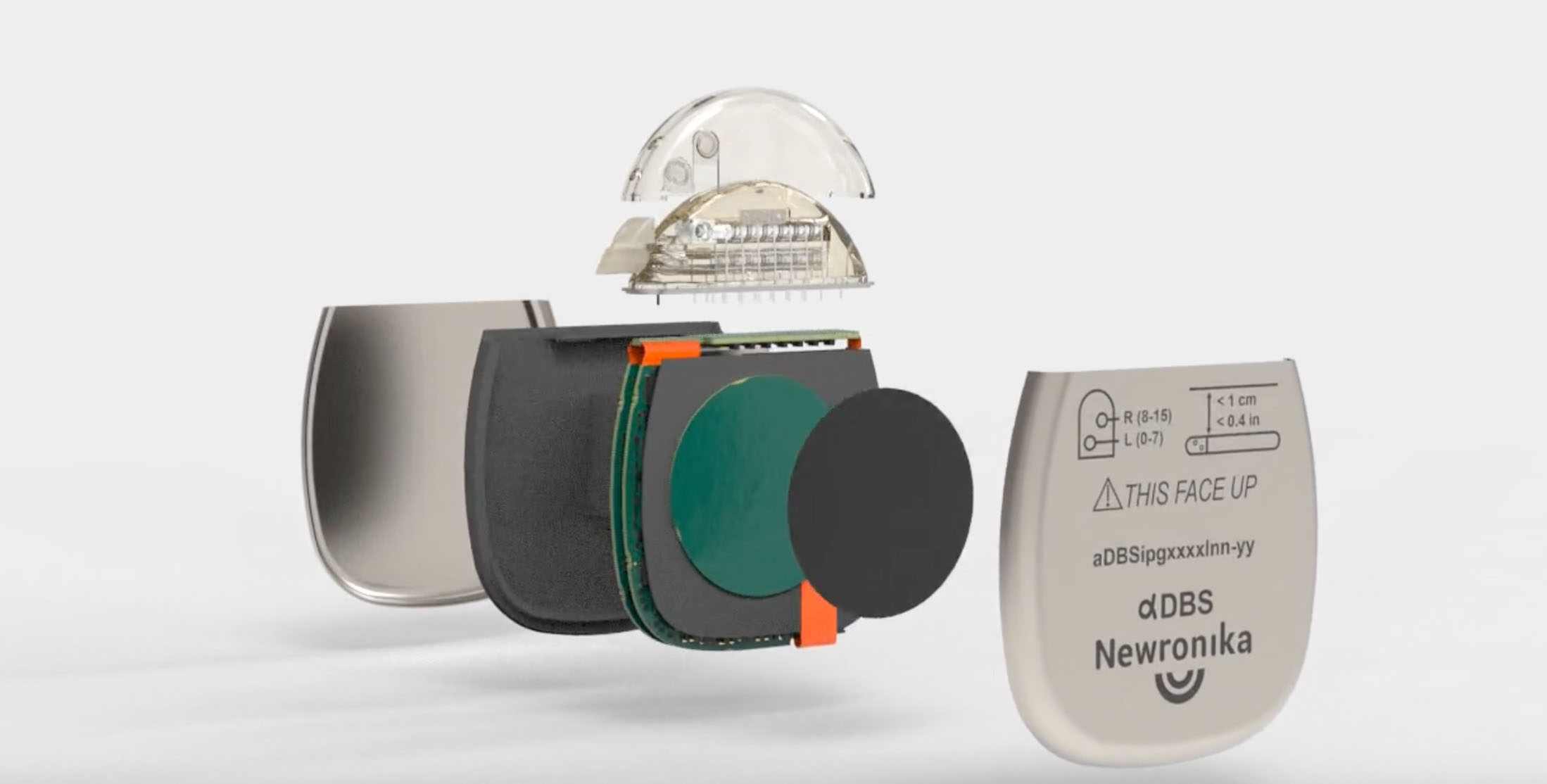
Last week, Milan-based Newronika announced the first patient implant in ADVENT, a 104-patient pivotal trial of its αDBS system. The study will compare adaptive and conventional stimulation within the same patients and is intended to support a future US approval application. αDBS is already CE-marked in Europe, where Newronika reports more than 50 patients implanted across its clinical development program.
The first ADVENT participant received the αDBS implant on September 21 at Fondazione IRCCS San Gerardo dei Tintori in Monza. The study is expected to enroll 104 people with levodopa-responsive Parkinson’s disease who are candidates for bilateral subthalamic nucleus DBS. The trial will eventually span up to 18 sites across the US and Europe.
Participants in ADVENT will receive both conventional and adaptive stimulation for around three months each, in randomized order, before selecting their preferred mode for a further three months. The study will track measures including motor scores, quality of life, and patient preference and runs under an FDA Investigational Device Exemption.
The trial marks the latest stage in a development program stretching back two decades. Newronika spun out of research at the University of Milan and Fondazione IRCCS Ca’ Granda Ospedale Maggiore Policlinico. The company raised a €13.6 million Series B in 2025 to support further clinical validation and commercialization, following earlier venture rounds and European public funding.
Newronika’s αDBS is already CE-marked in Europe and has progressed through several smaller clinical studies. Newronika says more than 50 patients have been implanted across its development program.
Adaptive DBS adds a feedback loop to conventional stimulation. Newronika’s αDBS records local field potentials from the implanted electrodes and tracks activity in a patient-specific beta range associated with Parkinson’s motor state. Its algorithm then adjusts stimulation intensity within clinician-set limits, as input signals change.
Whether adaptive stimulation translates into consistently better outcomes is not completely established. A 15-patient, Newronika-sponsored, randomized pilot trial found similar short-term motor improvements between adaptive and conventional DBS, but greater longer-term benefit with adaptive stimulation. Twelve of the fifteen patients preferred and continued with aDBS.
This year, an independent randomized crossover study, published in Movement Disorders, studied nine patients and found no statistically significant difference between beta-guided adaptive and conventional DBS.
Medtronic is currently the clearest commercial benchmark of adaptive stimulation. Its BrainSense Adaptive DBS system received FDA approval in 2025, making it the first adaptive DBS system approved in the US. Medtronic also entered the market with more than 40,000 patients already implanted with compatible Percept devices.
Abbott and Boston Scientific are the two other major DBS competitors, but their current commercial systems do not offer comparable neural-sensing adaptive stimulation.
.svg)