
When discussing global neurotech hubs, attention usually centres on the United States, the United Kingdom, and China. Yet on Europe’s mainland, France is emerging as one of the world’s most impressive neurotechnology ecosystems. With a long scientific tradition, a strong record of biomedical research, and historical figures such as Paul Broca, the country has a credible foundation for today’s translational activity across brain sensing, stimulation, imaging, and clinical infrastructure.
Nowadays, France is home to a dense translational ecosystem spanning research hospitals, engineering institutes, startup programs, and national funding initiatives. Institutions such as Inserm, Sorbonne Université, École Polytechnique, Institut de la Vision, and Grenoble’s engineering base have helped turn research in imaging, ultrasound, EEG, and neural interfaces into a range of sprawling companies. Here, we introduce some of the most exciting neurotech projects coming out of France.
The French have shown great proficiency in reading the brain, and NAOX Technologies is one of the clearest examples of that strength. The Paris-based company was founded in 2018 by Hugo Dinh and Michel Le Van Quyen to move EEG out of the conventional scalp-electrode setup and into an ear-worn form factor. Its core technology is an in-ear EEG earbud, with early clinical focus on neurological monitoring, especially epilepsy, and broader relevance for long-duration brain recording in home and healthcare settings.
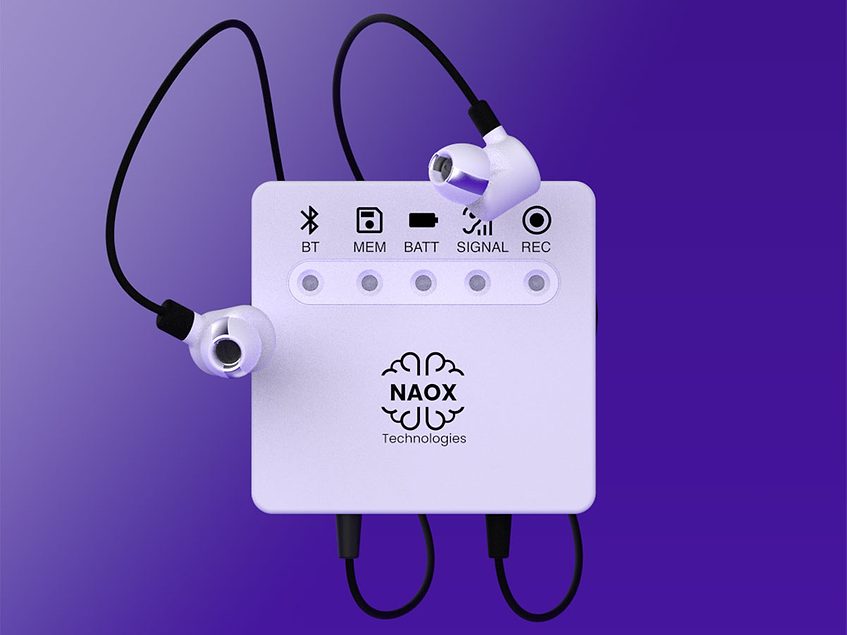
NAOX raised €4.3 million in 2022 to support development of its in-ear EEG platform. That work recently led to a major milestone for the company, when NX01 became the first in-ear EEG device to receive FDA 510(k) clearance.
A more unique use case for EEG comes in the form of Yneuro. The Paris-based startup was founded in 2019 by Thomas Semah and is developing Neuro ID, a neural authentication system that converts brainwave patterns into a biometric identity layer. The company is positioning neural readings as future-proof security infrastructure, using EEG sensors embedded into everyday devices such as earbuds, smart glasses, headphones, or AR and VR headsets to create individualized authentication signatures.
Meanwhile, Callyope, a Paris-based mental health AI company founded by Martin Denais, Rachid Riad, and Xuan-Nga Cao, takes a proxy approach to reading the brain. The company is developing speech-based monitoring tools for psychiatry, using voice and language as digital biomarkers for serious mental illness. Its initial clinical focus is schizophrenia, bipolar disorder, major depression, and relapse detection.
According to Callyope, speech can become a scalable measurement layer for mental health care, especially in the time between clinical appointments. In 2023, the company raised €2.2 million to develop its speech-based psychiatric monitoring platform. More recently, it was selected for EIC Accelerator blended finance for Callyope Copilot, a speech foundation model for transdiagnostic mental health assessment and relapse mitigation.
France’s progress on neurostimulation is spread across several different technical routes. Axorus sits at the visual restoration end of that spectrum. The Loos-based company, founded in 2019, is developing a contact-lens-based system for degenerative retinal disease, using photoacoustic retinal stimulation to convert light into ultrasound and activate residual retinal cells. The company is targeting conditions such as dry age-related macular degeneration and retinitis pigmentosa, where vision loss is driven by retinal degeneration rather than damage to the entire visual pathway.
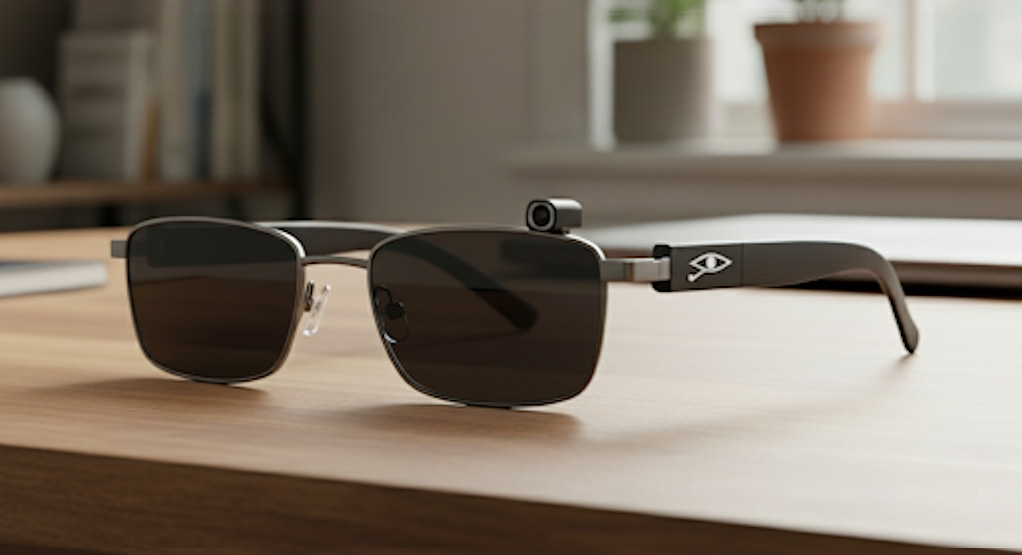
Axorus falls inside a broader push for vision restoration tech. Science is advancing PRIMA, a subretinal implant for advanced retinal degeneration, while Neuralink’s Blindsight program is targeting visual restoration through direct stimulation of the visual cortex. Axorus sticks out by staying at the retinal level and avoiding a conventional electrode array, using a photoacoustic mechanism instead.
SonoMind brings neurostimulation closer to psychiatry. The Paris-based company was founded in 2024 by Jérémy Bercoff, Mickael Tanter, and Jean-François Aubry, and is developing low-intensity focused ultrasound for drug-resistant depression. Its system uses personalized lenses to compensate for skull distortion and target deep brain regions non-invasively. In 2025, the company raised €3 million to support clinical development, making it one of the more visible French entrants in the growing ultrasound space.
Clarity represents another version of non-invasive neurostimulation. The Franco-American startup, founded by Raphaël Certain, is developing a platform for neurodegenerative disease that combines 40 Hz light and sound stimulation with virtual reality. Its initial focus is Alzheimer’s disease, where gamma stimulation is being explored as a way to engage memory-related neural circuits and slow down disease progression. Rather than treating light and sound stimulation as a static protocol, Clarity is trying to make the experience immersive, tolerable, and better matched to the patient population.
The company’s recent early feasibility work showed that its VR-based sensory stimulation could safely evoke gamma-frequency neural activity in cognitively healthy older adults, reporting little side effects. Neurofounders recently invited Raphaël onto the Conversations podcast, where he discussed how Clarity is developing personalized, immersive gamma stimulation as a treatment platform for neurodegenerative disease.
France is also home to strong clinical neurotech innovation, especially visible around stroke, neurovascular care, and ultrasound-based imaging. Resolve Stroke is among the clearest examples. The Paris-based company was founded in 2022 as a Sorbonne Université spin-off and is developing ultrasound for bedside brain monitoring. Its SYLVER platform captures raw ultrasound data and uses advanced algorithms to extract neurovascular information that is difficult to access in routine acute-care settings.
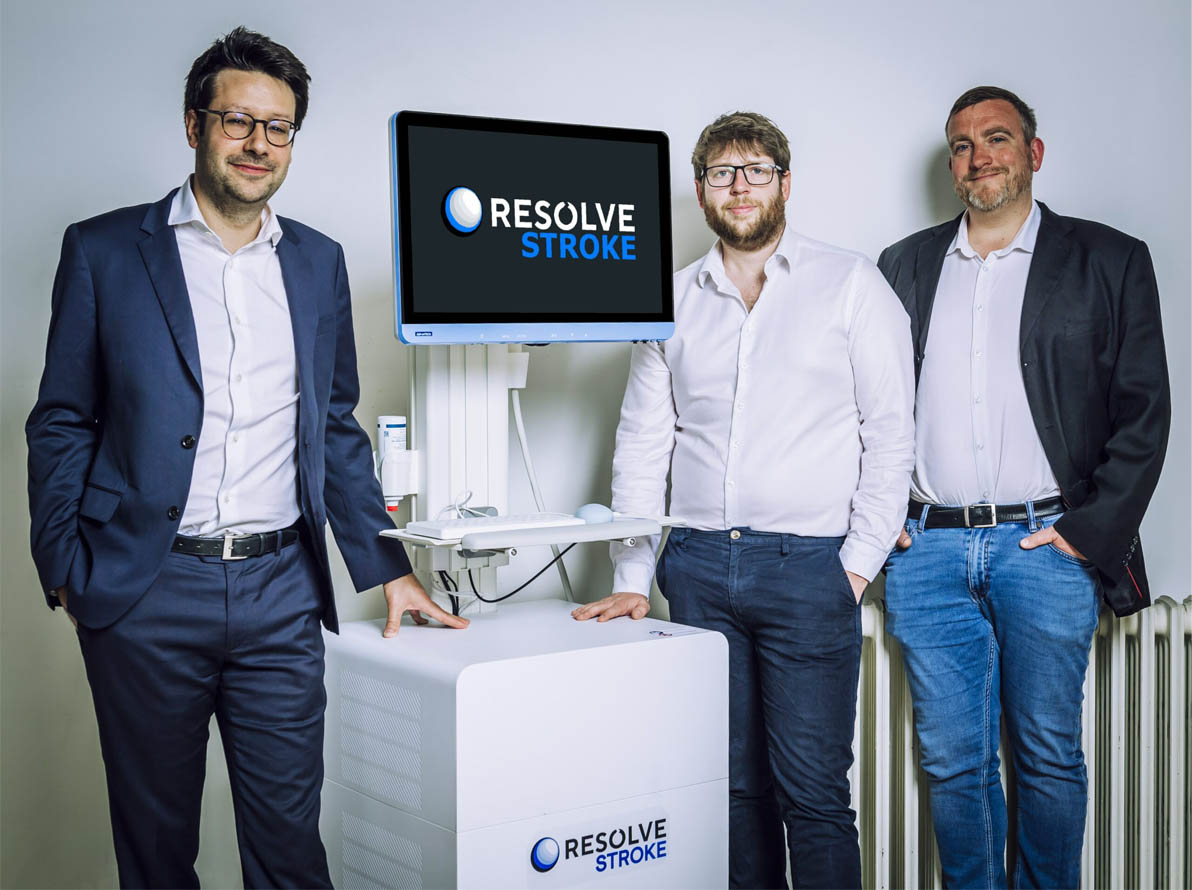
The company is focused on stroke and neurocritical care, where faster and more portable imaging could change how patients are monitored outside large imaging suites. Resolve Stroke raised €2.2 million in seed funding in 2023 and has since moved into clinical work, including first patient enrolment for SYLVER.
Sensome brings clinical innovation into the procedure room. The company was founded in 2014 from CNRS and École Polytechnique research and is developing tissue-sensing microchip technology for minimally invasive devices. Its lead product, Clotild, is a smart guidewire for ischemic stroke procedures, designed to help physicians characterize clot composition and boundaries during mechanical thrombectomy.
In its 12 years of operations, Sensome raised early venture funding, brought in Asahi Intecc as a strategic development and manufacturing partner, and received FDA Breakthrough Device designation for Clotild. More recently, the company reported clinical results showing that its guidewire could distinguish a clot from surrounding tissue during thrombectomy.
A clear sign of France’s neurotech success is its record of early exits. Dreem is among the strongest examples. Founded in Paris in 2014, the company built one of the better-known at-home EEG sleep-monitoring platforms, combining wearable hardware with sleep staging and longitudinal brain data. By the time Beacon Biosignals acquired Dreem’s R&D business in 2023, the company had raised more than $57 million and recorded more than two million nights of sleep data. Beacon framed the acquisition around clinical trials and has since integrated Dreem’s hardware with its EEG analytics platform for sleep, neurological, and psychiatric disorders.

In the consumer space, NextMind stole the headlines. The Paris-based company built a non-invasive brain-computer interface for visual attention and device control, gaining international attention through its developer kit and early AR/VR positioning. In 2022, Snap acquired NextMind to support long-term augmented reality research inside Snap Lab. The acquisition appears to have mostly focused on IP. Snap discontinued NextMind’s hardware after the deal, and there has been little visible product translation into Spectacles since.
The most recent acquisition came through Wisear. The Paris startup built technology for hands-free device control using neural and biosignal processing in earbuds and headsets. It raised €2 million in 2022 to begin licensing its interface technology to AR, VR, earphone, and headset manufacturers, before being acquired by Naqi Logix in January 2026. Naqi described the deal as a way to expand its non-invasive neural interface platform, strengthen its AI and signal-processing capabilities, and establish a stronger European base for commercialization.
.svg)








%20copy.jpg)