
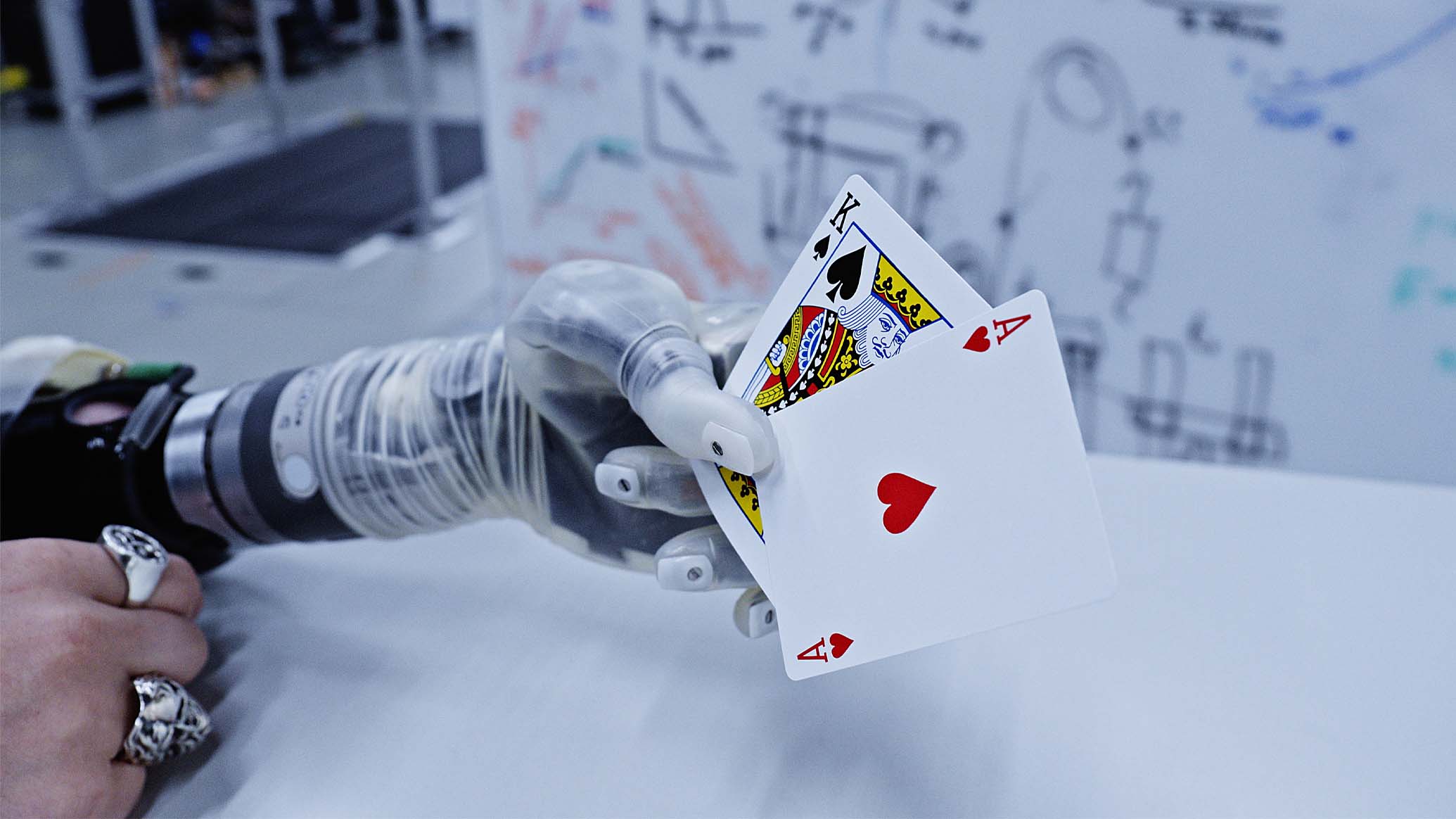
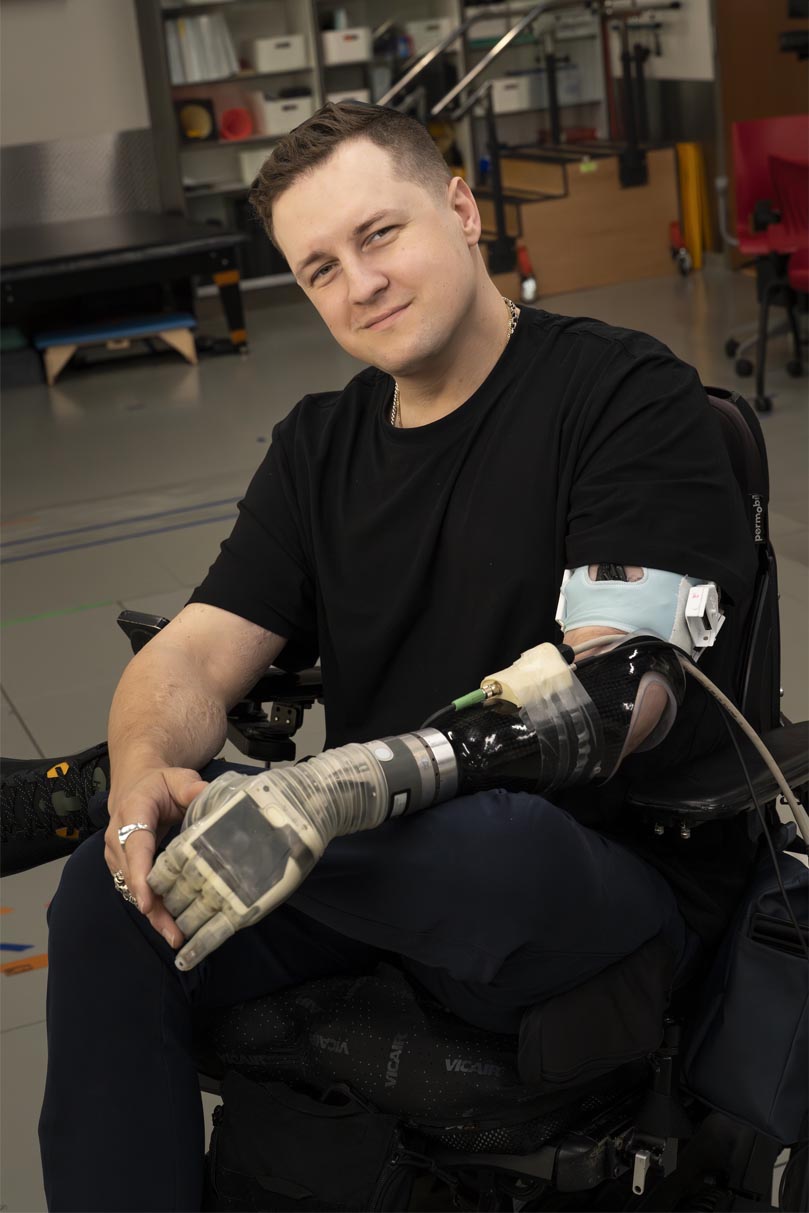
Seventeen years after losing his left arm below the elbow, Alexander Davidson is testing a prosthetic system that responds to his intended movements and returns a sense of touch. The system combines the multi-articulate LUKE Arm with an implanted peripheral nerve interface developed at the University of Utah and commercialized through spinout Biologic Input Output Systems.
Davidson is now using the system independently at home as part of a yearlong early feasibility study. Previous University of Utah participants tested the technology under research supervision, while a 2020 study demonstrated supervised at-home use of a portable LUKE Arm system without using the implanted nerve arrays for control. The new trial takes the next step, testing whether a bidirectional, nerve-connected prosthesis can be useful and reliable in everyday life.
The LUKE Arm was developed by DEKA Research & Development through DARPA’s Revolutionizing Prosthetics program. Unlike simpler powered prostheses, it was designed to reproduce much more of the movement of a human arm, combining a multi-articulating hand with powered wrist movement and, depending on the level of amputation, powered elbow and shoulder joints.
For a below-elbow user such as Davidson, the system offers six controllable degrees of freedom across the hand and wrist, including independent finger movements, wrist flexion and extension, and wrist rotation. The LUKE Arm can move several of these simultaneously, allowing for more natural actions such as adjusting the wrist while gripping an object.
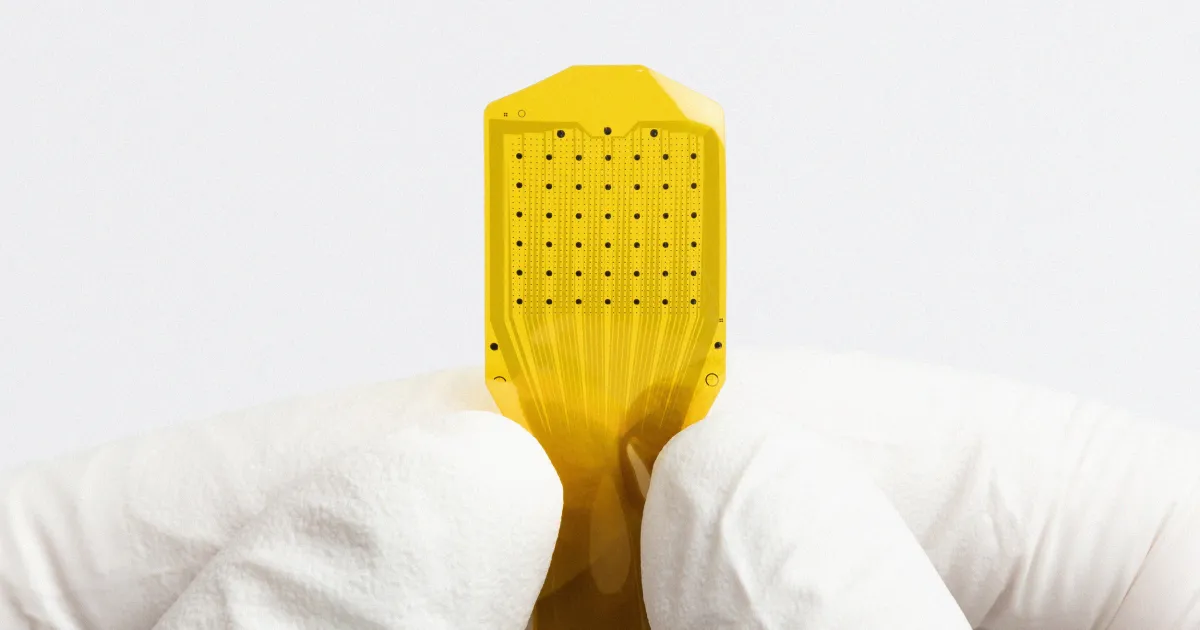
University of Utah researchers have taken that dexterous robotic platform further by pairing it with implanted neural interfaces that connect to the residual nerves and muscles in the user’s arm. The current system uses the BIOS Controller, a direct peripheral nerve interface. Neural and muscle activity associated with intended movement is decoded into commands for the prosthetic arm.
The connection also works in the opposite direction. Sensors in the hand measure information such as contact and pressure, which can be translated into electrical stimulation of sensory nerves.
This creates a closed loop in which the user can control the arm while also receiving tactile feedback. Earlier Utah studies found that sensory feedback could improve grip control and help participants differentiate properties such as object size and stiffness.
Davidson has already used the system to write, play cards and chess, prepare food, open containers, and handle delicate objects. He has also described using the returned sensation to regulate pressure while holding his wife’s hand.
Davidson is the ninth participant in this line of research at the University of Utah, but the first to use the latest nerve-connected system independently at home. Researchers plan to follow him for one year, with the possibility of extending the study.
That setting introduces challenges that are difficult to capture in controlled experiments. Neural and muscle signals can vary with posture, fatigue, and repeated use, while the prosthesis must work across objects and activities that were not selected by researchers. Long-term home use can also show whether sensory feedback is still valuable once the user becomes accustomed to the device and whether the system requires frequent recalibration.
“Clinical trial participants are experiencing the world in a whole new way that really shapes and encourages our research and development,” said Jacob George, director of the Utah NeuroRobotics Lab and chief scientist at BIOS. “The goal is to ultimately transform the standard of life and quality of care for individuals with limb loss.”
The study is still early-stage. It is being conducted under an FDA-approved Investigational Device Exemption (IDE) as an Early Feasibility Study, and the BIOS direct nerve interface received FDA Breakthrough Device designation in 2024.
The trial shifts the research from demonstrating what the system can do under controlled conditions to understanding how it performs as part of someone’s daily life. A year of independent use should give researchers a clearer picture of the reliability, usability, and sensory capabilities a nerve-connected prosthesis needs to move toward broader clinical use.
[Image credits: University of Utah]
.svg)





-1.jpeg)



%20copy.jpg)