.svg)
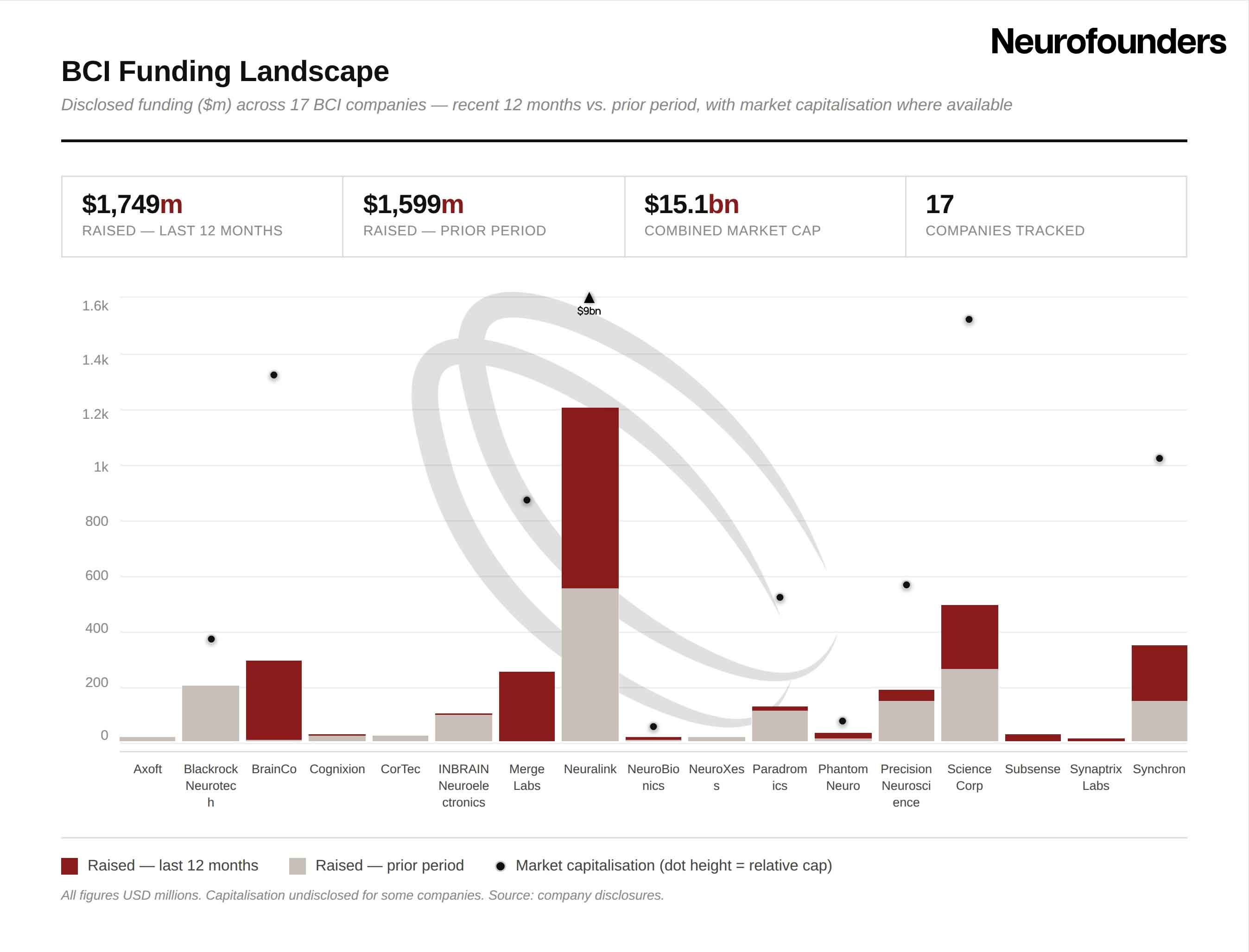
Brain-computer interface financing has started 2026 at a different scale than in prior years. Science Corp, Merge Labs, and BrainCo have already closed large funding rounds, adding significant early momentum to the category. To understand whether this reflects a broader shift, Neurofounders looked at a 17-company snapshot built around a narrow definition of BCI: companies developing technology that directly records neural signals and translates them into meaningful external control outputs.
Within that snapshot, disclosed funding over the last 12 months reached $1.75 billion. This total should not be read as the size of the full BCI market, since the dataset excludes companies without enough public funding visibility. Adjacent categories such as EEG-based state decoding, neuroanalytics, and non-closed-loop neuromodulation have also been excluded.
For such a narrow slice of neurotechnology, the amount is significant, exceeding the total raised by the same set of 17 companies across all prior years combined. Taking a closer look reveals that five companies account for the majority of the capital raised in this period, starting with Neuralink’s $650 million Series E, alongisde BrainCo’s $286.3 million strategic round, Merge Labs’ $252 million seed round, Science Corp’s $230 million Series C, and Synchron’s $200 million Series D.
Below, the picture becomes significantly thinner, with a smaller set of mid-sized funding and a longer tail of technically credible companies operating on much more modest capital bases.
This points to an increasingly stratified BCI landscape. A small upper tier of companies is pulling ahead through large follow-on rounds, rising valuations, and deeper investor concentration. Smaller players remain technically relevant, but they are doing so with far less capital behind them. The category is not just growing. It is separating into distinct funding tiers, with capital compounding around a handful of perceived leaders.