
While much of the world is watching Neuralink demos and US funding rounds, another neurotech ecosystem has been steadily gathering pace. China has put brain technology on its national agenda, backing it with policy roadmaps, specialist institutes, and engineering teams inside major hospitals. The results are now reaching public view: semi-invasive Beinao implants restoring basic motor control, flexible NeuroXess arrays decoding Mandarin speech, and a growing pipeline of devices moving from prototypes into structured clinical programs.
China’s neurotech market is growing by an estimated twenty percent each year, and invasive systems are beginning to take a larger role as trials expand and hardware matures. Beneath the few companies that do make international headlines sits a much broader landscape. Across cortical implants, EEG tools, neuromodulation platforms, and imaging hardware, multiple groups are advancing work that parallels Western efforts, and in some cases, moves faster. The snapshots below outline how the Chinese neurotech stack is being assembled.
NeuCyber NeuroTech and the Chinese Institute for Brain Research (CIBR) offer one of the clearest views into China’s neurotech ambitions. Their semi-invasive Beinao-1 device rests on the brain’s surface and streams neural signals wirelessly. In early participants, it has controlled a robotic arm, poured water, and typed text on a screen. Public plans released in early 2025 aimed for thirteen human implants by year-end, roughly matching Neuralink, and a fifty-person study in 2026, a scale that would exceed any single US trial. A second device, tested in monkeys, is reportedly being prepared for first-in-human use.
NeuCyber sits inside a state-owned industrial group and codesigns its system with CIBR, giving it a direct pipeline from research labs to national manufacturers. The device follows a high-density ECoG-style approach, trading penetration depth for a lighter surgical procedure and a simpler regulatory trajectory. Its stated focus is paralysis and motor restoration, and the pace of the program reflects how policy support, hospital partnerships, and domestic manufacturing are aligning to move implants into larger cohorts sooner than most Western groups.
NeuroXess sits at the center of China’s push to turn flexible electronics into clinical BCIs. Founded in Shanghai in 2021, the company builds semi-implantable micro-ECoG arrays that rest on the cortical surface. The current generation uses a 256-channel mesh, about 64 channels per square centimeter, fabricated using semiconductor processes and shaped to conform to the brain. Signals flow to a compact titanium module with low-power processing, balancing resolution with a less demanding surgical profile.
Early clinical reports have shown the system decoding intended movements in real time for a participant with a brain injury, and in another case generating audible Mandarin speech directly from cortical activity. A Science Advances paper detailed real-time decoding of Mandarin monosyllables and interaction with digital avatars, combining invasive recording with language-focused AI. NeuroXess is becoming a reference point for how China is translating flexible-electrode research into functioning human interfaces, in line with national plans to steer BCI work into structured clinical pathways.
NeuraMatrix represents a different side of China’s implant landscape, focusing on materials rather than full-stack devices. Founded in Beijing in 2019, the company develops high-channel electrodes and custom neural-acquisition chips. Its flagship concept is a minimally invasive platform that integrates dense electrode arrays with a dedicated system-on-chip for capture and onboard processing. The intended use looks to span Parkinson’s disease, epilepsy, paralysis, and facial palsy, covering both neuromodulation and BCI-driven restoration.
The company fits into China’s hardware supply chain as a component builder rather than a device maker, feeding electrodes and chips into systems designed by other companies and hospital teams. That direction mirrors broader research in China’s materials labs, where new electrode coatings and flexible structures are being explored to make implants safer and more stable over time.
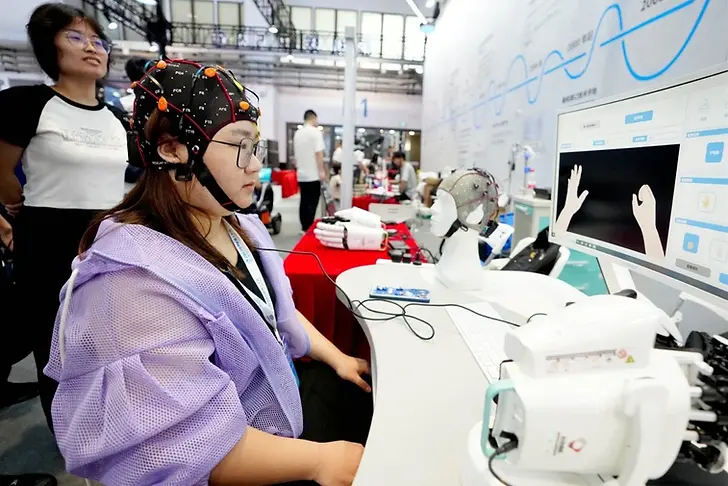
Neuracle represents a large share of China’s non-invasive neurotech. Founded in 2011 in Beijing, the company has become a major supplier of research-grade EEG, ERP, and transcranial stimulation systems, alongside medical EEG widely used in hospitals. Its hardware ranges from 32 to 128 channels in wired and wireless formats. These systems appear across a broad set of EEG and BCI datasets in China and abroad, including publications in Nature Scientific Data and numerous preprints, making Neuracle one of the region’s most widely used acquisition vendors.
Its footprint extends into clinical care. Neuracle provides EEG for epilepsy, tumors, cerebrovascular disease, and neurological rehabilitation, and is listed in several Chinese BCI surveys as active in both non-invasive and minimally invasive work. The company illustrates how China’s BCI activity is growing out of scalable lab infrastructure: the same devices used by graduate students feed into hospital workflows and early prototypes, creating a loop between academic research and clinical development.
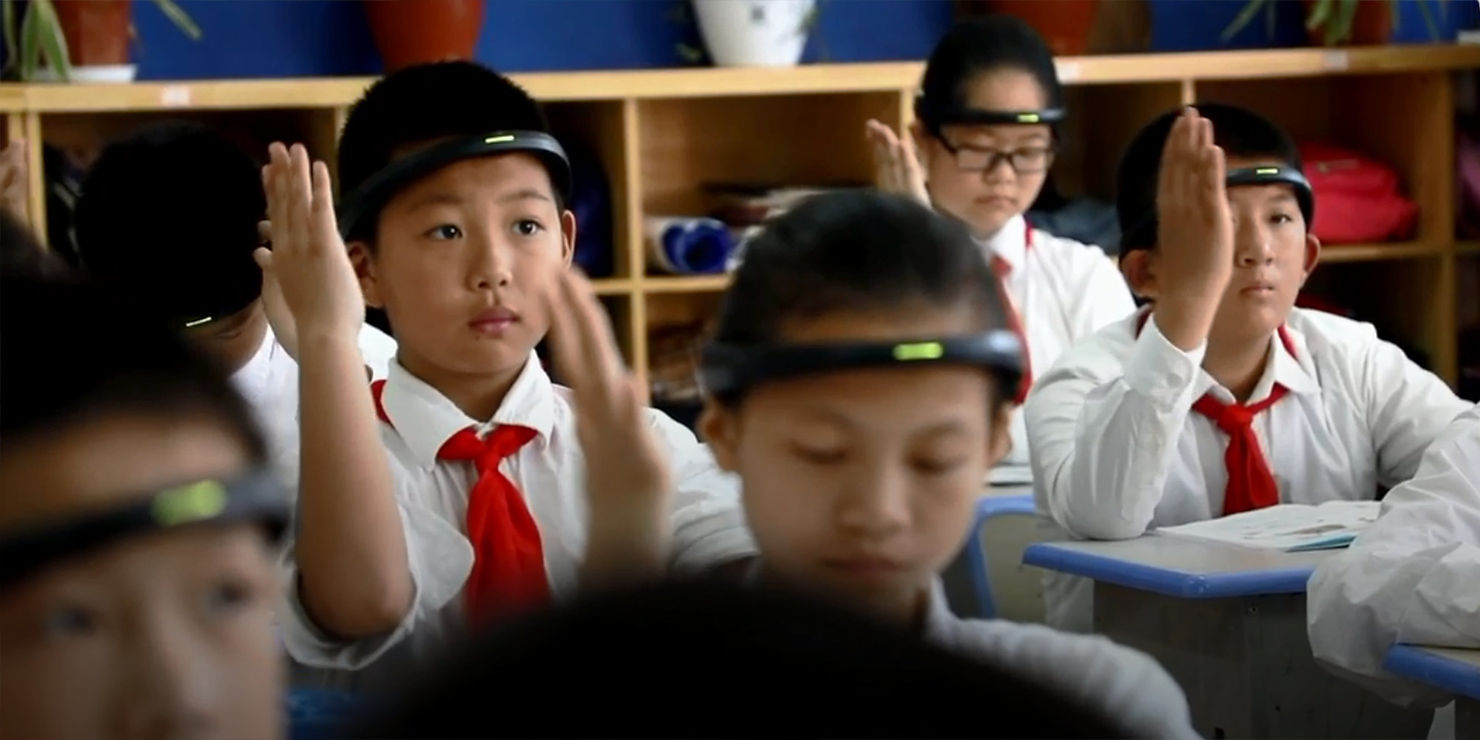
BrainCo sits in the consumer-facing corner of China’s neurotech ecosystem. Founded in 2015 out of the Harvard Innovation Lab, the company shifted much of its presence to Hangzhou’s Future Sci-Tech City with significant government-linked funding. Its products include EEG headbands for attention, relaxation, and focus training, along with a myoelectric prosthetic hand and a suite of classroom-oriented tools. Devices like FocusCalm occupy the space between consumer wearables and neurotech instruments, and broad distribution has made BrainCo one of China’s most recognizable EEG brands.
That visibility has brought scrutiny. Reporting by The Guardian described classroom pilots in Zhejiang where BrainCo headbands streamed real-time attention data to teachers and central servers, a program halted after parental concern. Additional investigation raised questions about long-term state-linked funding, school and athlete datasets, and partnerships with major Chinese tech companies. BrainCo is a case-study for what happens when wearables scale faster than the guardrails around them, raising uncomfortable questions about data, consent, and governance.
BrainUp occupies the space between wellness and clinical care. Founded in Beijing in 2018, the company focuses on non-invasive EEG for sleep monitoring and improvement. Its flagship system, SleepUp, combines medical-grade EEG with machine learning to track sleep stages, flag disturbances, and guide neural-modulation protocols aimed at improving sleep quality.
Their customer segment is growing quickly. Demand for sleep and mental-health tools in China is high, and several companies are building hardware that blends consumer accessibility with medically relevant features. BrainUp reflects a broader pattern in China’s neurotech strategy: designing devices that can operate in everyday life while still feeding into clinical workflows, aligned with policy aims to mainstream neurotechnology across daily health applications.
Yiruide is a long-standing player in neuromodulation. Based in Wuhan’s Donghu High-tech Zone, the company supplies rTMS systems that show up across Chinese psychiatry and neurology research. Devices in the CCY series are used in trials on depression, Parkinson’s disease with mood symptoms, post-stroke recovery, chronic pain, and other neuropsychiatric conditions, making Yiruide one of the most visible domestic rTMS vendors in the literature.
In parallel, Chinese groups are starting to pair rTMS with tools such as fNIRS to track cortical responses during treatment, using hemodynamic changes as a biomarker of response. Together, these studies show how neuromodulation and neuroimaging are beginning to link up in practice, with Yiruide’s hardware embedded in many of the stimulation protocols that underpin this work.
Lastly, there is United Imaging Healthcare, the company that anchors China’s neuroimaging effort. Based in Shanghai, it builds MRI, CT, and PET systems at national scale, supplying major hospitals in China and exporting to a growing number of centres abroad. Its 3-tesla MRI and combined PET/MR scanners sit at the core of several clinical and research programmes.
On top of the hardware sits an AI layer that speeds up scans and sharpens image quality, cutting MRI times while maintaining detail. United Imaging also offers software for analysing brain activity, connectivity, and structural pathways. The company shows that China’s neurotech push extends beyond implants and wearables into the imaging systems used every day in neurology, psychiatry, and research-areas where hardware and AI are now evolving together.
Note: Public information on China’s neurotechnology sector remains uneven. Many clinical and technical details appear only in company statements, state media reporting, or early academic papers. Where independent verification is limited, claims are described as reported rather than established, and readers should interpret them with that context in mind.
.svg)