
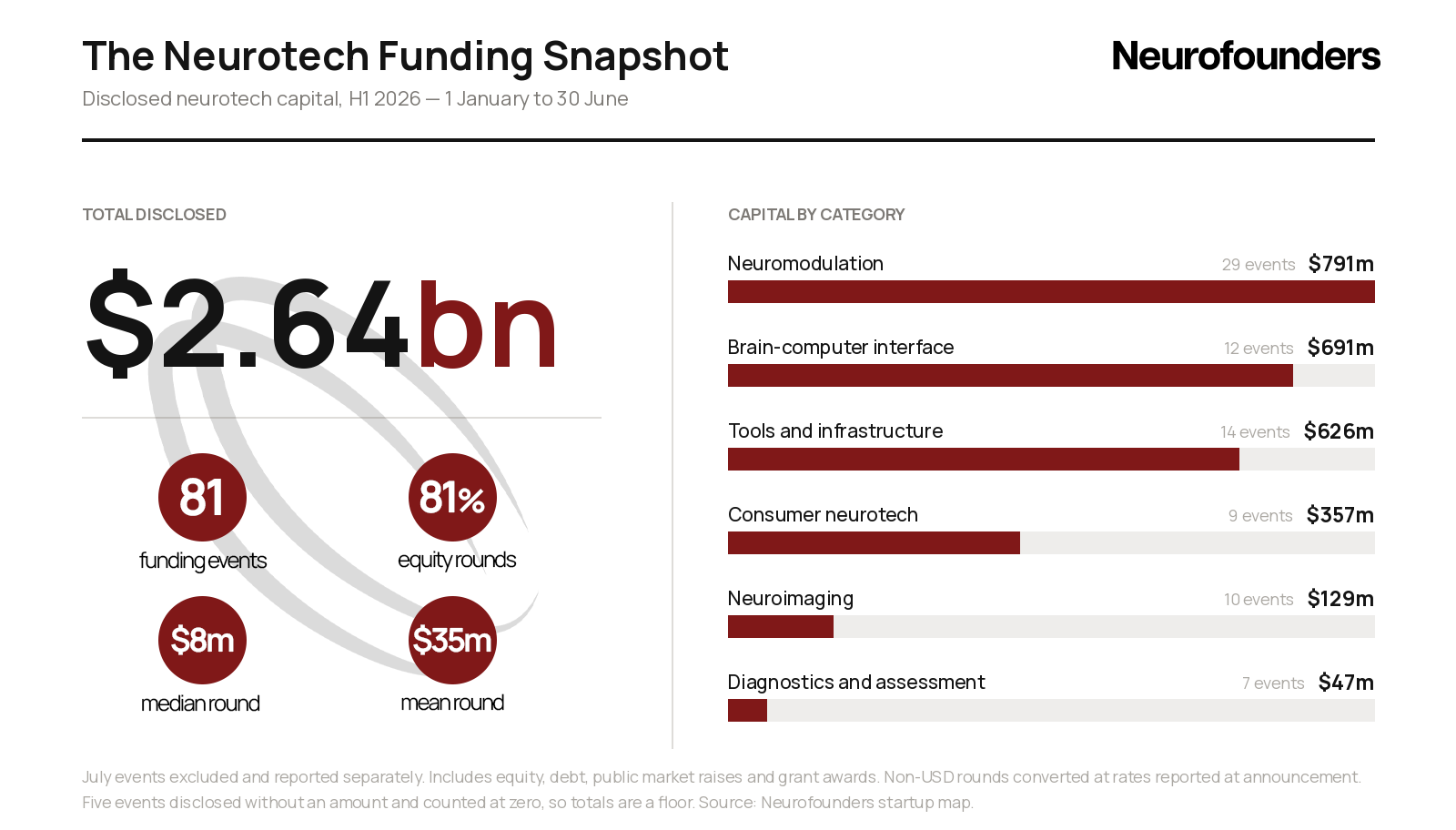
Last year, a handful of large brain-computer interface companies showed that neurotech can attract serious capital. The hundreds of millions of dollars flowing into Neuralink, Synchron, and others drew significant attention to the field. But while those well-funded BCI companies progress on capital raised in previous rounds, new funding continues to flow into neurotechnology. In the first half of 2026, the startups on the Neurofounders Startup Map raised a combined $2.64 billion.
That total is made up of 81 individual funding events, including traditional equity rounds, non-dilutive grants, debt financing, and some public-market activity. A few large BCI companies continued to lead the field, with rounds from Science and Merge Labs alone accounting for $482 million. At the same time, substantial capital also flowed into neuromodulation, Chinese neurotech, and brain-inspired computing. Below, we break down the main findings from the snapshot, looking at each category before turning to July funding and the broader picture emerging from China.
The first half of 2026 brought substantial funding into neurotech, but only a minority of companies participated in that activity. Across the 363 startups on the Neurofounders Startup Map, around 22% recorded a funding event during the period. Together, those financings amounted to $2.64 billion. Nearly four in five companies did not raise new capital.
That concentration is also visible in round sizes. More than half of disclosed financing rounds amounted to less than $10 million, with a median round size of around $7.9 million. At the other end, just 13 rounds of $50 million or more accounted for roughly three-quarters of disclosed capital, with seven events crossing $100 million.
Traditional equity remained the main source of capital, accounting for roughly $2.1 billion, or around 80% of the total. Public-market financings contributed another $357 million, while debt financing accounted for around $125 million. Grants and other purely non-dilutive awards added roughly $20 million, with another $32 million coming through financing that combined equity and non-dilutive support.
Across categories, neuromodulation attracted the most capital at around $791 million, followed by BCI at roughly $690 million and tools and infrastructure at $625 million. Several totals were heavily shaped by individual rounds. Merge Labs and Science Corporation accounted for around 70% of BCI funding, BrainCo dominated consumer neurotech, and Flourish contributed most of the infrastructure total. Neuromodulation was considerably more distributed across companies and approaches.
Updated [13/08/2026]: after publication, an additional $24m convertible note by The Biological Computing Company, announced 31 March 2026, came to light. Its H1 total is therefore $49m rather than $25m, and the half-year figures become $2.66bn across 82 events. Figures in the piece below are unrevised and reflect what was verifiable at publication.
BCI remained one of the largest funding categories in the first half of 2026, with roughly $690 million in disclosed capital. That total was heavily concentrated. Merge Labs raised $252 million and Science another $230 million, together accounting for around 70% of disclosed BCI funding. Neuralink also completed an undisclosed Series E extension, which means the true total for the category is higher.
Beyond those headline rounds, capital continued to spread across a broader group of companies and technical approaches. Axoft raised $55 million, Chinese startups StairMed and Zhiran Medical raised $72.7 million and $42 million, while Neurosoft Bioelectronics, ReVision Implant, Cognixion, and Fluent raised smaller rounds. The funded cohort spans penetrating and surface interfaces, soft bioelectronics, visual restoration, and newer approaches such as ultrasound, suggesting that BCI investment is widening beyond the small group of companies that initially defined the category.
Consumer neurotech accounted for roughly $357 million in disclosed funding, but the headline figure largely overstates how that capital was distributed. BrainCo alone raised $286.3 million, while Temple added another $54 million. Together, the two companies represented around 95% of the category total. Beyond them, most financings were small seed and pre-seed rounds, including SOND, Sychedelic, Mave Health, Connectome Health, and Audicin.
That leaves consumer neurotech looking relatively underfunded compared with the attention the category receives. BrainCo is expanding beyond its original consumer focus, while Temple sits closer to neuro-adjacent health monitoring than conventional consumer neurotechnology. Stripping those two out leaves only a modest pool of capital flowing into dedicated consumer-facing neurotech startups.
Diagnostics and assessment saw relatively little funding activity in the first half of 2026. Of the 56 companies in the category, seven recorded a financing event, together raising around $48 million. BrainCheck’s $13 million round, neuroClues’ $11 million Series A, and Firefly’s $10m placement led the group, while the remaining financings were all in the low single-digit millions.
The low total reflects both fewer companies raising and relatively modest round sizes. Funding was spread across cognitive assessment, digital biomarkers, eye-based diagnostics, and AI-enabled neurological analysis, without one approach attracting substantial capital. July brought a notable exception when Hemispheric emerged from stealth with a $52 million seed round, exceeding the category’s entire first-half total on its own.
Neuroimaging attracted roughly $125 million in the first half of 2026, with funding spread more evenly than in most other categories. Subtle Medical raised $33 million, Omniscient $27.2 million, Neurophet $22 million, and Hyperfine drew $15 million in debt financing. Smaller rounds for Brainomix, BrainSightAI, Cerca Magnetics, Theta Neurotech, and Wellumio added activity across both established imaging modalities and newer portable systems.
The boundary with diagnostics and assessment is inevitably blurry. We classify companies primarily around the technology they provide: businesses building or improving systems that directly acquire, reconstruct, or analyze brain imaging data sit under neuroimaging, while companies turning neurological signals into diagnostic or assessment products generally sit under diagnostics. Within that definition, neuroimaging saw a healthier mix of financing stages and modalities, spanning MRI, MEG, AI-based image analysis, and emerging imaging hardware.
Neuromodulation attracted more capital than any other category in the first half of 2026, at roughly $791 million. Unlike BCI or consumer neurotech, that total was spread across a relatively broad group of companies. Cognito Therapeutics raised $105 million, Nervonik $52.5 million, Spiro Medical $67 million, while Nyxoah, ONWARD Medical, Cala Health, Neuros Medical, SonoMind, and others added sizeable financings of their own.
The category also stood out for the variety of financing structures. Alongside traditional equity rounds, companies raised through public markets, debt facilities, and government grants, reflecting a more mature funding base than most other parts of neurotech. The underlying technologies were similarly varied, spanning brain stimulation, spinal stimulation, peripheral nerve stimulation, focused ultrasound, and other bioelectronic approaches, with capital flowing across both early-stage platforms and companies already moving toward commercialization.
Below the $17 million cutoff shown in the chart, another 16 companies raised a combined $68.9 million. These included Enspire DBS Therapy ($10.3m), Sinaptica Therapeutics ($9m), Attune Neurosciences ($8.4m), QV Bioelectronics ($6.1m), Neurolief ($6m), Surf Therapeutics ($6m), SonoNeu (up to $5.2m), Nexstim ($5m), Neupulse ($3.8m), NeuroLife ($2.9m), Neurinnov ($2.9m), Neubond ($2.0m), electrocore ($1.0m) Nexalin ($0.8m), Insellar ($0.5m), and Clarity ($0.1m).
Tools and infrastructure accounted for roughly $625 million in disclosed funding, making it one of the largest categories on paper. Most of that total, however, came from a single company. Flourish raised $500 million in June, while WISE, The Biological Computing Co., OYMotion, CraniUS, Beacon Biosignals, and others raised much smaller rounds. Excluding Flourish, the category falls to roughly $125 million.
That concentration also reflects some scope creep within the category. Flourish sits closer to brain-inspired computing than conventional neurotechnology infrastructure, and its round materially changes the picture for the group. Even so, biological and neuron-based computing emerged as one of the clearest themes, with funding also flowing to The Biological Computing Co., Cortical Labs, and Intactis Bio. The remaining companies were more varied, spanning neural-interface hardware, research platforms, assistive systems, and other enabling technologies.
Funding activity remained strong into July. Across the companies tracked so far, July added roughly $195 million in new capital, led by Alto Neuroscience’s $100 million registered direct offering and Hemispheric’s $52 million seed round. Epitel added a $26 million Series B, while NeuroBell, Time Is Brain, Universal Brain, and Aurenar raised smaller rounds. Gestala added on to an earlier round.
The Neurofounders Startup Map does not attempt to capture the full Chinese neurotech market. Companies are only included where there is enough verifiable information, demonstrated traction, and some degree of international relevance. That means the main funding snapshot understates activity in China, where a much larger group of companies is raising capital outside the cohort currently tracked on the map.
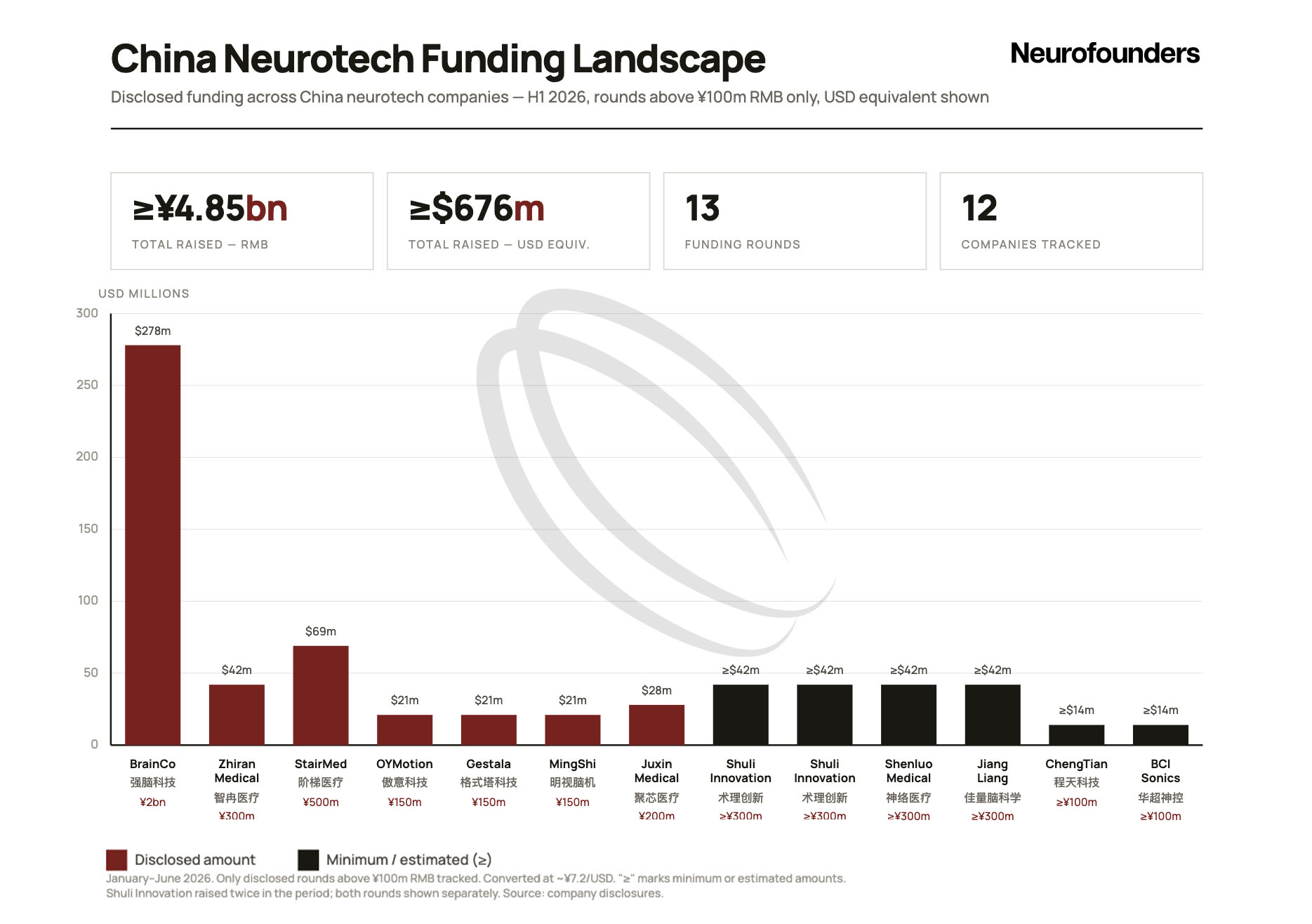
Chinese industry media reported 34 BCI financing events in the first half of 2026. In an earlier Neurofounders review, we identified 13 rounds of at least RMB 100 million across 12 neurotech-adjacent companies, representing at least RMB 4.85 billion, or roughly $676 million. BrainCo’s RMB 2 billion round dominates the chart, but sizeable financings also went to StairMed, Zhiran Medical, Shuli Innovation, OYMotion, Gestala, and several less internationally visible companies.
The figures in this analysis are based on publicly disclosed funding from the 363 companies currently included in the Neurofounders Startup Map. The map is intentionally curated and should not be read as a complete census of the neurotechnology industry. Companies are included when neurotechnology is central to the product, typically through directly measuring, modulating, or interfacing with the nervous system, or by providing specialized infrastructure that enables those technologies.
The map also applies thresholds around technical relevance and company maturity. Very early concepts, generic digital health products, conventional medtech, pharmaceuticals, and adjacent service businesses are generally excluded, while some older or larger companies remain where they are important to the structure of the field. As a result, the funding totals represent activity within a defined, evolving, and highly relevant neurotech cohort. The snapshot does not reflect the full amount of capital flowing into every company with a neurological, neurotech, PNS/CNS, or neuroscience-related product.
Visit the startup map.





.svg)