Few people dare to start a company, and even fewer attempt it in a technically complex field like neurotechnology. Yet Dr Hamed Bahmani has now done it three times. After launching a clinical-stage company focused on myopia and another targeting Alzheimer’s through the visual system, he is doubling down on complexity. His latest venture has just emerged out of stealth, but early hints suggest it draws on decades spent at the forefront of neuro-innovation.
Born in Iran, Bahmani studied engineering before moving to Germany, where he pivoted during his postgraduate years toward neuroscience. After more than a decade in academic research, he decided to put theory into practice and co-founded Dopavision. The Berlin-based startup has raised over $16 million to develop a digital therapeutic for childhood and adolescent myopia.
While still active as a researcher at the Max Planck Institute, Bahmani co-founded his second neurotech company, Nuuron. As a founding Chief Scientific Officer, he leveraged his deep knowledge of the visual system to develop a digital device that presents specific visual patterns to activate the hippocampus at frequencies associated with memory consolidation, aiming to improve memory in people living with Alzheimer’s.
“Both inventions behind these companies did not exist before,” Bahmani says. “That’s my area: proposing a mechanism of action that people don’t believe. When they say it won’t work, it gives me the energy to make it work. In both cases, there was no direct evidence, but the foundational science was there.” Across the two companies, he has generated more than 20 patents.

Earlier this year, he returned to the drawing board once more to begin what may be his most ambitious project yet: Insellar. While details remain under wraps, Bahmani hints at an entirely new kind of ‘inner-brain interface’: a method for stimulating deep brain structures to release oxytocin and other hormones dysregulated in psychiatric conditions like depression. While still early and exploratory, the concept aims to open a new path for treating severe depression by modulating the brain’s own neuroendocrine system.
I spoke with Hamed about what it takes to leave academia and build a neurotechnology company, and how nearly a decade of founding neurotech ventures has prepared him for his most ambitious project to date.
How did you get interested in neuroscience?
It really started during my master’s. My undergrad was in control engineering, a very technical branch of electrical engineering, which I studied back in Iran. Moving into biomedical engineering for my master’s opened things up: I became fascinated by the visual system, especially computational models of visual attention, which became my thesis. The engineering background helped a lot; it gave me a foundation in instrumentation and automation, making the shift from hardcore engineering to biomedical science very natural.
From there, my interest moved toward the neural basis of attention. That’s what took me to Tübingen in Germany, to join the Max Planck Institute of Biological Cybernetics. At the time, Nikos Logothetis, one of the leading figures in higher cognitive functions research, was the director, and I began working with animal models in his group. After several years in the lab doing very fundamental neuroscience, I realized I wanted to bring technology back into the picture. That mix of engineering and neuroscience is what ultimately led me toward the path I’m on now.
What sparked you to leave academia and start a company?
Part of it was personal. After a couple of years in the PhD program, I realized that I was getting fed up with day-to-day lab work. I’ve always been a technological person; from childhood, building things was my passion. Basic science is fascinating, but for me, at some point, it was enough. That’s also why, even at my first company, Dopavision, after five or six years, I felt ready to build the next thing, and then the next. Some people stay with one company forever; that’s just not my type.
The other part was the reality of academia. Opportunities are extremely tight, and I realized that early. Combined with my desire to build, to move faster, and to work at the intersection of tech and biology, industry was a much better fit. And interestingly, this was almost ten years ago; today, the environment has shifted even more. People now enter academia already knowing they’ll likely transition out. Translational work is much more appreciated than it used to be, and most funding actively encourages industry collaboration. I see that as a very positive development.
You are now working on your third venture. You must have learned a lot from the earlier ones. How are you approaching this new venture differently?
You learn a lot when you build something from scratch: how to structure a company, how to run it, how to optimize things efficiently. But you also learn what not to do. I’ve made mistakes in the past, and I’m very conscious of not repeating them. Some lessons carry over almost directly.
My earlier ventures also exposed me to the realities of translational work: medical device regulations, clinical trial pathways, and the complexity of convincing partners and investors when you're working on something unconventional. Those experiences matter even more now, because this new project is much more ambitious, involves hardware, and is technically more demanding than anything I’ve built before. So the fundamentals of how you build and how you manage stakeholders become absolutely critical.
One of the biggest lessons has been how to work with external partners: academic collaborators, clinical teams, and especially investors. With moonshot ideas, the people around you make a huge difference, and small mistakes can have irreversible consequences. So there are many lessons I’m bringing with me, and I genuinely hope they help me run this new company better than the last.
I’d love to dive more into the new venture. The approach seems incredibly challenging; you’re targeting something very deep in the brain. How do you even begin to do that?
The core motivation is the indication we’re targeting: depression. It’s an area with enormous unmet need. There are many treatments out there, but if you look honestly at the data, most of them don’t work for most patients. A huge proportion of people fall into treatment-resistant categories, so there must be something new.
What we’re proposing is to stimulate the brain at the source of a key neuroendocrine system, the posterior pituitary, focusing on oxytocin, a hormone with wide-ranging effects on mood, bonding, and emotional regulation. Only in the last five to ten years have we been able to reliably measure oxytocin clinically, and that changes what’s possible.
Technologically, the timing is right as well. We now have ways to access this deep brain region using a specialized route, and we can measure and track oxytocin levels in a way that wasn’t feasible before. So, the science, the tools, and the measurement capabilities have converged at the right moment. From a broader perspective, the mental health crisis worldwide makes this even more urgent.
I also wouldn’t have been able to attempt this ten years ago. Today I have the experience, the network, and the right team to take on something this difficult. And importantly, the regulatory and cultural landscape has shifted. The world is more open to implantable brain-related devices than it used to be, even if what we’re building isn’t a classical high-bandwidth BCI. So, while the challenges are enormous, the need and the timing align in a way they never have before.
You mentioned the market is huge, but it’s very hard to break into psychiatric indications with invasive devices, as the ‘perceived need’ is lower. How do you see this challenge?
It’s a fair point, and it’s actually at the center of a broader debate in the field. There’s no simple answer. But what I can say is that the spectrum of psychiatric diseases, especially depression, is so wide that the number of patients who don’t respond to existing medications is enormous. Treatment-resistant depression alone represents a very large group. We would start with this group, especially the patients affected by moderate to severe treatment-resistant depression, since acceptance and clinical justification are highest for patients who have exhausted all other options.
There’s also a misconception about what “invasive” really means. TMS, for example, is labeled non-invasive, yet if you look at the protocols used today for depression, the stimulation is extremely aggressive in terms of the brain impact. The same goes for pharmacological interventions like ketamine, a drug with profound systemic effects that is in many ways far more invasive than making a small surgical opening. And then there’s electroconvulsive therapy, which is still one of the most effective treatments for severe depression. If you read how ECT actually works, it’s arguably the most invasive and disruptive intervention we have, yet it remains a frontline therapy because it helps people.
So the question isn’t simply invasive versus non-invasive; it’s about balancing invasiveness with effectiveness. That’s the real axis. I believe that with Insellar, we can strike that balance in a way that is meaningful and justified for the right patient populations, especially those who haven’t responded to any other treatment.
What’s the plan for the next year and the next five years?
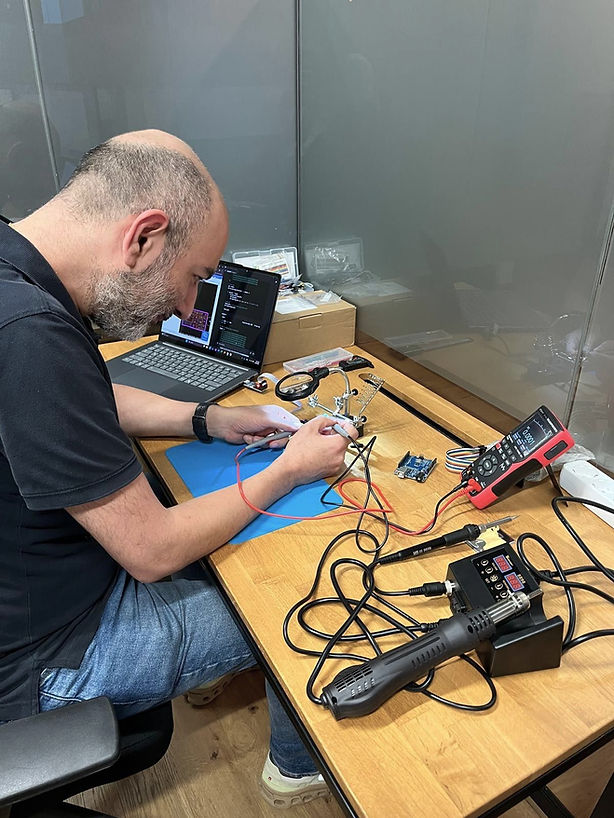
This venture, like my previous ones, is very R&D-heavy, especially in the early stages. And it’s not the kind of classical preclinical work you can simply outsource. A lot of it has to be done in-house, quickly and smartly, because the questions we’re asking are unconventional. Even though I’m now in a space equipped more like a workshop environment, the most important part is knowing how to work effectively with academic, scientific, and clinical partners; something I’ve learned from past experience.
The plan is to build evidence step by step with the right university and research centers. Instead of trying to answer “Does it work?” in one leap, we break it into smaller questions: does it work in this specific way, under this condition, in that subsystem? That’s how you build trust and momentum.
In the beginning, funding and spending will be minimal. When I started Dopavision, I had to build devices costing €500 or €1,000 myself because we couldn’t afford to buy them; we literally built our own eye tracker. I expect something similar here: very lean, very focused early work.
Currently, we are delivering the first proof-of-concept results, both on the device side and in early feasibility testing. The next stages will depend on external support. At that point, private and public funding become essential to move into more advanced preclinical studies and eventually into clinical trials.
It’s a long path, but the structure is familiar to me, and the early groundwork is already underway.
.svg)