.svg)




.webp)
Nike has long been known as a disruptor, from Air cushioning that defined the Jordan era to self-lacing MAGs that jumped from Marty McFly’s feet into real prototypes. Now, Nike is jumping on the neurotechnology train, introducing its new Mind shoes, footwear that primes the brain to focus using underfoot sensation as an interface. The shoes stimulate the skin of the sole, engaging sensorimotor pathways to make the moment feel a little more grounded.
The launch features the Mind 001 (mule) and Mind 002 (lace-up) products, both built around 22 independently moving, anatomically mapped foam nodes that act like tiny pistons across the heel and forefoot to stimulate plantar mechanoreceptors. In Nike’s phrasing, these “activate sensory areas of the brain.” Rollout is slated for January 2026. The launch sits within a growing wave of neuro-influenced products that large consumer brands are bringing to market.
Nike is introducing Mind, a new footwear platform aimed squarely at the pre- and post-game window. The shoes are meant to help athletes achieve calm, focused, and present mind states, preparing them for optimal performance. The first models carry the “neuroscience-based” label and position the foot-brain connection as a design brief, not a slogan. This is framed as a platform rather than a one-off drop, drawing on years of work inside Nike’s sport research organization.
Underfoot, each pair uses 22 independently moving foam nodes mapped across the heel and forefoot. They behave like tiny pistons, creating distinct pressure points that heighten tactile feedback instead of cushioning it away. The layout is anatomical: denser where perception benefits from separation, sparser where continuous contact matters. The goal is to stimulate plantar mechanoreceptors to increase sensory input upstream.
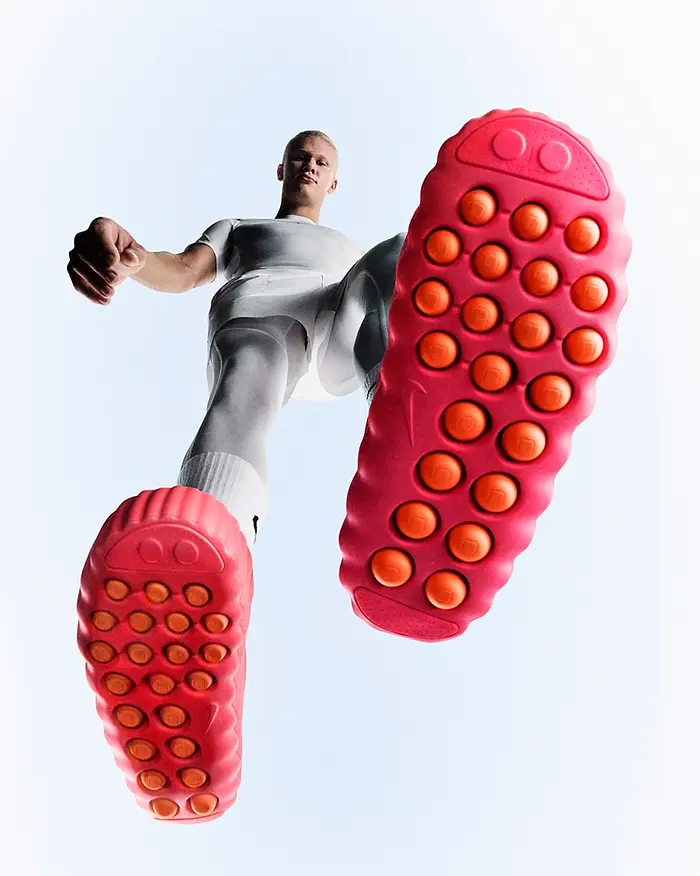
Nike credits a dedicated Mind Science Department inside the Nike Sport Research Lab, an in-house group of neuroscientists, perception researchers, physiologists, and engineers that has been working on Mind for years. Their toolkit, as described by Nike, spans EEG, EMG, pressure mapping, and “mobile brain-and-body” setups to study how underfoot stimulation propagates through the sensorimotor system.
The public narrative is that these studies informed the placement, spacing, and compliance of the 22 nodes, with internal readouts showing shifts in sensory-motor network activity and alpha rhythms during wear. Those findings are Nike-reported for now; full, peer-reviewed methods and effect sizes have not yet been released.
Rollout is slated to begin in January 2026, with a staggered launch through nike.com and select partners. U.S. pricing, per official and early retail listings, is $95 USD for Mind 001 and $145 USD for Mind 002. Regional timing and colorways will vary, but the treatment is clearly platform-level rather than a one-off drop.
Under the skin of the sole sits one of the body’s richest sensory surfaces. Cutaneous mechanoreceptors across the plantar foot feed dense streams of pressure and texture to the somatosensory cortex; change that input and posture, balance, and the felt sense of grounding can shift. Textured stimulation has long appeared in balance training for this reason. On mechanism alone, using underfoot sensation to cue attentional steadiness is plausible.
However, to separate effect from impression, we’d need clear methods and effect sizes; expectancy-matched controls; pre-registered outcomes tied to readiness/attention rather than broad “activation” language; and robustness under sweat, motion, and daily wear. Alpha shifts and sensorimotor activation on EEG are interesting markers, but without controls and durability data, they don’t yet read as “better focus for every athlete.”
As of publication, there is no peer-reviewed Mind study in the public domain. What’s available are Nike materials (an announcement, product pages, and a Mind Science profile) describing internal use of EEG/EMG/pressure mapping and reporting shifts in alpha and sensorimotor activity. Some press notes a white paper to come, but methods, sample sizes, and effect magnitudes aren’t yet available. In practice, the claims thus rest on a plausible mechanism, pending independent replication and field outcomes.
Mind also lands alongside a second prong of Nike’s 2025 pipeline: powered assistance. Project Amplify positions motorized footwear as an “e-bike for your feet,” adding mechanical help to each stride. The Nike x Hyperice Hyperboot pushes mobile heat and dynamic compression for warm-up and recovery. All together, Nike's portfolio shows a tech-influenced surge, with neuro-design (sensory priming, Mind) and mechatronic assistance (Amplify/Hyperboot) as parallel bets.
Zooming out, this announcement sits within a broader consumer neurotech wave. Meta’s Ray-Ban Display glasses use an EMG Neural Band that can decode subtle wrist signals into intent; CTRL-Labs' ideas translated into a mass-market bundle. The pattern points towards brain-adjacent interfaces moving into mainstream hardware ecosystems, where distribution, daily use, and dataset scale can become the accelerants.
Nike's story is one of a plausible mechanism with, so far, disappointingly limited open data. Even so, a global brand treating cognition as a design surface and pairing it with gentle robotics marks a valuable shift. The next neural interface may just sit under our feet.

.svg)
.svg)